
St George Mining Ltd (ASX:SGQ) (FRA:S0G) has identified multiple electromagnetic (EM) conductors during a downhole electromagnetic (DHEM) survey at the high-grade Mt Alexander Nickel-Copper Sulphide Project in Western Australia.
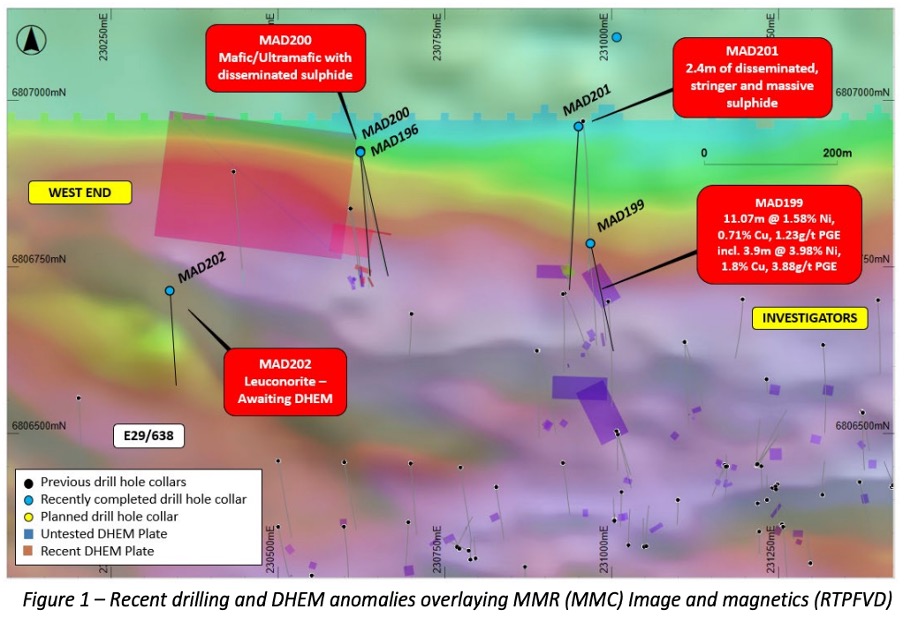
The DHEM survey took place over hole MAD200, a nickel-copper sulphide target within an underexplored portion of Mt Alexander’s West End prospect.
Three off-hole EM conductors were uncovered following the survey, with strike lengths recorded as 250 metres, 60 metres and 40 metres.
Now, St George is preparing for a seismic survey over the western section of Mt Alexander’s Cathedrals Belt region, covering the West End prospect and the new EM conductors.
Ultimately, it’s hoped the survey will guide future, deeper drilling activity by mapping the area’s structures and potential mineralisation.
Multiple conductors “particularly exciting”
St George Mining executive chairman John Prineas said: “Our systematic step-out drilling at the Cathedrals Belt is continuing to extend the footprint of the intrusive unit that is already known to host massive nickel-copper sulphides along a strike of more than 5.5 kilometres.
“All deeper drill holes in the western part of the Cathedrals Belt have intersected intrusive-style rocks. These results indicate a very large mineral system at the Cathedrals Belt with potential for further discoveries of high-grade mineralisation in the underexplored western section of the Belt.
“The multiple EM conductors identified at West End are particularly exciting. These are favourably located within the interpreted intrusive unit and on the same plane as mineralisation intersected by recent drill holes.
“The results of the seismic survey in this area could be very important in better understanding the distribution of mineralisation in this area and planning the next drill program for these targets.”
The new EM targets
The DHEM survey over the West End’s MAD200 target uncovered three EM conductors to follow up.
Specifically, the hole intersected a 12.7-metre intrusive unit from 500.7 metres downhole, including roughly 1.4 metres of disseminated and blebby nickel-copper sulphides from 512 metres downhole with lab assays pending.
Interestingly, the largest EM anomaly lies 75 metres northwest of MAD200, meaning it could be a vector to stronger, more distant mineralisation.
The West End findings come after a number of low conductivity EM anomalies were drilled along Mt Alexander’s Cathedrals Belt, with findings reported in April this year.
Ultimately, these targets successfully intersected nickel-copper sulphides and demonstrated that weak conductors can be a vector to high-grade sulphide mineralisation.
St George hopes to get a better sense of the West End region with its upcoming seismic survey, scheduled to kick off next week.
This will map the prospect’s intrusive structures up to 2 kilometres deep and cover a region where a recent gravity survey identified numerous gravity highs.
Scoping study for starter mine
As it considers a starter mine for Mt Alexander’s Stricklands deposit, St George is progressing a key scoping study by trialling two new initiatives.
The first is ore sorting — a process by which lower grade material is separated from a project’s high-grade ore, which can lead to higher recoveries and significant savings on processing and transport costs.
To trial this process, St George will send semi-massive, stringer, blebby and disseminated sulphide ore samples from Mt Alexander to Steinert, a sorting specialist that utilises sensors to effectively sort ore.
In addition, St George is testing a glycine-based leaching process, which separates the metals contained in an ore sample into high-purity powder concentrates.
Western Australia’s Curtin University has developed a new processing technology that uses a glycine-based reagent to selectively leach base metals, including nickel and copper, from sulphides.
The innovative leaching process will be trialled on a sample of nickel-copper sulphide mineralisation from Mt Alexander to test its amenability.
This process could be considered as an alternative to conventional flotation circuit processing – resulting in very significant capex and processing facility savings.
In addition to the two trial initiatives, ore from the Stricklands deposit is undergoing metallurgical test-work in Canada, with initial results expected later this quarter.
Speaking to the study, MD Prineas continued: “We are pleased to be progressing the scoping study for the potential starter mine at Stricklands. We are trialling two new processing initiatives which may materially enhance the economics of a potential starter mine.
“We look forward to providing further updates of exploration and development activities at Mt Alexander. We are also excited with the drilling currently underway at our Paterson Project and will provide an exploration update on that program shortly.”