
Chalice Mining Ltd (ASX:CHN) (OTCMKTS:CGMLF) continues to grow the resource potential at its flagship Julimar Project, where an intensive drilling program has defined continuous, high-grade nickel-copper-cobalt-gold-platinum group element (PGE) zones.
Seven drill rigs are on site, executing a 160,000-metre step-out and resource definition program across Julimar’s multi-element Gonneville Intrusion in Western Australia.
So far, Chalice has received results from a suite of infill and step-out exploration campaigns within the broader program, intersecting strong mineralisation across multiple high-grade zones.
Today’s results prime Chalice to conduct a comprehensive work program at Julimar in the new financial year, with further exploration, resource definition, environmental baselining and studies on the cards.
Understanding “continues to improve”
Speaking to the fresh results, Chalice Mining managing director Alex Dorsch said: “Resource drilling at Gonneville continues at a rapid pace, with predominantly infill drilling continuing to confirm a robust, major PGE-nickel-copper-cobalt-gold deposit.
“These latest results confirm continuous zones of high-grade sulphide mineralisation, as well as a large oxide/disseminated sulphide footprint.”
“We continue to see impressive zones of shallow palladium-copper-gold mineralisation along the eastern footwall contact of the intrusion, with these zones remaining open to the northeast.
“Step-out drilling is continuing to test the extent of the Gonneville Intrusion in this direction. Our understanding of the geology and metallogenesis of the deposit continues to improve as we gather more data.”
The latest results are in
Chalice’s 160,000-metre drilling campaign is taking place over the Gonneville deposit, spanning around 1.8 kilometres by 0.9 kilometres.
So far, 118 diamond and 324 reverse circulation drill holes have been completed at the project, with around 120,000 metres of drilling conducted to date.
Chalice has reported assays for 56 diamond and 249 reverse circulation drill holes, with results pending for a further 137 completed holes.
Today’s update reported on results from 75 new drill holes, which uncovered 298 mineralised intervals, 215 high-grade PGE intervals and 53 high-grade palladium-nickel-copper intervals.
Predominantly infill drilling took place over a 40-metre by 40-metre grid, targeting high-grade zones at the southern end of the Gonneville Intrusion.
Promisingly, infill activity continues to support the geological model and continuity of mineralisation at the deposit.
Some of the best results from infill drilling at Gonneville include:
- 25 metres at 3 g/t palladium, 1.4 g/t platinum, 0.2 g/t gold, 0.3% nickel, 0.3% copper and 0.03% cobalt from zero metres;
- 14 metres at 4.2 g/t palladium, 1.1 g/t platinum, 0.2 g/t gold, 0.5% nickel, 0.8% copper and 0.03% cobalt from 85 metres; and
- 23 metres at 1.9 g/t palladium, 0.5 g/t platinum, 0.2% nickel, 0.3% copper and 0.06% cobalt from 4 metres.
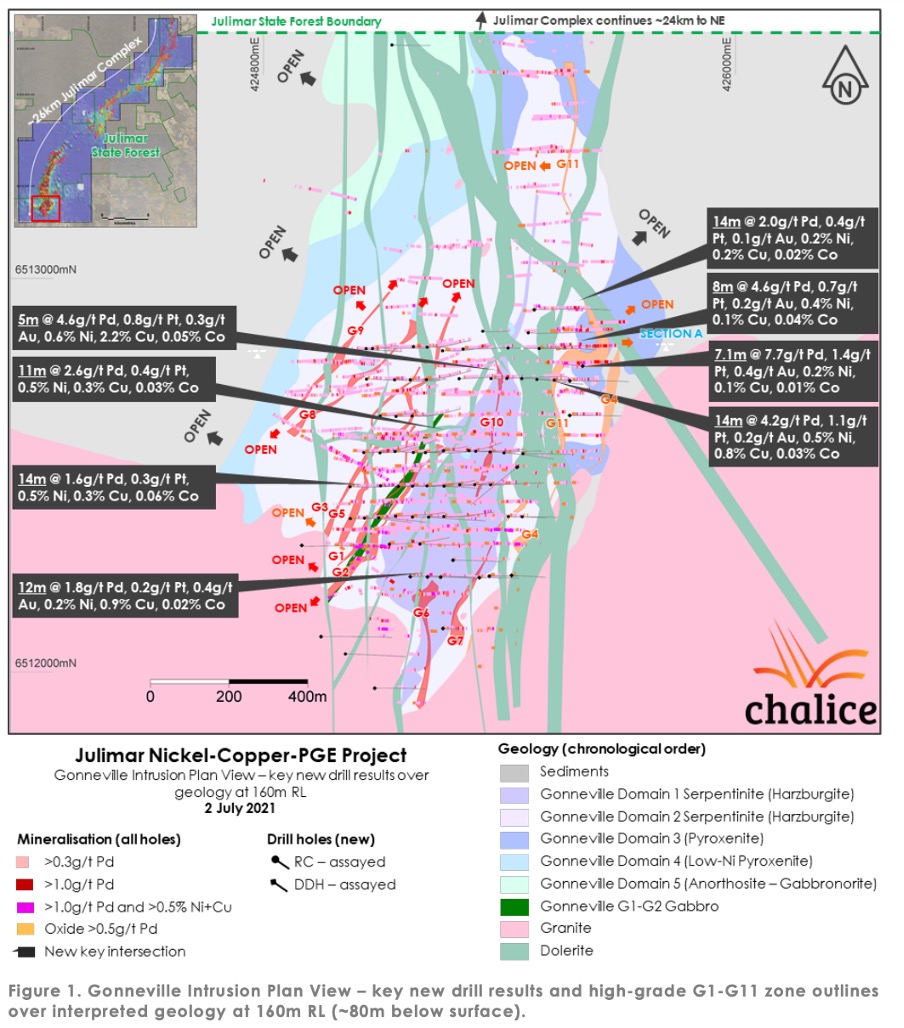
Additionally, Chalice embarked on a step-out drilling campaign across three high-grade zones within the Gonneville deposit.
This part of the program has extended the high-grade G3, G5 and G10 zones along strike, with significant results including:
- 7 metres at 3.8 g/t palladium, 0.8g/t platinum, 0.8% nickel, 0.1% copper and 0.08% cobalt from 189 metres within the G5 zone;
- 5 metres at 2.4 g/t palladium, 0.9 g/t platinum, 1.2% nickel, 0.3% copper and 0.08% cobalt from 44 metres within the G3 zone and;
- 15 metres at 1.5 g/t palladium, 0.4 g/t platinum, 0.3% nickel, 0.1% copper and 0.03% cobalt from 198 metres within the G10 zone.
What’s next?
As it waits on results for 137 more holes — currently with the lab for assay — Chalice continues initial, wide-spaced reverse circulation drilling. Within this program, the explorer is targeting the extension of Gonneville’s high-grade G4 and G11 zones to the northeast.
Meanwhile, Chalice is preparing to drill the Hartog Target, spanning around 6.5 kilometres in length, later this quarter — although this is subject to the company receiving access approval.
Broadly speaking, the company’s FY22 exploration campaign seeks to determine Julimar’s scale as rapidly as possible.
The explorer’s project strategy remains focused on the high-grade mineralisation at Gonneville, as well as the exploration potential of the entire 26-kilometre-long Julimar Complex.
Managing director Dorsch said: “Concurrently with the seven-rig resource drill-out, we are also progressing a comprehensive metallurgical test-work program on both the sulphide and oxide mineralisation at Gonneville.
“The core Chalice study team has now been assembled and several other preliminary studies are underway to guide the scoping and feasibility stages of the project.
“We continue to work closely with the relevant State Government departments regarding access to the Julimar State Forest for initial drill testing to the north of Gonneville, with initial wide-spaced drilling anticipated to commence at Hartog in late Q3 2021, subject to access approval.”