
PNX Metals Ltd (ASX:PNX) has begun a reverse circulation (RC) drill program of up to 2,800 metres at its Fountain Head Gold Project in the Pine Creek region of the Northern Territory.
The program aims to test five newly identified exploration targets with the potential to host additional ‘near-mine’ gold resources:
- South-East Zone;
- Far East Zone;
- NW Breccia;
- Banner Prospect; and
- Far West historic reef workings.
This will be the first drilling at Fountain Head since the company released a mineral resource estimate (MRE) of 2.94 million tonnes at 1.7 g/t gold for 156,000 ounces in June 2020.
The drilling to take around four weeks to complete, with assays due from early July.
“Potential to add to existing resource”
The company’s field mapping and assessment of geological data suggests that gold mineralisation at Fountain Head exists over a significant strike extent of around 5 kilometres along an anticline fold hinge from Banner prospect in the west to the Lady Josephine West prospect in the southeast.
PNX managing director James Fox said: “Gold mineralisation has been mapped for over 5 kilometres along the Fountain Head anticline with numerous prospective areas identified that essentially remain untested.
“This RC drill program will test five high-priority gold targets that have the potential to add to the existing resource base and extend the Fountain Head and Hayes Creek mine life.
“Assays are due from early July and we look forward to updating the market as new results come to hand.”

South-East Zone
The five high-priority targets to be drill tested at Fountain Head include the South-East Zone – which is 250 metres southeast of the Fountain Head resource boundary along interpreted offset Tally Ho trend.
Multiple parallel north-south trending zones of strong bedrock gold anomalism are supported by historic RAB drilling and surface workings within a quartz veined sequence of weathered sediments.
The RAB holes have an average depth of 10 metres and only a small portion of bedrock has been tested with deeper RC drilling in 2020 which returned:
- 1 metre at 9.98 g/t from 37 metres;
- 1 metre at 93.7 g/t from 19 metres, and 1 metre at 22.7 g/t from 42 metres;
- 1 metre at 31.9 g/t from 31 metres; and
- 1 metre at 5.67 g/t from 92 metres.
The zone remains open along strike.
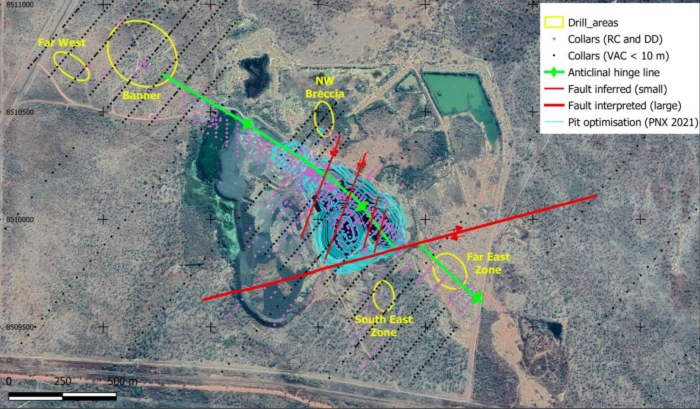
Location of the RC drill targets, and interpreted local structural zones.
Far East Zone and NW Breccia
The Far East Zone is an interpreted eastern offset of the Fountain Head anticline with broad spaced high-grade gold mineralisation from historic drilling.
It sits around 250 metres from the eastern edge of the proposed open-pit expansion with potential for a ‘starter’ pit.
The NW Breccia target is largely untested and located within an interpreted N/NW trending structural zone that crosscuts the main Fountain Head anticline and contains the high-grade Tally Ho mineral lode.
This structural zone has been mapped from aeromagnetic data and field observations as trending from the Glencoe deposit 3 kilometres to the north, through to the Klondike alluvial workings ~1.5 kilometres to the south.
Banner prospect and Far West targets
The Banner prospect is around 600 metres northwest of the Fountain Head MRE, with near-surface bedrock anomalism and deeper drill intersections over a 500-metre strike extent which require further testing and assessment.
Wide-spaced deeper drilling by PNX in 2020 produced strong results, including:
- 6 metres at 39.5 g/t from 54 metres;
- 1 metre at 10.88 g/t from 28 metres;
- 19 metres at 2.7 g/t from 66 metres;
- 1 metre at 6.71 g/t from 46 metres;
- 1 metre at 5.43 g/t from 15 metres;
- 4 metres at 1.90 g/t from 11 metres; and
- 1 metre at 7.9 g/t from 45 metres.
In addition, results from costeans and shallow RAB drilling at the Far West historic ‘reef’ workings highlight the potential for continuation of the Fountain Head gold mineralisation to the west.
Glencoe deposit drilling planned
Upon completion of the Fountain Head drilling, the company expects the drill rig to move to the Glencoe gold deposit (subject to approval of the company’s Mine Management Plan), which is 3 kilometres to the north of Fountain Head, for a further RC drilling program of around 2,000 metres.
The Glencoe MRE of 2.1 million tonnes at 1.2 g/t gold for 79,000 ounces remains open in all directions, extends from surface to 120 metres vertical depth and comprises a number of discrete lodes over a strike length of greater than 1.5 kilometres.