
St George Mining Ltd’s (ASX:SGQ) new assays have confirmed the latest high-grade nickel-copper sulphide discovery at its flagship high-grade Mt Alexander Project in WA's north-eastern Goldfields.
Assays from MAD199 confirmed a thick interval of high-grade nickel-copper sulphides:
- 11.07 metres at 1.58% nickel, 0.71% copper and 1.23 g/t total PGEs from 333.5 metres, including 3.9 metres at 3.98% nickel, 1.8% copper and 3.1 g/t total PGEs from 340.67 metres, and including 1.28 metres at 6.54% nickel, 2.96% copper and 3.88 g/t total PGEs from 342.12 metres.
Notably, as the deepest massive nickel-copper sulphides identified in the Cathedrals Belt, this hole confirms that the large intrusive mineral system on the Cathedrals Belt at Mt Alexander can host significant high-grade mineralisation at depth
“Breakthrough in exploration”
St George Mining executive chairman John Prineas said: “The high-grade intersection in MAD199 is a very important breakthrough in our exploration of the Cathedrals Belt.
“The MAD199 discovery is the deepest occurrence of massive nickel-copper sulphides identified in the Cathedrals Belt and supports the prospectivity of more high-grade deposits at depth.
“With multiple strong EM conductors identified from MAD199 as well as from the first step-out hole at MAD201, we are confident of drilling more high-grade mineralisation in this area.
“The search for nickel-copper sulphides at depth is still at an early stage and we are pleased to be rolling out a low-cost seismic survey that has the potential to identify in high-resolution the intrusive host system and any mineral deposits at depth.
“These results and our ongoing work are very positive for the growth potential of the high-grade mineralisation at Mt Alexander.”
Potential for further massive sulphides
The first step-out hole for MAD199 was MAD201, which intersected a 16-metre thick intrusive unit from 421.95 metres downhole, including a 2.4-metre interval of nickel-copper sulphides from 434.6 metres (assays pending).
The downhole EM survey in MAD201 identified three very strong conductors located up-dip towards the high-grade intersection in MAD199, which are modelled with conductivity of 120,400 Siemens, 30,000 Siemens and 23,000 Siemens, respectively.
The company is confident that this supports the potential for the presence of more massive sulphides along the 125 metres down-plunge extent between these two drill holes.
Deep Ground Penetrating Radar modelling
The Deep Ground Penetrating Radar (DGPR) survey field data (37.5 line kilometres) from the site is now being processed and modelled.
This survey focused mainly on the Radar, Cathedrals and Investigators prospects where shallow nickel-copper sulphides have been discovered with electromagnetics and drilling.
The data is expected to allow St George to model the high-grade massive sulphides in 3D which would greatly assist in resource definition drilling and targeting extensions to known mineralisation.
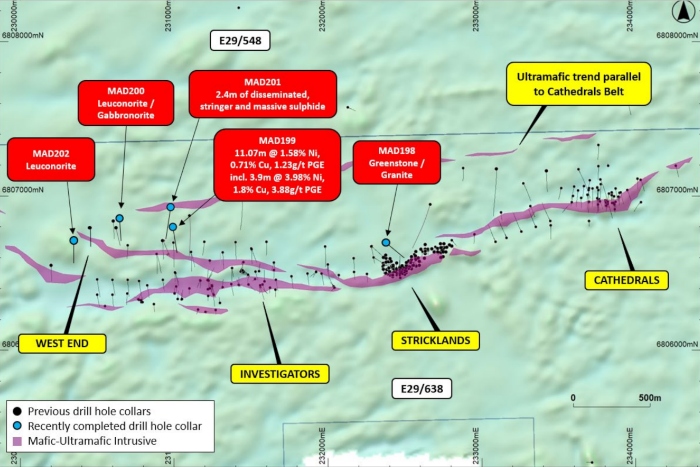
Map (against magnetic RTP 1VD data) showing drilling along the Cathedrals Belt and highlighting the most recently completed drill holes.
Seismic survey scheduled
A seismic survey designed for high-definition mapping of structures and potential mineralisation to depths up to 2 kilometres from surface is scheduled to be completed at the Cathedrals Belt next month.
A new, cutting-edge seismic technique, called eVibe and offered exclusively by Ultramag Geophysics, will be trialled.
The latest eVibe seismic applies a fraction of the force compared to a conventional seismic hydraulic system but delivers high-quality data to a similar depth and the cost is significantly lower than conventional seismic.
The company expects the survey results will assist to guide drilling of deeper targets for massive sulphides as well as resource definition drilling of shallow deposits.
DHEM survey planned
MAD202 was drilled to test a large coincidental gravity and magnetic anomaly at West End and was drilled to a downhole depth of 444.1 metres and intersected intrusive rocks from 421.95 metres to 436.8 metres.
The volume of intrusive rocks intersected in MAD202 is unlikely to explain the large gravity high and the company believes that potentially, dense rocks giving rise to the gravity high may be present below and to the northwest of the drill hole.
A DHEM survey will be completed in MAD202 soon to investigate for any conductive material around the drill hole.
The intersection of intrusive rocks in MAD202 confirms the host intrusive unit extends west into an area of the Cathedrals Belt that remains undrilled and the seismic survey and ongoing DHEM surveys will be important in identifying any mineral deposits in this area.
2021 drill program
Daily drill rates for MAD202 were lower than usual because of single-shift operations during late May and unscheduled maintenance.
The company is now seeking to source a replacement diamond rig to resume drilling at Mt Alexander with additional holes being planned and prioritised to test the growing portfolio of nickel-copper sulphide targets.
In the meantime, the company is continuing drilling at its 100%-owned Paterson Project in the highly prospective Paterson region in WA’s north.