
Orthocell Ltd's (ASX:OCC) shares jumped this morning after tabling positive nerve regeneration results one year on from a study testing its nerve repair candidate on quadriplegic patients.
The regenerative medicine company conducted the first interim data readout of all patients in the CelGro® clinical trial 12 months after the study concluded.
Promisingly, 25 out of 33, or 75.8%, of all nerve repairs that took place during the study resulted in functional recovery.
Now it has the 12-month data at hand, Orthocell is preparing for discussions with the Food and Drug Administration (FDA) to prepare CelGro for the approval pathway.
In addition, the ASX-lister is in talks with US insurance companies and key opinion leaders to finalise its commercialisation approach.
Shares were as much as 8.3% higher this morning to A$0.655, a new high of almost six years, while the company's market cap pre-open was approximately A$115.2 million.
“Increases success of nerve transfer surgery”
Orthocell managing director Paul Anderson said: “Consistently returning function to paralysed upper limbs is the primary goal in this study.
“I am delighted by the 12-month follow-up results, our most complete data set to date, demonstrating higher quality outcomes, improved predictability and consistency of return of muscle function following CelGro nerve regeneration treatment.”
Orthopaedic nerve specialist and clinical trial lead Dr Alex O’Beirne commented: “We are now seeing a consistent return of arm and hand function following nerve transfer surgery with CelGro. The quadriplegic patient results are particularly promising, with improved results at 12 months post-treatment compared to the literature.
“CelGro is increasing the success rate and efficiency of nerve transfer surgery.
“Seeing patients regain enough independence so that they can be involved in family life and return to work is very rewarding.”
The study
During the clinical trial, CelGro was applied during peripheral nerve repair surgeries. Patients who took part in the trial had one or more nerve repairs augmented with the CelGro product in one or both of their upper limbs.
To assess the patient’s recovery after the procedure, Orthocell graded the target muscle strength closest to the site of nerve repair.
One year of follow-up data from the study was available for 13 out of 19 patients, involving 33 nerve repairs.
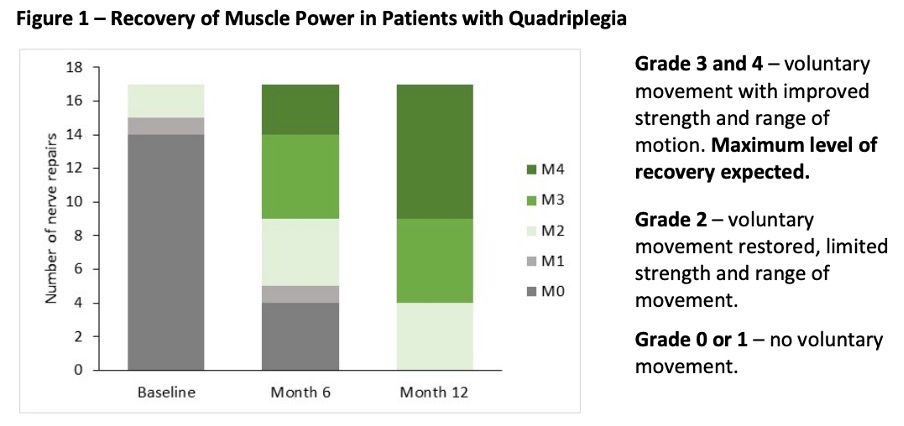
Quadriplegic patients who participated in the trial suffered traumatic nerve injuries following motor vehicle, sporting and/or work-related incidents, leading to the partial or total loss of use in their arms, and, in more severe cases, their legs and torso as well.
Specifically, over half the nerve repairs were performed in five quadriplegic patients. Of these 17 repairs, 13, or 76.5%, resulted in the best-case clinical outcome at 12 months post-treatment.
This means that quadriplegic patients regain a level of independence, meaning they can perform tasks like brushing their teeth, drinking from a cup, and transferring into and out of a wheelchair without assistance.
Adrian Walsh experience
Trial participant Adrian Walsh, who broke his neck in a mountain bike accident in June 2017 and is now a national wheelchair rugby champion, spoke to his experience with CelGro.
“This treatment has made a world of difference to me. The increased strength and mobility in my arm and hand has really boosted my independence.
“I am contributing more around the home and can help my wife and kids - it feels good. My new modified car is great too, I have already done 10,000 kilometres, driving the family around, going to rugby training and doing the school runs.”
Hear Adrian and his surgeon, Dr Alex O’Beirne, talk about their experiences, the nerve transfer procedure and his recovery at 12 months post-treatment:

How does CelGro work?
Essentially, CelGro is a surgical product that promotes nerve repair.
Conventionally, nerve repair procedures involve removing the damaged section of nerve tissue before the two nerve endings are sutured together.
Sometimes after surgery takes place, however, nerves can grow in the wrong direction, or scar tissue can get in the way, impeding the healing process.
CelGro seeks to combat this. It acts as a ‘bandage,’ wrapping around the nerve ends after the damaged nerve tissue is surgically removed.
The covering, which contains collagen fibres, allows the nerve endings to naturally heal and grow back together in the right direction, protecting them from other tissue that grows faster.
Once the nerve is fully healed, the CelGro covering is completely absorbed into the nerve.