
The pandemic has exposed the underlying vulnerabilities of global supply chains in the semiconductor industry, where barriers to entry are notoriously high, technological competition is cut-throat, lead times are long, and the balance of power overwhelmingly tilts towards a few gargantuan companies.
The problem has escalated to the point where governments are getting involved to help alleviate near-term bottlenecks and to develop long-term policies.
READ: Volkswagen to again reduce production due to dearth of semiconductors
However, it is important not to lose sight of the long-term trends, with a wide range of industries and products depending on semiconductors to provide the latest technologies: automobiles, personal electronics, and home appliances.
Before discussing the reasons for the underlying shortages and how securing semiconductor supply chains in the future will be critical to geopolitics and technological advancements, it's worth noting that the semiconductor supply chain is notoriously rigid and difficult to enter.
This is mainly because of three reasons:
- High R&D requirements for chip design
- An uneven geographical distribution of power in chip manufacturing
- The difficulty of building new factories or adjusting orders
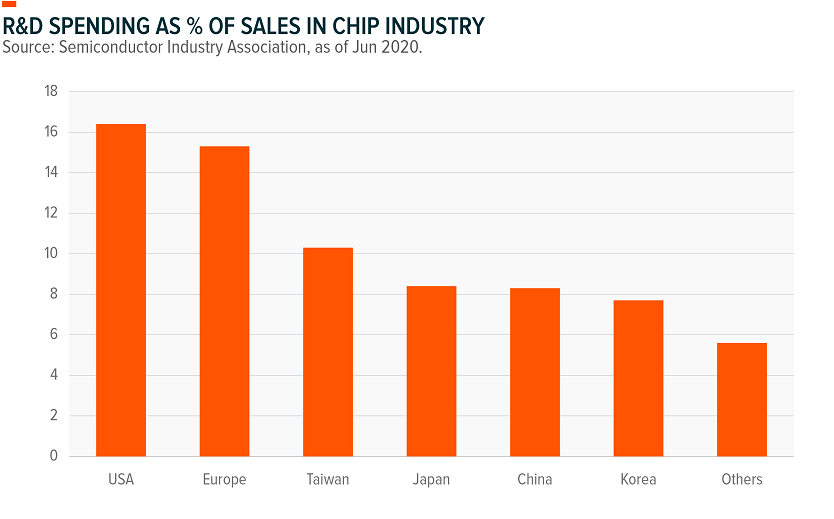
America is the global leader in the field of chip design and sales (47% of global semiconductor sales in 2019), while its R&D spending as a percent of sales in the semiconductor industry, leads the world at 16.4%.[i]
In Europe, the UK semiconductor industry is still a key centre for design of high-end silicon chips, and has the second highest number of design companies outside the US; with companies such as Infineon Technologies, STMicroelectronics, XMOS and Graphcore.
However, while UK is the home to chip designers ARM Holdings (bought by Softbank and recently snapped up by Nvidia) and Imagination Technologies (bought by US private equity firm US-Chinese firm Canyon Bridge in 2017), they do not manufacture the advanced silicon chips needed by the telecommunications and automotive sectors.
Like the rest of the world, the UK is reliant on Asian manufacturers, particularly Taiwan and South Korea, which account for 43% of global manufacturing capacity, led by Taiwan Semiconductor Manufacturing Co (TSMC) and Samsung. [ii]
R&D Spending as % of Sales
Building a new company to meet growing demand is simply not a feasible solution for short-term disruptions because of the immense capital and time required to do so (building and bringing it up to full capacity can take anywhere from 24 to 42 months at a price tag of anywhere from $1.7bn to $5.4bn).[iii]
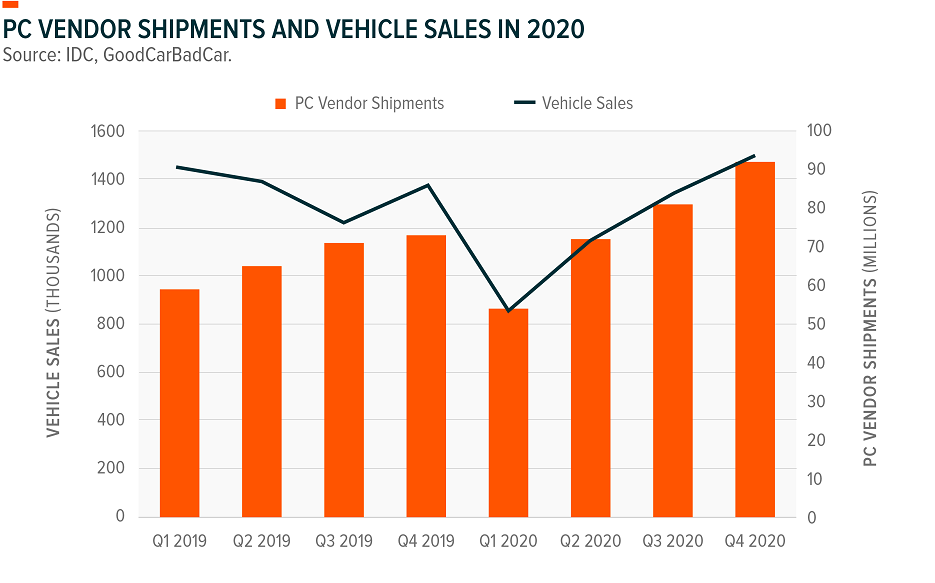
On the demand side, the uncertainty of COVID caught companies and consumers off guard. In particular, demand for household electronics remained resilient with consumer electronics companies continuing to order chips.
PC Vendor Shipments and Sales
The semiconductor shortage has escalated to the point where governments feel the need to act. In the United States, the Biden administration signed an executive order calling for a 100-day review of supply chains; in Japan, the Abe and Suga administrations dispatched a delegation in June to negotiate with and invite TSMC to build a company in Japan.
However, reshoring the semiconductor industry is difficult and not all efforts to do so will succeed.
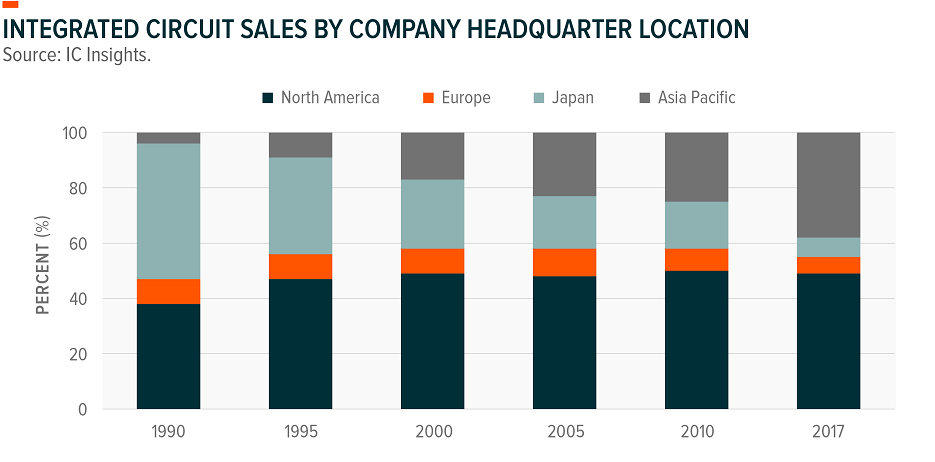
The geographical centres of power have shifted. Japan once dominated as its companies took in 49% of integrated circuit sales in 1990. In 2017, that number dwindled down to 7%, with most of it going to Japan’s rapidly growing neighbours.[iv]
Integrated Circuit Sales by Location
In China, there is an increasing sense of urgency over the independence of the domestic semiconductor. Meanwhile, European Union (EU) officials have put forth a plan that aims to bring EU chip production up to 20% of world supply by 2030.[v]
A reshoring of the semiconductor industry could bring about a decline in the “design, market and outsource manufacturing” model as companies vertically integrate from chip design to manufacturing. There is plenty of room for that as Moore’s Law, which predicts that the number of transistors that can fit on a chip will double every two years, has generally stayed true.
The semiconductor shortage will have a palpable impact across multiple industries in 2021.
As semiconductors become increasingly important to a digitalized economy, governments and businesses are reassessing their dependence on supply chains that run through foreign countries.
Companies are questioning the sector model and their lack of vertical integration, while policymakers are looking for ways to incentivize breakthroughs in semiconductor research, innovation, and production.
With the growing importance of innovation for economic growth, we expect to see greater investment in chip design and manufacturing alongside attempts to reshore strategic components of the chip industry to domestic markets.
Risk warning:
Investing involves risk, including the possible loss of principal. International investments may involve risk of capital loss from unfavourable fluctuation in currency values, from differences in generally accepted accounting principles, or from economic or political instability in other nations. Emerging markets involve heightened risks related to the same factors as well as increased volatility and lower trading volume. Securities focusing on a single country and narrowly focused investments may be subject to higher volatility. The companies in which the funds invest may be subject to rapid changes in technology, intense competition, rapid obsolescence of products and services, loss of intellectual property protections, evolving industry standards and frequent new product productions, and changes in business cycles and government regulation. The investable universe for thematic ETFs may be limited. The funds are non-diversified. There is no guarantee the trends discussed will continue. Shares of ETFs are bought and sold at market price (not NAV) and are not individually redeemed from the fund. Brokerage commissions will reduce returns.
References:
- Semiconductor Industry Association, “State of the Industry Report 2020,” June 2020.
- Bloomberg, “Chip Shortage: Taiwan, South Korea’s Manufacturing Lead Worries U.S., China,” Mar 3, 2021.
- McKinsey, “Semiconductor design and manufacturing: Achieving leading-edge capabilities,” Aug 20, 2020.
- IC Insights, “IC sales share by company HQ 1990-2017,” Mar 2, 2020.
- Bloomberg, “EU’s Breton Says Time to Fix ‘naïve’ Approach to Chip Supply,” May 5, 2021