
Latin Resources Ltd (ASX:LRS) (FRA:XL5) has secured three new tenements totalling around 570 square kilometres in the highly prospective Lachlan Fold Belt in New South Wales.
The recently granted Manildra and Burdett projects straddle the regional scale Manildra Fault within the Lachlan Transverse Zone, with known gold and copper occurrences including recent shallow RC drilling results of 26 metres at 1.5 g/t gold from 25 metres, and 3 metres at 7.82 g/t gold from 57 metres.
In addition, the new tenement application Boree Creek hosts known copper mineralisation, with historic rock chip assays returning up to 2.7% copper.
“Significant step in NSW exploration strategy”
The company is confident of the prospectivity of the project area, which sits just 30 kilometres to the northwest of the Newcrest Mining Ltd’s (ASX:NCM) (TSE:NCM) (FRA:NMA) (OTCMKTS:NCMGF) Cadia Mine (22 million ounces gold, 4.3 million tonnes copper), 60 kilometres west of Regis Resources Ltd’s (ASX:RRL) (FRA:RKQ) (OTCMKTS:RGRNF) McPhillamys Project (2 million ounces gold).
Latin Resources exploration manager Tony Greenaway said: “The granting of our Manildra and Burdette Gold tenements is a significant step forward for our NSW exploration strategy, enabling us to get on the ground in this highly prospective area.
“The addition of the Boree Creek Tenement to our wider project portfolio immediately to the west of the world class Cadia Mine, further enhances our presence in this highly sought-after region.
“We intend to launch straight into our exploration work on our newly granted tenements with land access agreements already in place, while we wait for our new
Boree Creek tenement to make its way through the grant process.”
The company aims to commence regional and project scale first pass exploration targeting which will include reconnaissance mapping, low-impact systematic geochemical sampling and geophysical surveys.
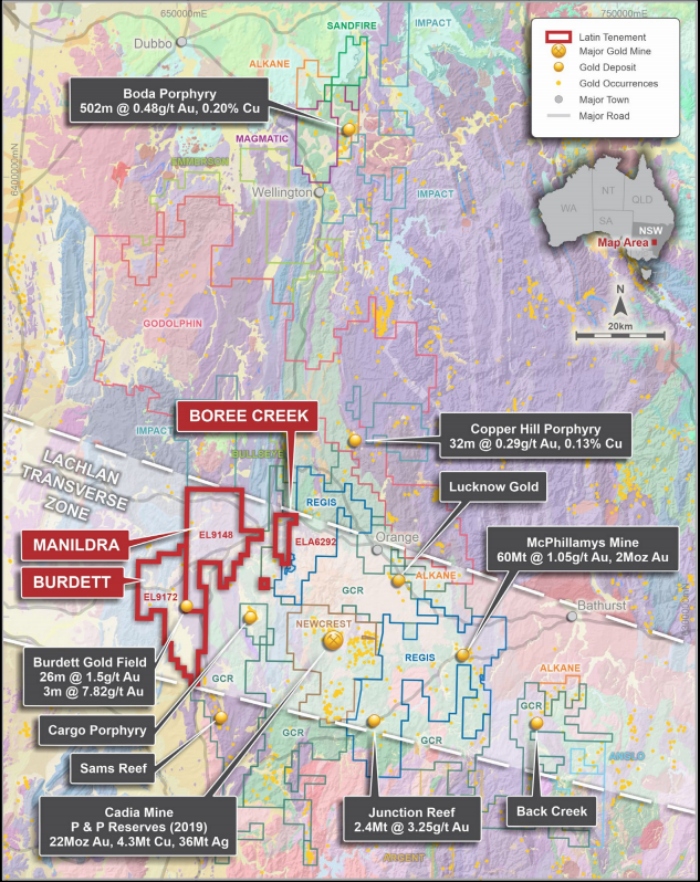
EL9148, EL9172 and ELA6292 Project Location and regional setting, highlighting major Gold Mines and deposits in the district.
“Gundagai tenements secured”
The company has also secured a major new project area with the addition of two new tenement applications Mooney and Sandy Creek, around 15 kilometres northeast of Gundagai in central southern NSW.
Together these tenements total some 165 square kilometres of ground highly prospective for ultramafic layered intrusive nickel-copper-platinum group element style mineralisation, orogenic gold mineralisation, and skarn type mineralisation.
Greenaway said: “We have also secured the outstanding Gundagai Ni-Co-PGE Project to the southeast via a further two new tenement applications.
“To once again be able to secure new exploration projects at very low cost to the Company, over areas with known precious and base-metal mineralisation occurrences is a great team achievement.
“In parallel with our other work, we progress initial land access discussions at Gundagai so that we are ready to commence work once the tenement is granted.”
Following the grant of the two new tenements, and securing land access and other statutory approvals, Latin proposes to complete regional and project scale first pass targeting exploration, which may include geophysical surveys and low-impact geochemical sampling, followed by RC drilling of any defined targets.
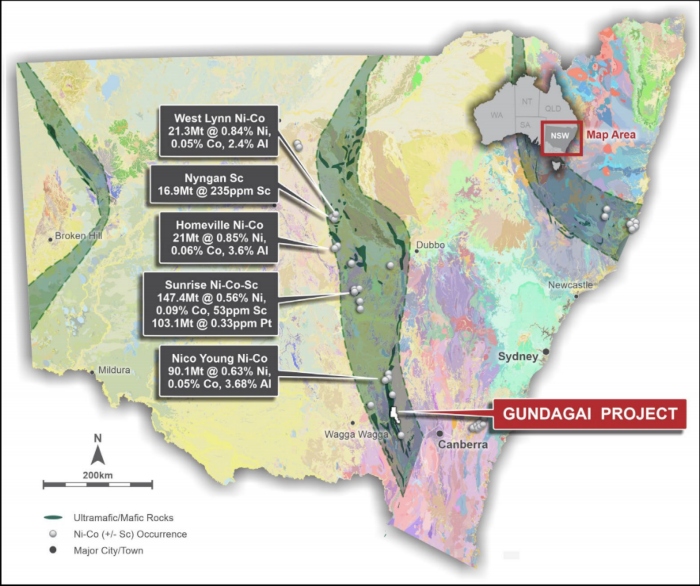
Ni-Co±Sc±PGE resources and occurrences within NSW showing locations of mafic-ultramafic belts and LRS Gundagai Project area.
Yarara exploration underway
Latin has begun prospecting work over the Peep O’Day historic workings within the Ournie Zone of the Yarara project.
On-ground reconnaissance mapping and rock chip sampling has been undertaken along the 1200 metre strike extent of the historic gold workings.
Assay results from the 57 rock chip samples collected at the Peep O’Day prospect are pending, however historic rock chip samples taken along the length of the workings have assayed up to 5.4 g/t gold.
The company will now undertake a program of systematic soil geochemical sampling over the strike length of the historic line of workings, comprising around 400 close spaced samples across 14 sample lines.
The results will be used to finalise potential drill sites for the next planned phase of work and enable the submission of the required ground disturbing activity applications.