
Azure Minerals Limited (ASX:AZS) has hit further broad zones of nickel-copper sulphides during exploration at its Andover project in Western Australia’s Pilbara region.
Seven holes drilled across the VC-07 West and VC-07 East prospects, situated within the VC-07 mineralised corridor, intersected broad zones of sulphide mineralisation.
The latest seven holes form part of a broader, 30,000-metre exploration program, announced in January this year, aimed at defining a mineral resource within the VC-07 corridor.
So far, Azure has completed 49 diamond drill holes, covering nearly 22,000 metres, along Andover’s flagship mineralised corridor and the VC-23 prospect.
“Continues to have great success”
Azure managing director Tony Rovira said: “It’s very pleasing that our drilling continues to have great success intersecting more and more zones of nickel-copper sulphide mineralisation within the VC-07 mineralised corridor.
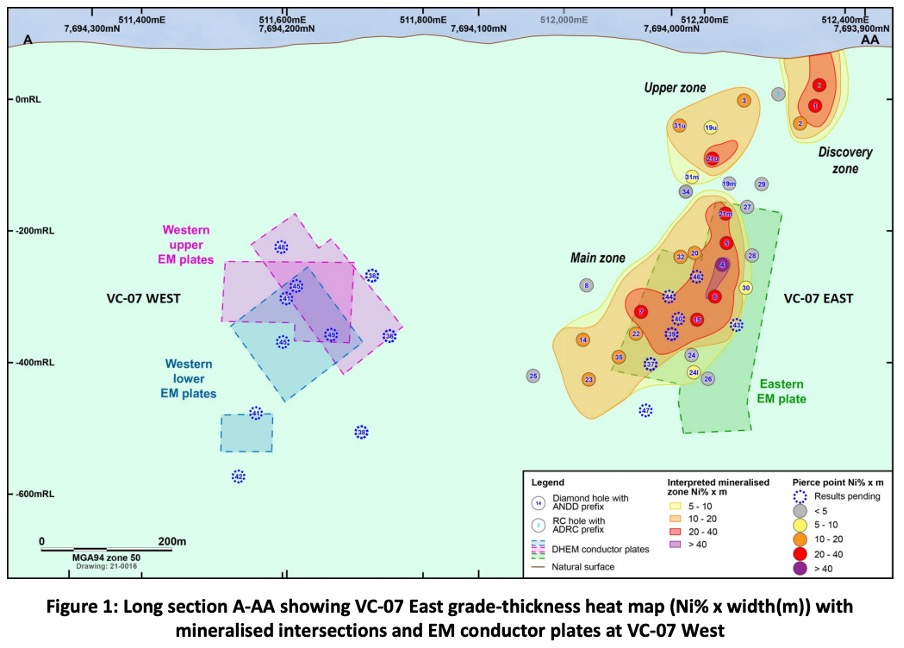
“As with our earlier drilling, these latest mineralised intersections are coincident with electromagnetic (EM) conductors, confirming the strong association of nickel-copper sulphide mineralisation with EM conductance.
“With multiple mineralised drill hits and numerous nearby EM conductors that are yet to be drilled, the western part of the VC-07 corridor is shaping up very nicely to host a substantial body of nickel-copper sulphide mineralisation.
"Meanwhile, the infill and extensional mineral resource drilling at VC-07 East continues to intersect mineralisation in line with expectations.”
VC-07 West
Further exploration at VC-07 West was sparked by the discovery of two substantial zones of nickel-copper sulphide mineralisation last month.
Specifically, hole ANDD0041 intersected:
- 36.6 metres of matrix and heavily disseminated nickel-copper sulphides from 428.15 metres; and
- 28.9 metres of matrix, stringer and disseminated nickel-copper sulphides from 644.1 metres.
In order to follow up on the result, Azure drilled four more holes within the VC-07 prospect.
While hole ANDD0042 intersected disseminated nickel-copper sulphide mineralisation, holes ANDD0045, ANDD0048 and ANDD0049 all intersected broad, and in some cases multiple, zones of semi-massive, matrix and heavily disseminated nickel-copper sulphide mineralisation.
One of the best intersections came from hole ANDD0049, which hit 17.2 metres of semi-massive, matrix and heavily disseminated nickel-copper sulphides from 472.4 metres.
Drilling continues at VC-07 West, aiming to test down-hole transient electromagnetic (DHTEM) conductors and follow the prospect’s mineralisation along strike to the east and west.
VC-07 East
Coinciding with work at VC-07 West, Azure set out to conduct mineral resource drilling in the VC-07 corridor’s eastern portion.
Promisingly, four holes drilled recently in this zone intersected significant nickel-copper sulphide mineralisation.
Hole ANDD0046 was a particular highlight: it uncovered 25.9 metres of massive, semi-massive, matrix and disseminated nickel-copper sulphides from 389.2 metres.
Overall, the latest intersections at VC-07 East confirm mineralisation within the zone is of a grade and thickness in line with Azure’s expectations.
Extensional drilling within the area continues to increase the size of the mineralised zone, while DHTEM surveying has indicated VC-07 East’s significant depth potential.
Work continues
Following the latest round of assays from Andover, Azure has laid plans for its next stage of exploration.
Currently, two diamond drill rigs are on-site at the VC-07 West system, testing the multiple mineralised zones discovered so far.
Meanwhile, a third rig is progressing work within the VC-07 East mineralised zone in a bid to better define the area’s mineral resource.
Simultaneously, Azure is working on plans to conduct additional drilling at a suite of high-priority zones at Andover - a list that includes the VC23, VC-18 and VC-41 targets.
To advance exploration, the ASX-listed explorer will utilise data from an airborne survey conducted by the Creasey Group in 2008 and Azure’s recent Fixed Loop Time Domain Electromagnetic (FLTEM) and high-resolution aeromagnetic surveys.
Azure will also fly a new, high-resolution VTEM survey in July in order to better define the electromagnetic conductor bodies across the targets.