
Aspire Mining Ltd (ASX:AKM) (FRA:WKU) is progressing its wholly-owned Ovoot Coking Coal Project (OCCP) in Mongolia, with the front-end engineering and design (FEED) study contract awarded and recent lab tests confirming the product is high-quality premium fat coking coal.
The Ovoot Coking Coal Project contains a JORC 2012-compliant total coal reserve of 255 million tonnes of high quality (fat) coking coal, which can be used to blend with other coking coals to produce coke, an essential component of producing steel using the blast furnace production route.
This type of coal is in increasing demand in China, Mongolia's southern neighbour, particularly as China's relationship with Australia is strained which impacts the amount of coal imported from Australia.
The company’s Ovoot Early Development Plan (OEDP) and pre-feasibility study is focused on a truck and rail operation to deliver up to 4 million tonnes per annum to end markets in China and Russia - and with no signs of China reversing its policy on Australian coal imports Aspire looks well-placed to cater to Chinese demand.
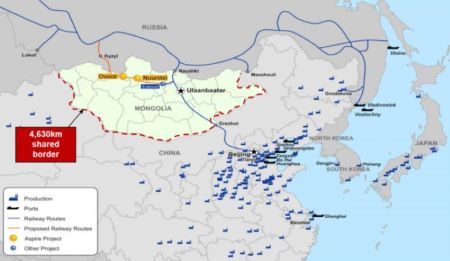
Infrastructure map showing Ovoot transport route to steel customers.
Phased FEED study
Last month the company awarded the FEED contract on Coal Handling and Preparation Plant (CHPP) infrastructure in Mongolia to CIMIC Group Ltd’s (ASX:CIM) (FRA:WKU) wholly-owned minerals processing company, Sedgman Pty Limited.
The FEED Study will be conducted in a phased approach over a period of around five months.
Stage 1 will comprise trade-off analyses to identify the most appropriate concepts and technologies, which will take about eight weeks, and Stage 2 will then focus on the agreed path and will produce accurate estimates of capital and operating costs and designs to enable tendering for construction.
This work will be completed under a schedule of rates arrangement with the total cost estimated at A$600,000.
The intended CHPP infrastructure to be investigated will be based on existing modular designs and will enable low impact processing of approximately 1.5 million tonnes per annum of run-of-mine (ROM) coal with capability for later expansion.
Aspire will also work with Sedgman on identifying opportunities for the CHPP infrastructure construction to qualify for export credit finance assistance.
Premium fat coking coal
The company recently received fresh laboratory results confirming the OCCP is a high-quality premium fat coking coal of high value and that is in demand in neighbouring China.
A 60-kilogram sample of fresh coking coal indicative of Ovoot’s Upper Seam, which will be the focus of the Ovoot Early Development Project, was tested by SGS in Tianjin China.
Key results are consistent with earlier laboratory tests and reaffirm the attractiveness of Ovoot Fat Coking Coal as having outstanding caking, fluidity and plastic properties across a wide temperature range.
The company will now work with Chinese and Russian institutes to pre-qualify the coal prior to marketing activities commencing.
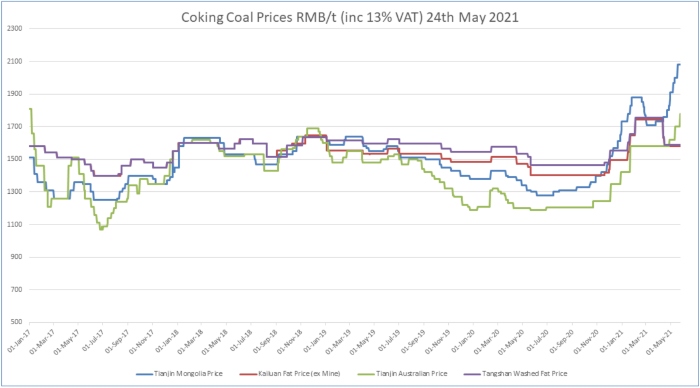
Five-year price chart showing the price of fat coking coals are around the same as hard coking coals in Tianjin China. Source: sxcoal.com.
Making up Chinese shortfall
High-quality fat coking coals have an important value in use in the Chinese steel industry, particularly at present with import limitations being put on Australian hard coking coals.
China is not self-sufficient in sourcing hard coking coals and since 2009 has relied on imports to make up the shortfall.
Adding quality fat coking coals allow steel mills to add lower quality coking coals into the batch, more than what hard coking coals could carry to make quality coke.
Fat coking coals like Ovoot’s would be used between 5% to 10% of a coke batch in order to support the carrying ability of the limited supply of prime hard coking coals.
Notably, fat coking coals are priced at around the same as hard coking coals in Tianjin China.
The company is confident that the development of the Ovoot Coking Coal Project will benefit the shift from China away from Australian coal.