
Chalice Mining Ltd (ASX:CHN) (OTCQB:CGMLF) has received strong results from ongoing regional reconnaissance exploration at the Julimar Nickel-Copper-Platinum Group Element (PGE) Project in Western Australia.
A ground gravity survey and reconnaissance soil sampling has identified several extensive nickel-copper+/-palladium soil anomalies with gravity highs and, in some cases, coincident with airborne EM anomalies at Baudin, Jansz and new Drummond targets at the northern end of the Julimar Complex.
The company said the new soil anomalies were comparable to the initial soil sampling results over the Gonneville pre-discovery.
Additionally, the ground gravity data indicates the presence of a largely continuous gravity high extending over >26 kilometres of strike, coincident with the magnetic high of the Julimar Complex.
Shares were as much as 2.27% higher to $8.75 while Chalice's market cap at the start of trade was approximately $2.914 billion.
Strong gravity highs
The district-scale gravity high is interpreted to be associated with mafic or ultramafic geology, which confirms the current interpretation that the ~1.8-kilometre-long Gonneville Intrusion is part of the ~26-kilometre-long Julimar Complex.
The Hartog and Drummond targets, at the southern and northern end of the complex, show the strongest gravity highs, which the company interprets as indicating the presence of larger volumes of mafic/ultramafic rock-types at depth.
This type of response could be associated with feeder zones within the complex, making these areas high priority drill targets.
Target prospectivity
The new low-level nickel and copper +/- palladium soil anomalies delineated have upgraded the prospectivity of the Baudin and Jansz AEM targets.
Extensive anomalies have also been defined further north of Jansz at the newly identified Drummond Target, which is now considered a high-priority target due to localised soil anomalism and the presence of a coherent and discrete gravity-magnetic high.
Baudin, Jansz and Drummond are yet to be tested with moving loop EM (MLEM).
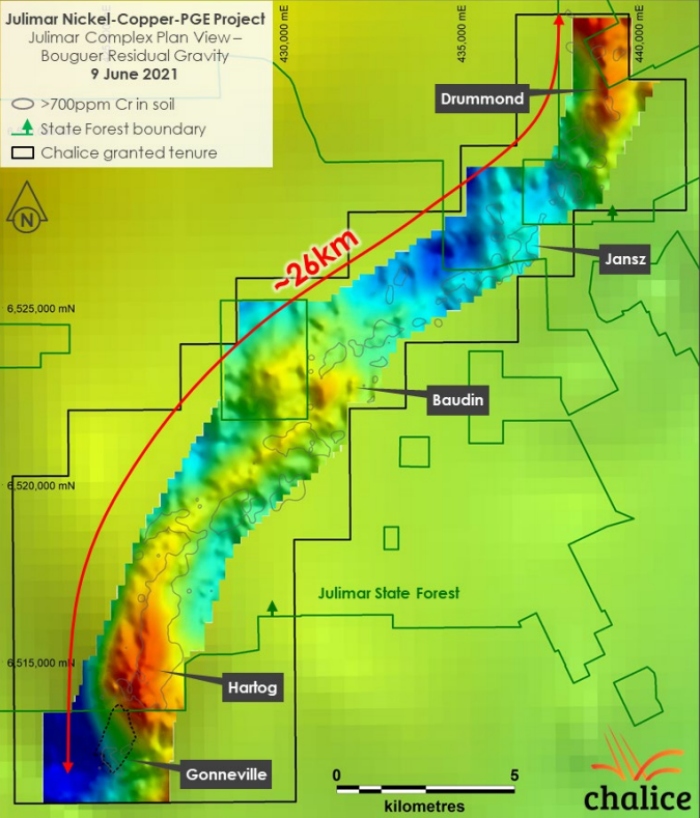
Julimar Complex Plan View – Bouguer residual gravity image and >700 parts per million chromium in soil contour over regional bouguer gravity.
Soil geochemistry
Background metal content in soils was approximately 25 parts per million nickel, 5 ppm copper and <1 parts per billion palladium across the entire dataset.
Notably, values above 80 ppm nickel, 20 ppm copper and 5 ppb palladium are considered highly anomalous.
A largely continuous chrome-in-soil anomaly (>700 ppm chromium) has been defined co-incident with the gravity and magnetic high of the Julimar Complex.
The company believes this provides further evidence that mafic-ultramafic geology extends along the majority of the ~26-kilometre strike length.
Looking forward
Based on the soil and gravity results at Baudin, Jansz and Drummond, initial first-pass MLEM lines are planned over the coming weeks.
This program aims to define drill-ready targets and is anticipated to be completed by the end of June.
Infill soil sampling will also be completed over the new targets.
Additionally, environmental surveys have been completed at the Hartog Target in preparation for initial drill testing, which is planned for late Q3 2021, subject to access approvals.
And the company is continuing its ~160,000 metre step-out and resource definition drill program at the Gonneville discovery with seven rigs (three RC and four diamond) currently drilling.
Early-stage economic studies are also continuing.