
Golden Rim Resources Ltd (ASX:GMR) has released additional geochemical sample results from Loreto copper target at its Paguanta Project in northern Chile, which indicate the porphyry centre, a highly prospective copper target, is around 2.3 kilometres x 1 kilometres - or double the area suggested by previous sampling.
Notably, Loreto’s interpreted porphyry centre lies within an even larger 3.5-kilometre x 3.5-kilometre leached cap (intense hydrothermal alteration zone) and geochemical sampling has not yet been conducted over the entire alteration zone.
The company is preparing access agreements with landowners with plans to construct an access road and conduct exploration including additional geochemical sampling and geophysical surveys to define targets for drilling.
“Potential for Tier 1 discovery”
Golden Rim managing director Craig Mackay said: “Golden Rim believes that Loreto could well represent the last unexplored outcropping Oligocene-Eocene porphyry system in northern Chile and it has potential for the discovery of a Tier 1, world-class, Collahausi-type porphyry copper deposit.
“Not surprisingly, Loreto is surrounded and over-pegged by BHP Group Ltd (ASX:BHP) (NYSE:BHP) and Codelco, two of the largest copper companies in the world.
“Golden Rim’s initial exploration at Loreto continues to highlight the exciting potential for the large and growing porphyry centre at Loreto to host a deeper porphyry copper deposit.
“The company looks forward to finalising access agreements with the landowners so that systematic geochemical and geophysical exploration can commence to generate drill targets.”
Porphyry pathfinder
The assay results from 12 rock chip samples returned anomalous molybdenum results (up to 25 parts per million molybdenum) in samples located northwest (on the other side of a major drainage with recent sediment cover) and south of previous samples with anomalous molybdenum.
As molybdenum is a geochemically immobile element, it is an excellent porphyry pathfinder, highlighting the centre of the porphyry cell.
The company is confident further exploration could extend the area of the porphyry centre.
Importantly, the low silver results in rock chip samples from Loreto clearly differentiate the geochemical assemblage at Loreto’s porphyry hydrothermal cell, with potential for a copper deposit, from the polymetallic geochemical assemblage (silver-lead-zinc) at the epithermal Patricia cell, 3.5 kilometres northeast.
This geochemical difference also coincides with the identification of higher temperature alteration minerals at Loreto (pyrophyllite, phlogopite), compared to lower temperature alteration minerals evident at Patricia.
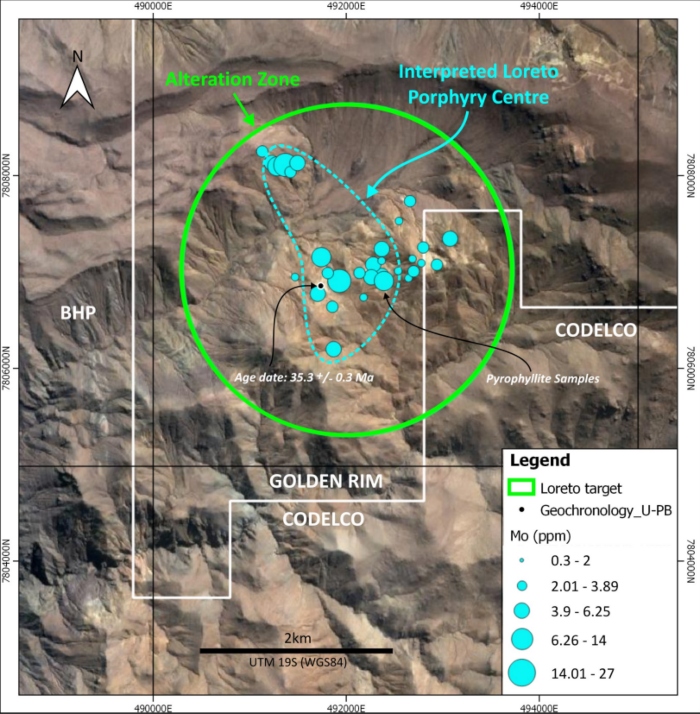
The 3.5km x 3.5km alteration zone (colour anomaly) is within the green circle (parts of which have shallow recent alluvial cover) and the interpreted 2.3km x 1km porphyry centre is indicated by the blue outline and includes the area of anomalous molybdenum.
Regional prospectivity
Whilst the Loreto porphyry target has not previously been explored, the area has been on the radar of the major companies which tightly hold the area surrounding Paguanta and are all looking for another Collahausi-style copper deposit in the northern extension of the Oligocene-Eocene Porphyry Belt.
Based on the field observations, Golden Rim believes that Loreto corresponds spatially to the upper portion of a porphyry system and that it corresponds in time to the most productive copper mineralising age in northern Chile (Late Oligocene – Early Eocene).
In addition, Loreto shows good evidence to suggest a telescoped system (hydrothermal alteration overprinting) - meaning that economic mineralisation might be in a range of hundreds of metres below surface, within the zone of phyllic and potassic porphyry alteration.
Evidence for this deeper alteration includes the clasts with potassic altered porphyries plus sulphides from the igneous breccia and the pyrophyllite hyperspectral finding.
Remnant copper oxides at surface, chalcopyrite in the igneous breccia clasts and traces of chalcopyrite in late multiphase porphyry dykes show evidence of copper fertility at Loreto.
Planned exploration
Golden Rim is preparing access agreements with landowners before constructing an access road and commencing exploration at Loreto.
Proposed initial work includes geological mapping (1: 5,000 scale), geochemical sampling, clay hyperspectral analysis, ground magnetics and 3D Induced Polarisation (IP)/Resistivity geophysical surveys.
The company then plans to commence a short program of diamond drilling on priority targets identified in the earlier work.