
Platina Resources Ltd (ASX:PGM) (OTCMKTS:PTNUF) (FRA:P4R) is moving towards the exploration phase at Xanadu Gold Project after executing binding purchase agreements and commencement of tenement transfers.
This exploration strategy will initially comprise low-cost geophysics and geochemistry aimed at increasing geological knowledge.
Tenement application
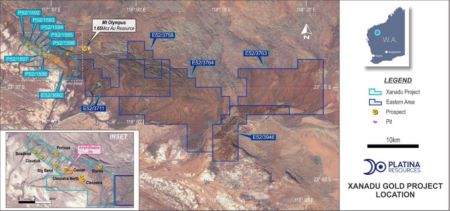
The company has also expanded the project footprint with application E52/3946 for an additional 69 square kilometres covering the target Duck Creek Dolomite and the Nanjilgardy fault zone and its splays.
Xanadu is in the Ashburton province near the multi-million ounce Mt Olympus gold deposit of ASX-listed Kalamazoo Resources Ltd (ASX:KZR).
Mt Olympus has past production of 350,000 ounces and resources of 1.65 million ounces for a combined 2-million-ounce gold endowment.
“Immense appeal”
Platina managing director Corey Nolan said the exploration strategy was aimed at building a deeper knowledge of the geological potential of the project and to define shallow and deeper targets for drilling.
He said: “Xanadu has immense appeal given the number and width of economic grade gold drill intercepts which have never been followed up with a systematic exploration campaign.”
Strong similarities
Xanadu Project comprises a large alteration system hosted within sediments and carbonates prospective for intrusion-related gold mineralisation such as the Telfer Gold Mine of Newcrest Mining Ltd (ASX:NCM) and the Hemi discovery of De Grey Mining Ltd (ASX:DEG).
The project also displays strong similarities to the Carlin gold deposits in Nevada, USA.
Potential to expand
The company believes the project offers upside due to several factors including:
- A favourable regional scale structural setting, with the multi-million-ounce Mt Olympus gold deposit, situated 7 kilometres to the east;
- Widespread gold mineralisation identified within a large and intense hydrothermal alteration system which extends for over 10 kilometres in strike extent;
- The host lithology, the Duck Creek Dolomite, is a highly reactive rock and favourable host to the target intrusion-related and Carlin styles of gold mineralisation; and
- Immediate targets from the surface and at depth within the interpreted east plunging alteration system.
Nolan said: “Whilst we believe there is significant potential to expand upon the known oxide mineralisation, the longer-term prize is targeting primary mineralisation within the alteration core of the system which has never been tested by historical drill programs.”
The new tenement application will increase the ground position to 562 square kilometres with contiguous coverage along a 60 kilometres strike length of the Nanjilgardy fault and its splays and the Duck Creek Dolomite stratigraphy, which is host to gold mineralisation within the project area.