
Shree Minerals Limited (ASX:SHH) has discovered new copper occurrences during its first site visit to the Edwards Creek Project in the Northern Territory and this comes at a time of very positive copper market fundamentals.
The new occurrences identified during a reconnaissance trip to the site in late May are hosted by an ironstone unit that extends for more than 200 metres.
This trip was made to assess access and to check the location of copper and base metal occurrences recorded by previous exploration companies and the Northern Territory Geological Survey.
There were 16 rock chip samples taken and these have been submitted to the laboratory for analysis of gold, copper and multi-elements.
“Exciting outcome”
Shree Minerals executive director Sanjay Loyalka said: "The discovery of new copper occurrences at Edwards Creek is an exciting outcome of the initial fieldwork at Edwards Creek.
"In particular, it suggests that despite previous exploration the project is still highly prospective.
"Only a small portion of the prospective horizon has been drilled previously and assumptions about the lithostructural setting of mineralisation may have been incorrect opening up new areas for exploration that may have been overlooked."
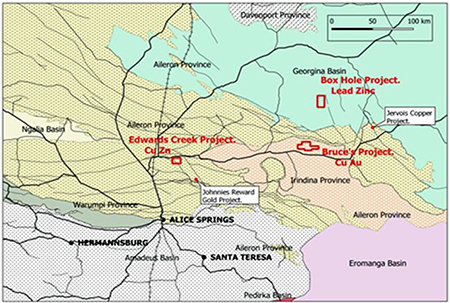
Regional location of the Arunta Joint Venture projects and major resource projects in the region.
The presence of copper and base metals has been confirmed at the Edwards Creek gossan and the extensions to the north and south within the folded sequence of felsic and mafic granulite, marble, calcsilicate and amphibolite.
Copper mineralisation, which was identified around 750 metres east of the main gossan, is most evident within the siliceous gossan where it forms green malachite coatings on rock faces.
Lead and zinc to boot
Lead-zinc mineralisation in the form of white oxide coatings on rocks occurs along strike to the north within carbonate rocks.
The new occurrences comprise coarse ironstone with malachite staining within a poorly exposed horizon around 1-metre wide. This ironstone horizon is exposed intermittently for more than 200 metres trending in a northeasterly direction.
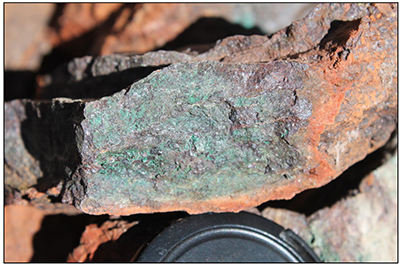
Malachite-stained ironstone.
The junior explorer said the new occurrences had not been reported by previous exploration companies that focused exploration on the area around the main gossan.
These new copper occurrences suggest that the structural setting may be more complex than previously thought.
Next comes remodelling
Shree will now engage a geophysical consultant to conduct remodelling of airborne electromagnetic data at Edwards Creek to assist with the targeting of further drilling.
The site visit has revealed that the collars for the previous drill holes are still open and depending on the results from the remodelling of the data, the old holes could be re-entered and cleaned out to allow a downhole electromagnetic survey allowing the EM conductor to be modelled with greater accuracy.
The intense folding evident suggests that sulphide bodies could form narrow plunging shoots similar to those at the Rockface prospect at KGL Resources Ltd’s (ASX: KGL) Jervois project about 200 kilometres to the east.
Additional geological mapping, rock chip sampling and detailed soil sampling is planned around the new copper occurrences.
If soil sampling is successful the program may be extended to cover additional areas, particularly the north and east limb of the folded prospective horizon that contains undrilled lead-zinc occurrences.
Edwards Creek recently granted
Edwards Creek Project is about 75 kilometres north-northeast of Alice Springs and was recently granted.
The project forms part of the Arunta Joint Venture between Shree Minerals and Territory Lithium Pty Ltd covering an area of around 380 square kilometres in the highly prospective Arunta Region.
Green malachite staining prompted the acquisition of exploration licences over the prospect in the 1970s.
Territory Exploration Pty Ltd acquired new EM data over the area in 2017 and identified a strong EM conductor interpreted to be caused by sulphide mineralisation at depth.
Two reverse circulation holes drilled to test this conductor intersected relatively weak zones of copper mineralisation in a clay zone and no further work was conducted.