
Meteoric Resources NL’s (ASX:MEI) (FRA:RNF) first deep drill hole (JUDD042) designed to test the deep high-chargeability IP anomaly at the Juruena Project in Brazil has confirmed the potential for a major copper-gold porphyry environment, closely related to the shallow epithermal deposits (Dona Maria, Crentes and Querosene, among others).
JUDD042 was designed using all available geological and geophysical data including; hydrothermal alteration, structural interpretation, soil and rock-chip sampling and two phases of IP to test a porphyry model for copper-gold mineralisation associated with a deep high chargeability IP anomaly.
The drill hole is currently stopped at 940 metres, within the Juruena Fault, in a very promising copper sulphide bearing breccia, awaiting delivery of narrower drill rods to enable deeper drilling.
Potential for a “significant magmatic ore system”
Meteoric managing director Andrew Tunks said: “While it is very frustrating to have a technical hitch right as we drilled into the best zone yet in Hole JUDD042, we are buoyed by the exciting geology we have observed as we have entered the Juruena Fault zone.
“The alteration styles, minerals present, including: molybdenite, chalcopyrite and bornite plus the porphyritic intrusives and breccias noted, all lead to the conclusion that we are in a significant magmatic ore system.
“We have temporarily moved the rig onto Hole JUDD043, approximately 500m WNW to continue the exploration but will re-enter JUDD042 and complete an additional 150-200m of drilling of this exciting zone.”
Exploration vectors
The core shows features that are typical of porphyry environments and the detailed description and interpretation of those features is being used to generate exploration vectors.
Those vectors, albeit in 2D, are very useful in planning follow up drilling and particularly for targeting the source of known copper-gold mineralisation.
It will be possible to generate 3D vectors as soon as we have additional holes.
Hydrothermal alteration
Classic porphyry related hydrothermal alteration assemblages are identified in the drilling and show a mineral zonation that will be used as a vector towards any major potential source of copper-gold mineralisation.
The dominant regional alteration is propylitic in nature, which overprints the other alteration types.
Although overprinted, strong phyllic alteration is still well preserved and is the most important in terms of copper and gold mineralisation.
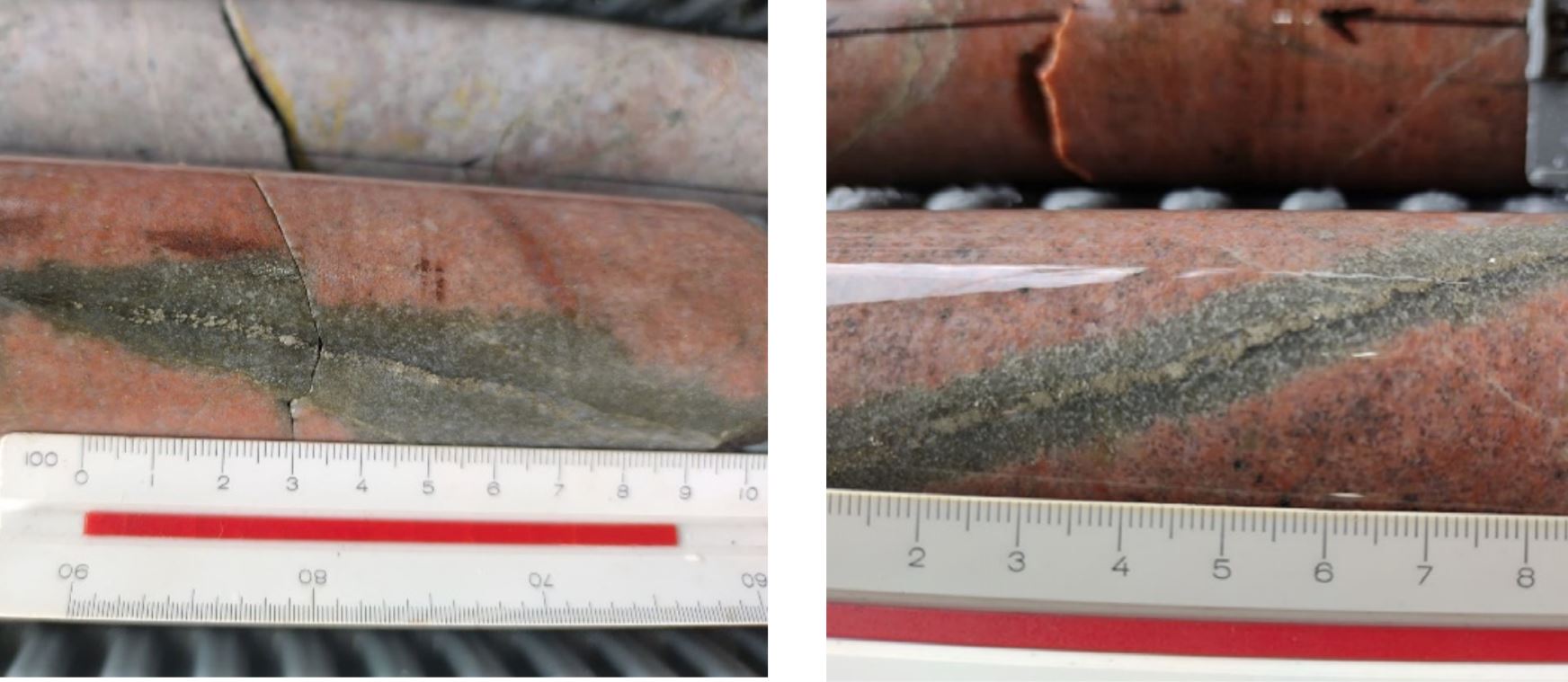
Fine grained granite with typical phyllic alteration (sericite + phengite + pyrite) occurring as haloes around quartz-pyrite veinlets. The alteration increases in occurrence and intensity towards the Juruena Fault Corridor and has been sampled for potential gold values.
Vein types
The rocks intercepted in JUDD042 contain locally intense veining and the association between the various vein types can constitute a potential vector towards mineralisation as Meteoric approaches the Juruena Fault.
Veins observed in JUDD042 appear to fit the ‘classic’ copper-gold- molybdenum porphyry models and as such, the company has adopted this classification.
Sulphide assemblages
Different sulphide associations are noted to occur down JUDD042. Pyrite is the most common sulphide.
It occurs as disseminations and as discrete vein haloes with chlorite within propylitic alteration; and more particularly with sericite and phengite within phyllic alteration.
At the Juruena Project, phyllic alteration is most typically related to shallow-level gold mineralisation and consequently Meteoric has interpreted prospective gold-bearing zones in the following phyllic-rich intervals:
- 123 metres to 319 metres – 4% to 8% phyllic;
- 535 metres to 557 metres – 2% to 6% phyllic; and
- 579 metres to 641 metres – 2% to 6% phyllic.