
Caspin Resources Ltd’s (ASX:CPN) diamond drill program at the Yarawindah Brook Nickel-Copper-Platinum Group Elements (PGE) Project in Western Australia has intersected broad sulphide zones.
Two holes for a total of 601.6 metres both encountered significant widths of copper and nickel sulphides.
The first hole intersected several zones of disseminated sulphide, typically around 1 to 3% by volume, with sulphide mineralisation occurring from 66.2 to 314.3 metres downhole, with distinctly more intense sulphide zones (locally up to about 15% based on visual inspection) at around 68 metres, 156 metres and 308 metres.
Disseminated copper sulphides observed are consistent with the targeted PGE mineralisation style
The second hole, YAD0018, also encountered similar styles of sulphide mineralisation between 71 to 187.2 metres down hole, hosted by mafic to ultramafic rocks.
While the visual observations are encouraging, samples now being prepared for assay.
“Good visual proxy for potential PGE”
The company has not confirmed whether PGE mineralisation is present, given that can only be determined through laboratory analysis, however, the presence of disseminated chalcopyrite is a characteristic of PGE mineralisation at Chalice Mining Ltd’s (ASX:CHN) (OTCMKTS:CGMLF) (FRA:C8U) Julimar Project.
Caspin chief executive officer Greg Miles said: “The two holes at Yarabrook Hill have delivered exactly what we wanted to see, that is, mafic and ultramafic rocks with broad zones of copper and nickel sulphide mineralisation which we believe is a good visual proxy for potential PGE mineralisation.
“The holes are 1.25 kilometres apart, so the scale of the opportunity is significant.
“Now we wait with anticipation for the assay results.”
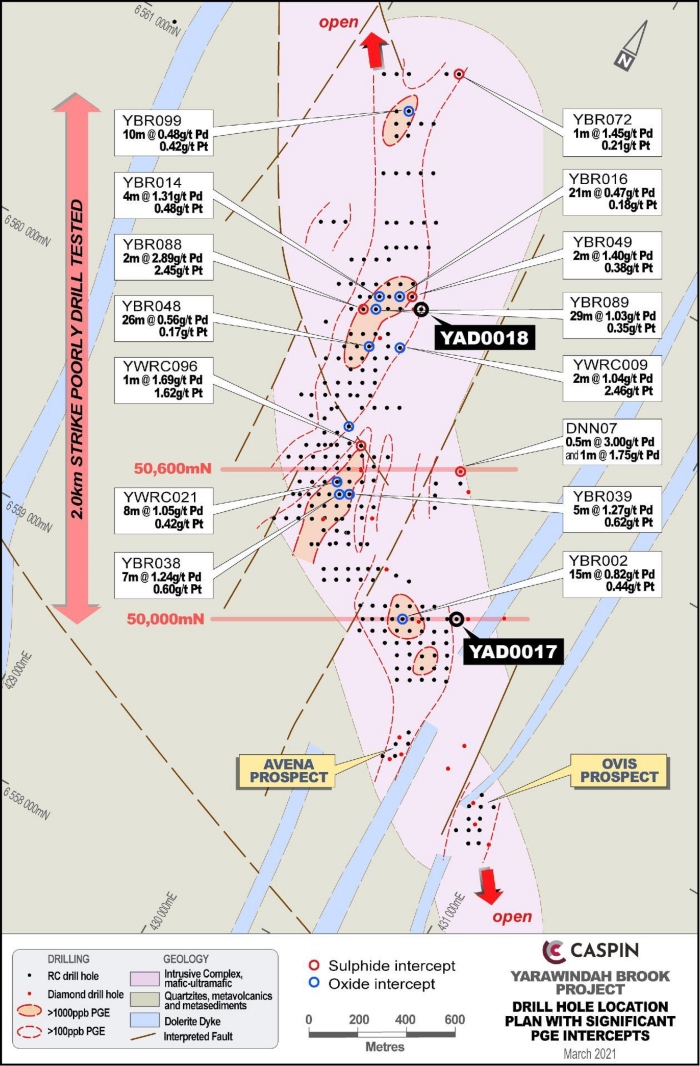
Drill hole locations and electromagnetic conductors at Yarabrook Hill Prospect.
Next steps
All holes will be surveyed by downhole electromagnetics (DHEM) to evaluate the potential for ‘off-hole’ conductors and secondary drill targets.
Both holes at Yarabrook Hill terminated in a predominantly barren gabbro unit, although it is unclear if this represents the basal unit of the host intrusion or if additional mineralisation is hosted deeper in the intrusion.
The company has been awarded a co-funded drilling grant through the WA government Exploration Incentive Scheme to test this concept and planning is already underway.
Miles said: “We are extremely grateful to have received a co-funded drilling grant through the WA Government Exploration Incentive Scheme.
“This is going to allow us to drill the deepest hole at Yarabrook Hill to date which will give us a huge amount of new geological information as well as another opportunity for discovery.
“While we wait for assay results, we will also commence work on our Mount Squires Project which is highly prospective for gold, copper and nickel.
Assays for the XC-29 Prospect are also pending.