
AVZ Minerals Ltd (ASX:AVZ) (OTCMKTS:AZZVF) (FRA:3A2) has revealed its initial exploration target at the Manono Project in the Democratic Republic of Congo, defining the potential for alluvial hosted tin resources based on an independent review of historical exploration records produced by Zaïretain - the previous operators of the project.
The review was conducted by independent geological and mining consultants, Behre Dolbear International Limited (Behre Dolbear) based in the United Kingdom.
This exploration target is in addition to the existing JORC hard rock tin and tantalum mineral resource estimates (MRE) of 125 million tonnes at 175ppm tin and 26ppm tantalum at a 0.5% lithium cut off.
Potential “significant resource”
Managing director Nigel Ferguson said: “We have been aware that historical exploration work had been conducted on the extensive alluvial tin resources to the north of the main hard rock pegmatite orebodies in the latter years of the historical mine’s operation by the previous mine operator, Zaïretain.
“The obvious first step in determining the success or otherwise of this work was to conduct a full review of all available information.
“Subsequently, we contracted Behre Dolbear in the UK to carry out this study due to their previous geological investigations in this area and I am pleased to present their results here.
“There is compelling evidence to suggest that significant alluvial tin placer resources exist in the floodplains along the banks of the current and palaeodrainages of the Likushi River.
“With a strengthening tin price this could represent a significant geological resource worth pursuing.
“Zaïretain also exploited and evaluated the potential of laterite hosted eluvial tin deposits in the Kitotolo Sector.
“Presently, there is insufficient confidence in the data to determine an exploration target, but research investigation has provided sufficient information to guide future exploration programs targeting these styles of mineralisation.”
Exploration Target
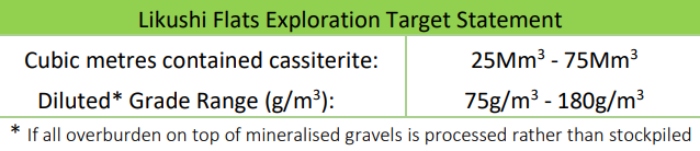
Placer tin exploration target volume and grade ranges
The exploration target covers an area of around 14 square kilometres and has been defined by blocks F1, F2, F4 and F5.