
St George Mining Ltd (ASX:SGQ) (FRA:S0G) has used recent geophysical surveys to identify multiple new nickel-copper sulphide targets at its flagship high-grade Mt Alexander Project in WA's north-eastern Goldfields.
Ground-based EM surveys completed along the Cathedrals Belt identified similar shallow EM conductors to those that resulted in nickel-copper sulphide discoveries at Stricklands, Investigators, Cathedrals and Radar.
However, the ground-based EM surveys were of limited effectiveness at West End because of the conductive cover to the west of Investigators.
Subsequently, a high-resolution ground gravity survey has been completed over West End and Investigators with data supporting the prospectivity of the area for nickel-copper sulphides.
“Targeting nickel-copper sulphides”
Multiple targets have been identified by downhole electromagnetic (DHEM) surveys, with three strong on-hole EM conductors identified from MAD199 at Investigators that support the potential for an extension of the thick high-grade mineralisation.
St George executive chairman John Prineas said: “The results of the gravity survey are very exciting and could provide a great advance in the targeting of nickel-copper sulphides in the Cathedrals Belt.
“A number of the gravity features are compelling drill targets for massive sulphides.
“These gravity highs are located within the interpreted trend of the mineralised intrusive host unit, an ideal location for dense massive sulphides.
“The concurrent use of downhole EM and drilling is continuing to provide a vector to mineralisation at depth. The multiple EM plates modelled around the new high-grade discovery in MAD199 support the potential for further high-grade mineralisation in this area.
“Drilling continues 24/7 and we look forward to reporting more drill results.”
High-priority targets
A number of gravity features have been identified along the mineralised trend of Investigators and at West End in areas that have never been drilled – providing targets for the potential discovery of further nickel-copper sulphide mineralisation.
Of particular interest are a string of large gravity highs, the largest of which appears at West End.
Several of these features are down-dip along the interpreted plane of the ultramafic intrusives and seen in the gravity data as discrete ‘bulls-eyes' within areas of lower density.
These features are ranked as high priority with an additional drill program to test them being prioritised.
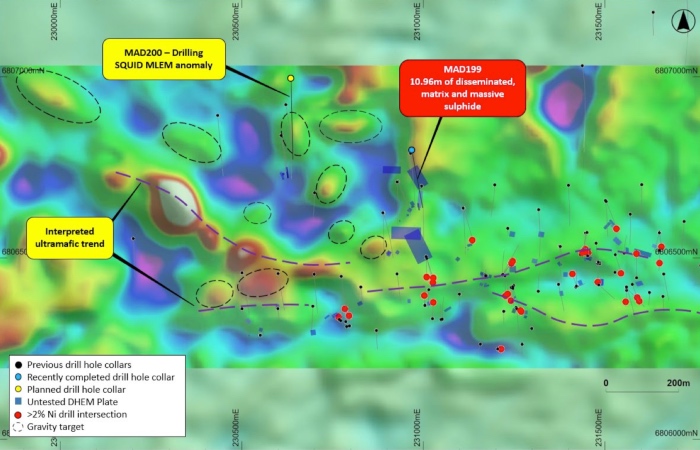
Plan view map of West End and Investigators showing recent gravity survey data and prior drilling. Gravity highs are targets for potential areas of nickel-copper sulphides.
Continuity of massive sulphides at depth
MAD199 intersected a thick 10.96 metres interval of nickel-copper sulphides from 333.6 metre downhole, which is the deepest occurrence of massive sulphides drilled in the Cathedrals Belt to date.
This discovery is an important milestone at the Cathedrals Belt as it confirms that massive nickel-copper sulphides are present at depth, beyond the interpreted detection limit of surface EM surveys.
The DHEM survey in MAD199 has recorded a strong on-hole EM response between 345 metres to 350 metres downhole with three new EM plates modelled and the DHEM survey in MAD195 also resulted in three EM plates being modelled - with one of these plates (MAD195_p1) intersected by MAD199.
All EM plates have varying strike lengths, dip directions and conductivities, indicating a complex geometry to the massive sulphide source – and the likelihood that there is more than one source.
Step-out drilling
Step-out drilling has been designed to test the extent of the DHEM conductors and the down-plunge continuity of the MAD199 mineralisation.
The first follow-up drill hole will target around 40 metres to the northwest of MAD199 – an area down plunge of the intrusive host unit and interpreted mineralised trend.
This new drill hole – MAD201 – will begin once MAD200 is completed.
Further drilling is also planned along strike from MAD197 to continue the search for nickel-copper sulphides in this trend.
In addition, anomalous EM responses recorded in MAD198 (Stricklands) warrant further exploration.
Looking forward
Alongside the 2021 diamond drill program, an additional drill program is being planned to test the new gravity features.
The targets are in areas with no previous drilling, which requires earthworks and access routes to be prepared prior to drilling and the approval of a new program of works.
These matters are being prioritised so that drilling of these targets can commence as soon as practicable.