
Argonaut Resources NL (ASX:ARE) is progressing deep drilling at the Murdie Project in South Australia, targeting Iron Oxide Copper-Gold (IOCG) mineralisation defined by large gravity anomalies.
The company is progressing well with the first hole of an initial four to five hole program at the project targeting a residual anomaly called Smith Dam and as part of this program.
Drilling of the first hole, WLTDOO1, has reached the depth of 594 metres and is planned to be drilled to about 1,100 metres.
Geophysical modelling done by the company indicates that the residual gravity anomaly will be intercepted at a depth of 890 metres.
While drilling at the project, the company is taking precaution while drilling to protect the salt crust of Lake Torrens via protective ground mats and absorbent geofabric.
The company is conducting drilling round the clock in two shifts and is using different specification mats for specific purposes.
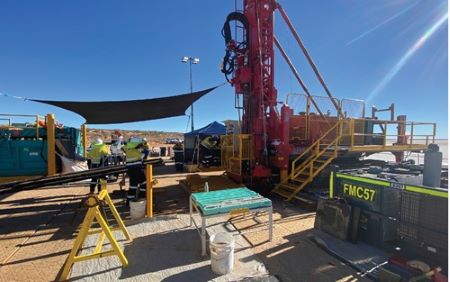
Drilling at the Murdie project.
The project
Argonaut holds two highly prospective South Australian exploration licences that cover 1,015 square kilometres and are contiguous with the company’s Torrens Project.
The Murdie exploration licences cover two large-scale, regional gravity anomalies – West Lake Torrens and Murdie - and these anomalies represent large volumes of high-density rock that could contain economic IOCG deposits.
Drilling targets
Efforts are focusing on the West Lake Torrens anomaly where seven drilling targets have been identified.
These targets are near the shoreline of Lake Torrens and the company plans to drill test Smith Dam 1 and Smith Dam 2 first.
Through its 2021 drilling program, the company is targeting ‘residual’ gravity anomalies within the wider West Lake Torrens anomaly.
A volume of high-density rock causes a measurably higher gravitational pull at surface and this manifests as a gravity anomaly.
Therefore, mineral explorers can use gravity surveys as a means to define gravity anomalies and potentially discover dense ore bodies.
IOCG ore bodies contain high concentrations of iron and copper minerals making them particularly dense.