
Southern Gold Ltd (ASX:SAU) (FRA:UH4) has advanced the Deokon Project in South Korea along strike of mineralised zones, which has resulted in the discovery of the Thistle and Nettle zones and the extension of the Golden Surprise trend to a strike length of at least one kilometre.
A soil sampling grid over the trend has revealed a strong gold-silver-arsenic anomaly at Nettle, which potentially indicates the presence of an intersecting structural position of the north-northwest Golden Surprise trend with a north northeast trend.
The best result was 1.77 metres at 0.99 g/t gold and 73 g/t silver, with low-grade mineralisation occurring over wide (up to 5 metres) intervals.
This is highly encouraging, given that it is interpreted to be high in the epithermal system, based on the chalcedonic vein textures and argillic alteration assemblage.
"Very exciting" greenfields play
Managing director Simon Mitchell said: “Southern Gold takes the approach of high-quality, effective drilling programs.
“If the initial scout drilling does not reveal the right textures or potential for epithermal mineralisation, then the focus and energy will move onto other areas or Projects.
“Therefore, each project in South Korea can be thought of as a ‘prospect’ in an Australian exploration context.
“Southern Gold continually evaluates and ranks each target in the portfolio based on new work and results and is agile enough in-country to work on multiple exploration programs (surface, soils, drilling) in multiple areas at the same time or one after another.
“We have persevered with the Golden Surprise trend at Deokon as we are uncovering widespread gold and silver mineralisation on surface, both in rocks and soils, on kilometre scale.”
Mitchell added that Southern Gold is looking forward to drilling the Nettle zone to see if they have the right structure and lithological trap that will give them a chance of discovering an economic deposit.
He added: “Our greenfields play in South Korea remains a very exciting one.”
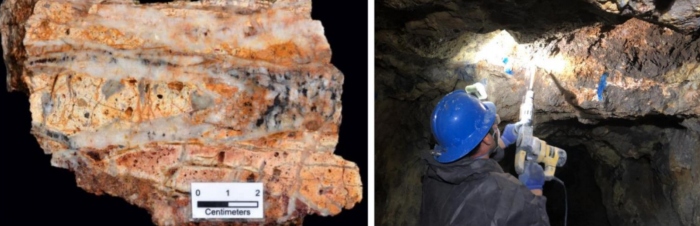
Rock sampling, slabbing and analysis as well as underground sampling
In addition, a series of four-channel saw lines using a hand-held brick saw were taken across the outcrop at the Nettle Zone, where a previous outcrop rock chip sample returned 8.56 g/t gold and 8,940 g/t silver.
Drill testing is planned straight away once regulatory approvals are gained, likely in late April.
Channel saw samples were taken across the Nettle outcrop. DKCH_001 to 004 were taken perpendicularly across hydraulically brecciated, quartz ±sulphide veined and silica-illite-adularia-pyrite altered rhyolitic tuff outcrop.
The outcrop is about 9 x 9 metres in dimensions, where veining within the structural zone exposed is sheeted and of moderate to low vein density.
Minor amounts of carbonaceous volcanogenic sediments are apparent, and it is interpreted that the outcrop is near the contact of the overlying felsic tuff and the underlying volcanogenic sediments.
Previous field activities
Deokon, which has been a growth project since the initial tenements were granted in 2018, represents a typical ‘case-study’ methodology into how a South Korean Project can evolve.
Southern Gold was initially drawn to the area based on historical mine workings, high silver grades and the prospective geological location, coupled with what was noted in the historical data compilation and analysis.
Initial reconnaissance sampling was then completed, which verified the prospectivity of the area.
Petrologic studies of surface rock chips from the Golden Surprise Trend were also undertaken.
This defined mineralisation in paragenetic association with low-sulphidation, epithermal style alteration of proximal acid pyroclastic or diatreme-like rocks, with a higher arsenic and lower lead trend in whole-rock geochemistry and mineralogy possibly defining a more distal hydrothermal out-flow/up-flow in the northern Thorn Zone relative to the Bonanza Zone in the south.