
Theta Gold Mines Ltd's (ASX:TGM) maiden underground pre-feasibility study (PFS) for the TGME Underground Project in South Africa shows that the extensive flat high-grade narrow reef systems of East Transvaal Goldfield can be mined economically.
The company's chairman Bill Guy said that the PFS demonstrated that the use of modern mechanised mining and metallurgy could deliver strong project economics.
This maiden PFS covers the Beta, Frankfort and CDM underground (UG) mines, which form part of the Central Northern area and are collectively referred to as TGME Underground Project.
The TGME Phase 1 Underground Project, which excludes the open pits, has compelling financials based on a forecast gold price average of US$1,570/ounce and a ZAR/USD exchange rate of 15.9. These include:
- Pay-back period from first gold 13 months;
- Pay-back period from start of mining 22 months;
- 419,000 ounces gold delivered to plant over initial Life of Mine (7.67 years);
- By the third year, production over 60,000 ounces gold/year (recovered);
- US$241.2 million EBITDA over LoM;
- Internal Rate of Return (IRR) 82%;
- US$91.2 million Net Present Value (NPV); and
- US$905/ounce gold all-in sustaining cost (AISC) over LoM, bottom quartile for South Africa producers.
It estimates total LoM capital expenditure of US$79 million including:
- Peak capex for first three years of US$37 million (oxide and backfill plant and beta mine development);
- Year 4 of US$27 million sulphide circuit and Frankfort and CDM mine development; and
- US$15 million of remaining capital to develop and sustain operations.
“Economical mining clearly demonstrated”
The PFS shows that the narrow high-grade reef system can be mined with modern mechanised mining techniques (safer, increased productivity and minimum dilution), and that the gold can be recovered utilising modern metallurgical technologies (Ultrafine grinding and Intense CIL).
This proof of concept is part of de-risking the underground projects.
Chairman Bill Guy said: “Now that the company has generated a PFS for the TGME Underground Project, we can optimise our development strategy based on confident numbers.”
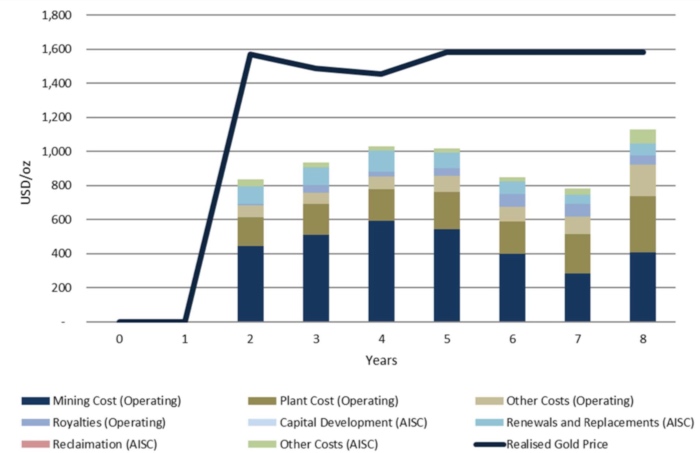
ASIC cost on yearly basis for TGME Underground Project.
Process plant operations
The UG plant will be able to accommodate a variety of ore sources incorporating different streams that require different treatment solutions while sharing front-end (crushing) and back-end (CIL, elution, gold room, tailings) infrastructure.
It will also be further expandable with modular additions and the CIL section will also be shared with the 50kt/m Theta Open Pit plant (oxide ore plant).
The existing process plant will be upgraded and refurbished to treat ore from Beta and will follow a conventional Carbon-in-Leach (CIL) configuration at a rate up to 30ktp/m.
Frankfort ore will be concentrated via Dense Media Separation (DMS) at the shaft and only the concentrate will be trucked to the process plant – the ore from CDM mines will also follow the same process route.
The DMS will process up to 15,000tp/m and discards will be stockpiled at the shaft.
The existing tailings facility will be re-commissioned for the first phase, while for subsequent phases the CIL Tailings will be pumped into the mined-out workings of the Beta mine adjacent to the process plant as backfill.
Potential upgrading of mined ore from Beta and CDM via XRT or DMS is under investigation and not factored in but it could potentially further increase gold production.
Bottom quartile of costs
Guy said: “At a 63% conversion ratio, Theta Gold still has 3.5 million ounces of gold in underground resources to develop in order to extend LoM and increase production into the future.
“Due to the shallow, high grade and on-reef development characteristics of the ore, our AISC of US$905 per ounce of gold sits in the bottom quartile of costs for South Africa.
“At a forecasted average US$1,570 gold price, EBITA is US$241 million from revenue of US$545 million and the NPV is US$91 million; all based on a very small proportion of the overall project area.
“The capex is modest and staged and production peaks at 70,000 ounces gold per annum.
“This PFS clearly demonstrates very strong project economics for the underground mines.
“In real terms, we have only completed the study on 16% of the total of 4.5 million ounces of gold in the underground mineral resource.”
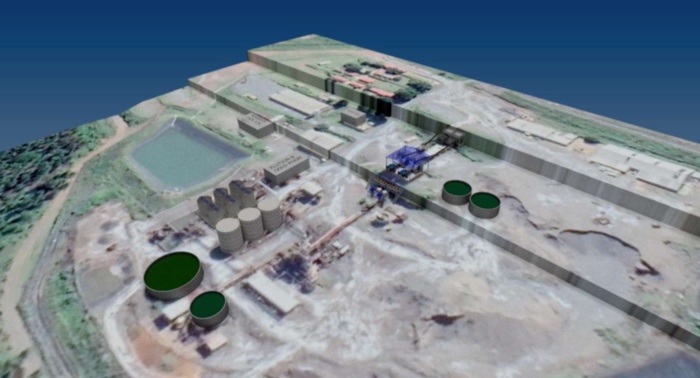
3D view of refurbished process plant superimposed on current plant footprint.
Resource growth potential
The maiden underground PFS is based on only 16% of the 4.5 million ounce gold underground gold resource and incorporates only three mines out of a total 43 historical mines across the project area.
This initial study focused on the easy access of 684,000 ounces of gold in the measured and indicated categories of the TGME underground resource for the Beta, Frankfort and CDM areas.
A further 3.5 million ounces gold of inferred resources is available to be upgraded to the measured and indicated resource category and potentially a portion could be converted into mining reserves.
Rietfontein PFS in Q3
Previously the company announced a five-year plan, which targets four mine developments - Theta open-pit Starter Project (MR83 only), Theta open pit extension (MR341) and the Rietfontein and Beta underground mines.
This four-mine strategy provided the company with a clear growth plan with a combined open pit and underground resource of over 2.75 million ounces.
The company will continue to build up its mining reserves during the year by progressing Rietfontein and other mines through to PFS level, while concluding detailed designs for the Phase 1 UG Project.
Guy said: “The team will complete the Rietfontein PFS in quarter three of this year.
“The mining reserve from Rietfontein can then be brought into the updated PFS to further increase the production profile."
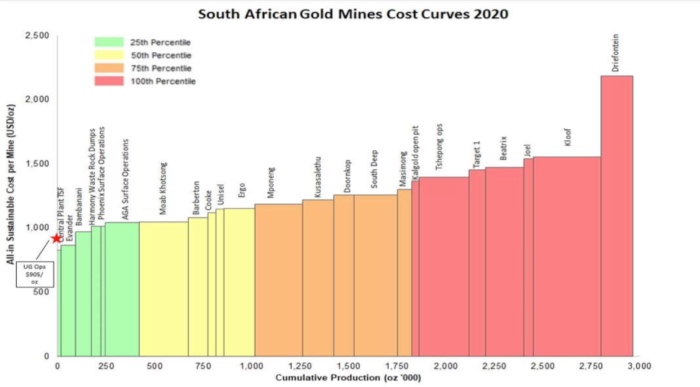
The AISC costs for the UG PFS continue to reflect a project that is at the bottom quartile when compared to South African peer mines.
Key player in South Africa
Guy added: “At Theta Gold, the resource pipeline into the future is strong, and the scale of the potential resources and the geology in South Africa should not be underestimated.
“The company will soon be a key player in the South African mining industry, a sector that has produced more tonnes of gold than any other country when measuring gold bullion tonnage.
“Over 40% of the world’s gold has come from the small corner of South Africa that we call home.”