
OAR Resources Ltd’s (ASX:OAR) (FRA:F1S) results from maiden aircore drilling at its 100%-owned Gibraltar Halloysite Project on the Eyre Peninsula of South Australia, confirm the presence of kaolinite in all holes sampled and high-value halloysite in 24 of the 59 holes drilled.
Gibraltar is adjacent to Andromeda Metals Ltd’s (ASX:ADN) kaolin-halloysite projects that have seen that company attract considerable global attention in the last 12 months.
The high proportion of halloysite samples give the company encouragement that it can improve on this very exciting initial discovery, given the location of the Gibraltar exploration tenement proximate to other known halloysite mineralisation in the area.
Shares were up as much as 48% to 3.2 cents, approaching the 12-month high of 3.3 cents, with more than 269 million changing hands.
Aggressive follow-up
OAR believes it has identified a high-grade halloysite zone at which further drilling could improve the resource potential of this discovery. The company’s major focus is on the halloysite and determining the size of the halloysite deposit.
Approval to extend drilling to the north has been received from the South Australia Department of Energy and Mining, with additional work programs to infill and extend drilling to the south, east and west submitted, pending approvals.
An aggressive follow-up drill campaign is being planning and is anticipated to begin next month, aimed at expanding the footprint of this emerging deposit.
‘Extremely pleasing’ results
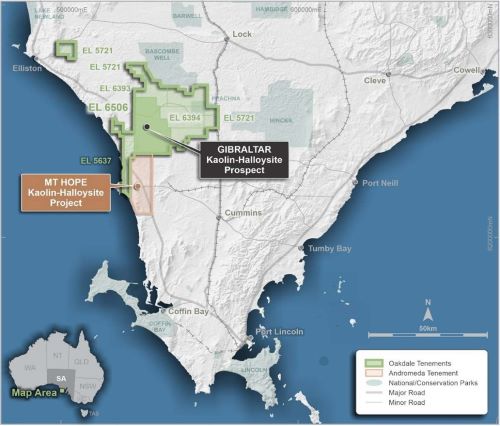
Location of the Gibraltar project on South Australia's Eyre Peninsula.
OAR Resources general manager of exploration Tony Greenaway said: “These results from the maiden aircore drilling program at our Gibraltar Project are extremely pleasing, having confirmed the presence of the high-value halloysite mineral within the kaolinitic saprolite.
“Our test-work results are showing multiple pods within the kaolinite, where halloysite is present.
“Our highest-grade result of 20% halloysite occurred in the last hole of a line of drilling, with no drilling to the west or south, leaving this high-grade pod completely open in those directions.”
New drilling to be fast-tracked
He said: “This drilling program was undertaken on the basis of a single comment noting halloysite in a historic report; the fact that we now have halloysite confirmed in 24 of the 59 holes drilled is an excellent result and gives the company a high degree of confidence in the potential of the Gibraltar Project.
“We will now look to extend out drilling to the north, southeast and west over the coming months.
“This new drilling campaign will be fast-tracked to allow OAR to move into resource definition as quickly as possible.”
High-grade results
Results include up to 20% halloysite at the end of one line, with results remaining open in all directions.
Best results include:
- 3 metres at 19.6% halloysite, 42.4% kaolinite from 26 metres;
- 1-metre at 12.6% halloysite, 28.7% kaolinite from 23 metres;
- 3 metres at 10.1% halloysite, 45.9% kaolinite from 11 metres;
- 13 metres at 5.3% halloysite, 80.9% kaolinite from 13 metres; and
- 12 metres at 4.8% halloysite, 77.4% kaolinite from 30 metres.
Detailed X-Ray Diffraction (XRD) and Scanning Electron Microscope (SEM) analysis of clay particles has shown high-grade halloysite, with grades up to 20% in one drill hole located at the end of a line of drilling, with no drilling to the west or south of this high-grade intersection.
An additional high-grade halloysite (more than 10%) zone has been identified in the last hole of a ‘scout’ line of drilling about two kilometres to the south, where additional drilling will also be concentrated.
Fully funded for next drilling
Having recently received final approvals from the South Australian Department of Energy and Mining, the company now intends to begin an aggressive second drill campaign to extend the halloysite zone with sufficient results to be able to advance to a maiden resource calculation for the project.
The company is fully funded to complete this next phase drilling and with a suitable drilling contractor already identified, drilling is anticipated to commence in March 2021.
Dominant land position
The current area of drilling covers an area of just five square kilometres of the total 317 square kilometres area of the Gibraltar Project tenement EL6505, which provides the company with the dominant land position in the region.
Logging of drill cuttings showed the development of a consistent layer of kaolinitic saprolite in the northern area, with several deeply incised channels containing lignite clays encountered on the scout lines to the south.
Test-work has confirmed strong kaolin development within the saprolite with over 85% kaolin detected in a number of samples.
Results from the XRD and SEM analysis for the high-value halloysite mineral has highlighted specific ‘pods’ where halloysite has developed within the kaolinite material, with these pods remaining open in all directions.
Halloysite priority
Halloysite is a rare derivative of kaolinite that commands a significantly higher contract price in industrial applications.
The company will, therefore, focus its efforts on determining the halloysite mineralisation component as a priority over the kaolinite found at Gibraltar.
Halloysite has potential in multiple applications which include controlled release drug delivery, carbon capture, premium medical grade ceramics and given its purity, an excellent feedstock for High Purity Alumina (HPA) production which fetches between US$5,000 per tonne (3N 99.9% aluminium oxide) and US$30,000 per tonne (4N 99.99% aluminium oxide) used in smartphone screens and has a projected compound annual growth rate of around 29.9%.