
Matador Mining Ltd’s (ASX:MZZ) exploration drilling has resulted in the discovery of four new high-grade gold zones at its 100%-owned Cape Ray Gold Project in Newfoundland, Canada.
The intersection of higher gold grades over greater widths than anticipated within the existing mineral resource area demonstrates the upside potential of the resource.
Further, the final results from the recent Angus greenfield exploration discovery have extended the mineralisation footprint, with assay results for samples for 14 drill holes (1,660 metres) expected this quarter.
Upside potential
Matador Mining executive chairman Ian Murray said: “The majority of drilling completed so far at Window Glass Hill, our second largest deposit (232,000 ounces) has been to a maximum depth of only 120 vertical metres.
“Drill-hole CRD151 was drilled in our recent field season to test the depth potential below the existing mineral resource.
“To be able to report multiple zones of high-grade mineralisation, including a new zone below the existing mineral resource, is very exciting.
“The intersection of higher gold grades over greater widths than anticipated within the existing mineral resource area in three mineralised horizons demonstrates the upside potential of this important resource.
“Both factors are expected to add to the mineral inventory and improve the quality of the Cape Ray Project.
Angus discovery
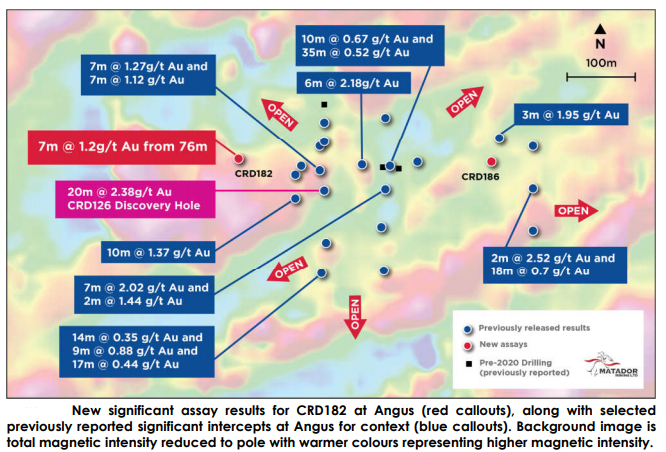
“Additionally, we received the final results from our new greenfield discovery, Angus.
“The footprint of this deposit has now expanded to 450 by 300 metres and remains open in all directions.
"With all 2020 results now received for Angus, including the majority of the multi-element geochemistry, our team can commence the detailed analysis and geological interpretation of this discovery which will underpin our 2021 exploration strategy for Angus, as well as other greenfield targets in our vast, but under-explored tenement holding.”
Window Glass Hill drill hole
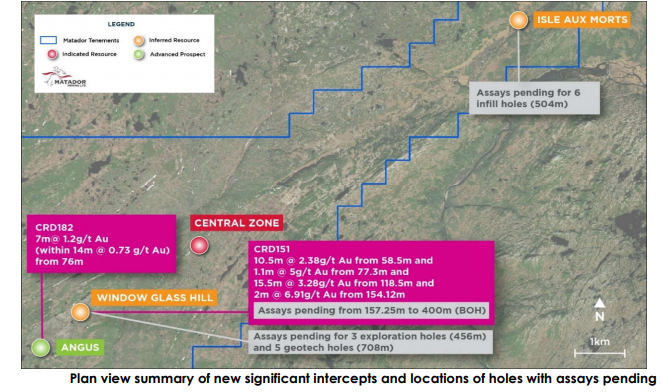
CRD151 is the second of two deep angled holes drilled through the WGH mineral resource in 2020 and it intersected four significant mineralised intervals within the top 157 metres with important implications for the potential of the WGH mineral system.
The deepest gold intersection, 2 metres at 6.91 g/t from 154.12 metres, represents a new (deeper) mineralised horizon about 15 metres below the existing WGH mineral resource, opening up a new target area to be tested through 2021.
A wide high-grade intersection of 7.08 metres at 6.93 g/t including 3 metres at 14.11 g/t, within 15.5 metres at 3.28 g/t from 118.5 metres, occurs within the existing mineral resource wireframes.
However, this intersection exhibits materially higher grade and greater width than mineralisation in surrounding holes.
Similarly, the intersection of 10.5 metres at 2.38 g/t from 58.5 metres, including 1-metre at 10.58 g/t, exhibits higher grade than surrounding historic holes used in the 2020 mineral resource estimate and about 6 metres of this intercept is outside existing mineral resource wireframes.
Angus greenfields drill results
Significant intercepts at the Angus greenfields exploration site include 7 metres at 1.2 g/t including 1-metre at 4.65 g/t, within14 metres at 0.73 g/t from 76 metres.
Gold mineralisation at Angus is still open in all directions, including at depth.
All 2020 drill holes intersected highly altered rocks identical to the alteration in the strongly mineralised holes, indicating that the company has not yet defined the outer extent of the alteration halo that led to the Angus discovery hole.
Importantly, strong demagnetisation features (thought to be associated with structurally-controlled areas of sericite-kaolinite alteration correlated to gold) remain to be tested northwest, southwest and northeast of existing mineralised intercepts at Angus.