
Blue Star Helium Ltd (ASX:BNL) (OTCMKTS:AZZEF) welcomes the independent prospective resource evaluation by Sproule Incorporated for the Galactica, Pegasus and Argo prospects which lie within a proven helium play fairway in Colorado, USA.
The assessment has added a total P50 unrisked prospective helium resource of 6.1 BCF across the newly assessed prospects, with the historic wells at Galactica and Pegasus having interpreted gas shows.
This has increased the company’s total P50 prospective helium resource 175% to 9.6 billion cubic feet (BCF) across five assessed prospects in the Las Animas portfolio.
“Almost triples the total resource”
Blue Star managing director Joanne Kendrick said: “This resource assessment is an outstanding result for Blue Star, which brings our total P50 resource to 9.6 BCF net recoverable helium from the five prospects we have had assessed in the Las Animas portfolio.
“This almost triples our total resource which, together with the interpretation of gas columns at two historic wells within the Galactica and Pegasus prospects, is hugely supportive of our planned drilling program.
“We will continue to secure additional acreage within the prospect areas and look forward to the issue of the recent leases won at the December 2020 Bureau of Land Management auction at which stage we will be updating the prospective resource across these prospects.”
The Federal acreage won at the December 2020 auction is not included in this resource evaluation and an evaluation of prospective resource associated with that acreage will not be published until those leases are issued to Blue Star.
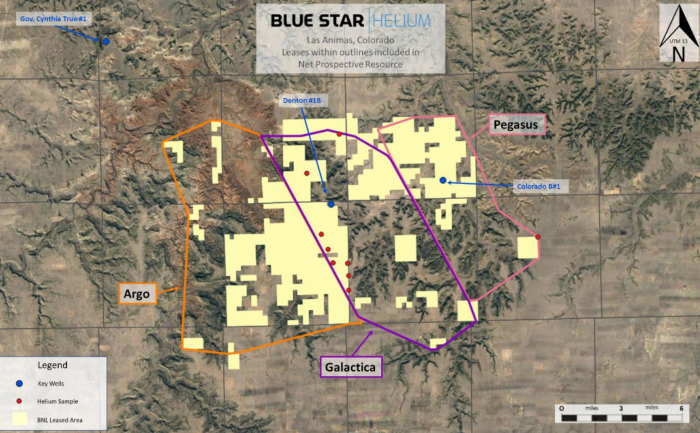
Galactica, Pegasus and Argo net prospective resource leasing.
Helium charge
The play elements of helium charge, high-quality reservoir and the presence of a good top seal have been proven to extend across the Argo, Pegasus and Galactica prospects.
Helium charge is regionally proven as demonstrated by the Model Dome field analogue with the gas analysis for eight wells in the Model Dome area showing an average of 8% helium content.
There are additional wells in the area that have helium tests which show that the helium source and migration routes are widespread such as the Govt Cynthia True #1 well which flow tested 8.8% helium, however, it lies under Federal protected lands like the historic Model Dome field and is not available for leasing.
This well is situated on an interpreted independent fault bounded structure on the northern nose of the greater structure on which the Galactica and Pegasus prospects are also located - around 12 miles away.
Notably, helium soil gas survey analyses across the region performed by Blue Star also support the presence of widespread helium source and migration (charge).
Reservoir presence
Petrophysical analysis commissioned by the company of wells associated with and surrounding the Argo, Pegasus and Galactica prospects has confirmed the presence and reservoir quality of the Lyons Formation sandstone to be consistent and as good as seen at the Model Dome analogue.
The analogue Model Dome Field contained the Hoff Heirs #2 well which had a tested production rate from the Lyons Formation of 500 mcf raw gas per day and the Govt Cynthia True #1 well also flowed gas from the Lyons Formation.
Top seal presence
The top seal is confirmed at the Model Dome analogue and by the gas accumulation at the Govt Cynthia True #1 well.
Petrophysical analysis suggests that the top seal across the Argo, Pegasus and Galactica prospects is of good quality and generally improves regionally to the east of Model Dome across the prospects.
Development potential
Given the proven play elements and gas interpretation in key wells, the geological chance of success is assessed by the company to be moderate to high for an exploration target with Galactica and Pegasus having lower risk by way of having good well control with petrophysical analysis and interpreted gas columns.
The company believes that, based on the work it has done to date, the chance of development, upon a discovery, is strong.
Modular, skid-mounted processing units located proximal to any discovery would concentrate the raw gas stream to around 98%+ gaseous helium, which could then be loaded at site onto an offtaker’s tube trailer for transport to a liquefaction plant or end-user.
Forward work program
The company is planning an initial three to five well drilling campaign to maximise the prospective resources being tested.
Engineering estimates have confirmed the expected dry hole cost at circa US$300,000.
Should the first well on any prospect discover helium, Blue Star intends to conduct a log evaluation and well testing program.
If commercial production rates of helium are indicated during the well testing, that well may be completed as a producer, in which case completion costs have been estimated at US$100,000 (in addition to the dry hole cost).