
Kin Mining NL (ASX:KIN) (FRA:8KM) has further enhanced the exploration potential of its 100%-owned Cardinia Gold Project near Leonora in Western Australia after receiving and interpreting the results of a detailed gravity survey completed in December 2020 over the eastern part of the project tenements.
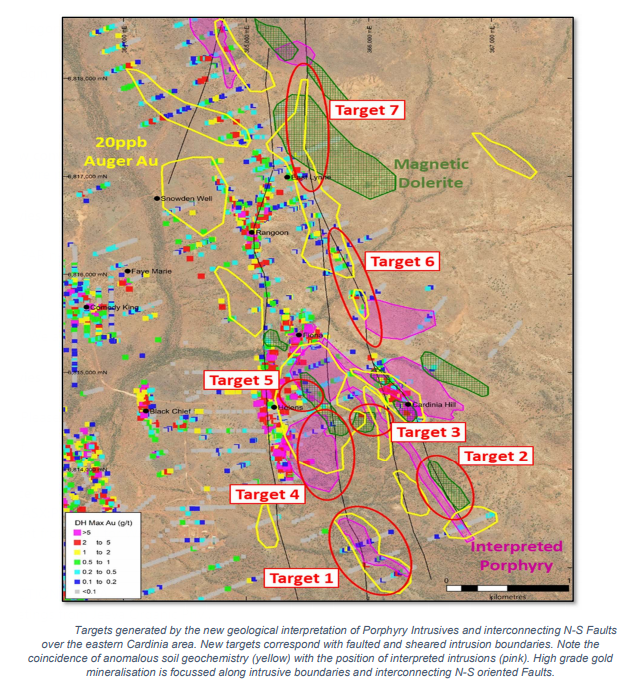
Interpretation of the results has revealed up to seven new priority target areas along the Eastern Corridor where Kin Mining believes there is excellent potential to discover new zones of high-grade mineralisation.
These targets will be systematically tested as part of the 2021 Phase 4 drilling program.
An expanded gravity survey will also be undertaken over the western side of the Cardinia Gold Project and over the East Lynne, Collymore and Hobby prospects to the north.
Primary control of mineralisations
Kin Mining managing director Andrew Munckton said: “The gravity survey results from the eastern part of the Cardinia Gold Project have revealed a number of intrusions that we believe are critical geological features in controlling the locations of the high-grade gold mineralisation intersected in RC and diamond drilling at key locations drilled during Phase 3 exploration programs last year.”
"A series of important deposits sit around the perimeter of the low gravity bodies that are present between Helens and Cardinia Hill.
“Deposits here have significant depth extent (up to 200 metres vertical in the case of Helens) and strong intersections at depth, and we, therefore, believe that these intrusions and the faults and shear zones generated by them are a primary control of mineralisation at Cardinia.”
Compelling exploration target
Munckton said: “The survey has also highlighted extensions of the north-south oriented Faults both south of Helens and Cardinia Hill and north through Rangoon to East Lynne.
“This structural architecture of intrusions and faults therefore represents a compelling exploration target for high-grade gold mineralisation to be followed up in 2021, with up to seven priority target areas identified.
“The company has for some time been looking at the closest geological analogy for the Cardinia mineralisation, with its distinctive multi-element signature and broad alteration zones in felsic and mafic rocks.
“The discovery and confirmation of a number of porphyry intrusions and north-south oriented faults as the primary controls of mineralisation have confirmed for our geological team that the Carosue Dam Project is the best analogy for Cardinia.
“Carosue Dam is located approximately 160 kilometres so the south-east along the Keith-Kilkenny Shear and consists of a series of deposits located along north-south oriented faults activated by the intrusion of felsic to mafic porphyries.
“In addition, the Carosue Dam mineralisation also contains a distinctive set of alteration and mineralisation indicators very similar to Cardinia."
Carosue Dam is located in felsic-dominated rocks adjacent to the Keith-Kilkenny shear zone that displays similar geology, alteration and mineralisation indicators to those tested at Cardinia during 2020 in the Phase 3 exploration program.
Major mineralised gold camp
Munckton said: “The high-grade results delivered from the recent Bruno-Lewis drilling campaign provide further evidence that the Cardinia area is a major mineralised gold camp, similar in scale and style to other multi-million-ounce gold camps along the Keith-Kilkenny Shear Zone that have supported other gold operations for many years.
“We have also received the final batch of assays from the Phase 3 drilling program, with a number of significant results reported in this announcement from Pelsart, Helens East and Cardinia Hill.
Mineral resource updates this quarter
Munckton said: “That paves the way for us to further update the mineral resource for several key deposits this quarter, building further on the project-wide resource update announced just prior to Christmas. Importantly, it also clears the way for us to resume drilling with our Phase 4 program scheduled to get underway in the near future.”
Drill results
Its final assay results from the Phase 3 program, include shallow high-grade mineralisation at Pelsart, positive results from deeper drilling at Cardinia Hill and results from diamond drilling at Helens East.
The Phase 3 program consisted of about 48,000 metres of drilling at Cardinia over a number of prospects, mostly on the eastern side of the project, including historical prospects at Helens, Comedy King, East Lynne and Hobby and the new discoveries at Cardinia Hill Helens East and Collymore.
Final assay results from the Phase 3, 2020 drilling program, include:
➢ Shallow high-grade mineralisation intersected at Pelsart:
- 12 metres at 1.75 g/t gold from 99 metres; and
- 2 metres at 2.17 g/t from 13 metres
➢ Deeper drilling at Cardinia Hill intersects the mineralised structure 200 metres below surface:
- 3.6 metres at 1.18 g/t from 224.2 metres;
- 4.3 metres at 1.75 g/t from 213.05 metres;
➢ A diamond drill hole at Helens East returned:
- 5.2 metres at 1.15 g/t from 79.8 metres.