
Azure Minerals Limited (ASX:AZS) has observed nickel and copper sulphide mineralisation in each of the first three diamond core holes drilled at the VC-23 target on the Andover Nickel-Copper Project, which is 60% owned by the company.
The first of the high priority targets to be tested in the regional diamond drilling program is VC-23, which comprises several discrete conductor plates identified by both FLTEM and DHTEM surveying.
The VC-23 prospect was initially tested by the Creasy Group in 2018 with two reverse circulation (RC) drill holes, one of which intersected three zones of nickel-copper sulphide mineralisation associated with an EM conductor including:
- 2 metres at 2.10% nickel and 0.44% copper from 15 metres downhole;
- 6 metres at 0.45% nickel and 0.39% copper from 22 metres downhole: and
- 6 metres at 0.31% nickel and 0.55% copper from 34 metres downhole.
“Very exciting result for Azure”
Azure managing director Tony Rovira said: “This is a very exciting result for Azure and highlights the potential of Andover to host multiple nickel-copper sulphide deposits.
“EM surveying has identified numerous conductors indicative of bedrock-hosted sulphide mineralisation and, geologically, Andover does not appear to have any physical characteristics that may generate false positives.
“Importantly, wherever we have drilled an EM conductor at Andover we have intersected nickel-copper sulphide mineralisation and this 100% hit-rate has continued with the successful drilling of the new targets at VC-23.
“While most of our drilling in 2021 will be focused on delivering a JORC mineral resource for the VC07 conductor several other significant, high-priority conductor targets have been identified and drilling of these will be tested concurrently.”
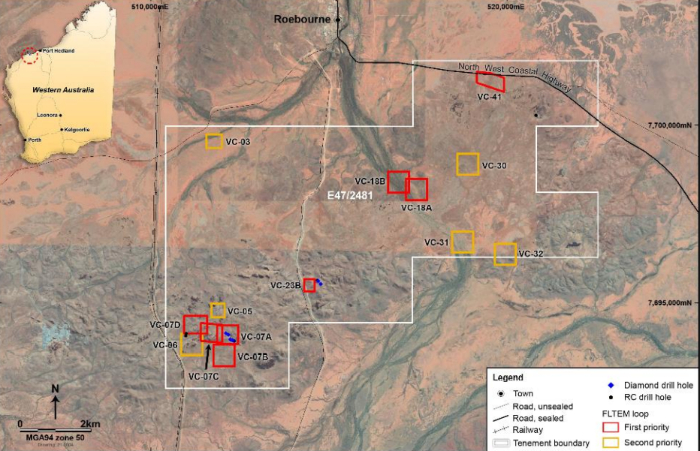
Andover nickel-copper project showing identified geophysical (FLTEM / DHTEM) targets
Drilling ongoing
Azure’s diamond drilling campaign on the VC-23 prospect is ongoing in three holes and is also progressing on the fourth hole.
All drill holes have been prepared for DHTEM geophysical surveys which will be completed as soon as practicable and will, in addition to detailed geological logging, enable geological interpretation of the mineralisation and provide a basis for targeting additional follow-up drilling.