
Sipa Resources Limited (ASX:SRI)(FRA:SPO) has received up to 2.9% lead in final assay results from reverse circulation (RC) drilling completed in October 2020 at its 100%-owned Wolfe Basin Project in the Kimberley region of Western Australia.
A total of nine holes for 1,545 metres tested targets adjacent to a previously unexplored, surface gossanous horizon with an associated IP chargeability response,.
Eight holes intercepted highly anomalous base metals over 250 metres down-dip from the surface gossan and nearby transfer fault.
Results included 1-metre at 2.9% lead from 144 metres downhole in WBC009, and 1-metre at 1.1% lead from 20 metres downhole in WBC009.
Strongly anomalous copper (max 0.45%) and zinc (max 0.38%) were also returned.
“Extensive base metal anomalism”
Mapping at the project has defined a prospective horizon more than 80 kilometres in length, with anomalous base metals observed in soil sampling for at least 20 kilometres, with the drill program testing only a small portion of this prospective strike.
Sipa managing director Pip Darvall said: “The results from our initial drill program at Wolfe Basin are very encouraging, with confirmation of the mineralisation model and extensive base metal anomalism identified across our initial target area.
“The widespread significant intercepts demonstrate that base metal rich fluids have circulated through the stratigraphy and exploration efforts will now focus on identifying additional areas where fluid flow has been focused, and there is the potential for significant accumulations of sulphides.”
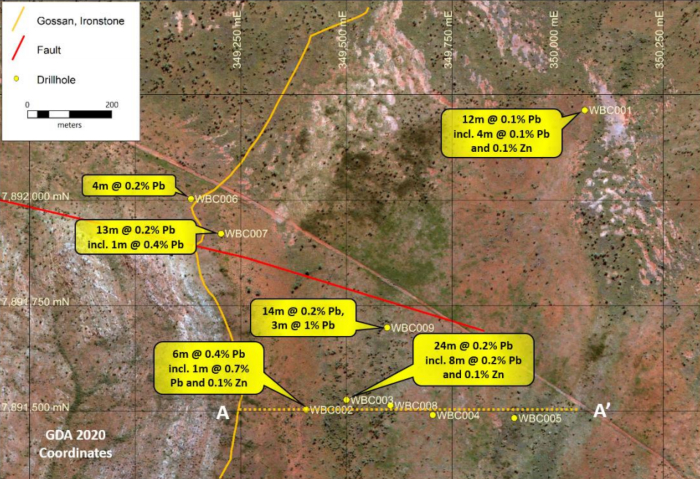
Wolfe Basin plan showing the collar locations of completed RC drill holes and selected intercepts.
Further targeting planned
Mineralisation was identified in several horizons, including at shallow depths, and remains open down dip and along strike in all directions.
Further targeting will be undertaken to determine potential locations for thicker and higher-grade accumulations of sulphides, and the best geophysical techniques to locate these prior to additional drill testing.