
Critical Resources Ltd (ASX:CRR, FRA:9S70) has completed more than a month of continuous cycling of a full-format laboratory pouch cell using its solvent-free Dry Supersonic Deposition (DSD) cathode technology, establishing an engineering baseline for the next phase of its solid-state battery development program.
The hand-assembled cell underwent around 780 hours of continuous electrochemical testing at a 0.2C charge-discharge rate, completing 65 cycles and retaining approximately 75% of its initial capacity.
Importantly, the characteristic lithium iron phosphate (LFP) voltage plateau remained present throughout all 65 cycles and coulombic efficiency stayed near 100% for most of the test, which Critical Resources said was consistent with the DSD cathode chemistry remaining electrochemically active throughout.
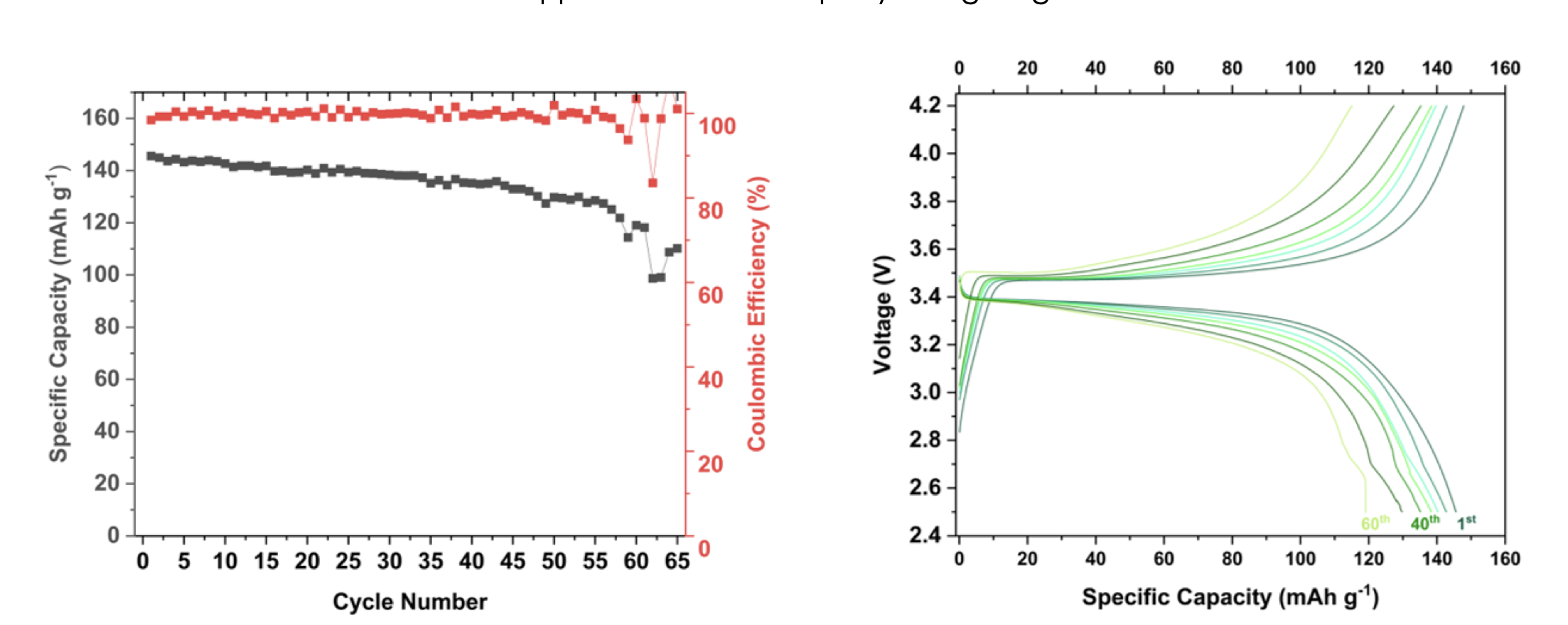
LEFT – Specific capacity (left axis, grey squares) and coulombic efficiency (right axis, red squares) of the DSD pouch cell across 65 cycles at 0.2C on a liquid-electrolyte baseline. RIGHT – Voltage against specific capacity at intervals across the test, from the 1st to the 60th cycle. The flat lithium iron phosphate plateau at 3.4–3.5 V is retained throughout; the widening separation between the charge and discharge curves with cycle number is polarisation.
Cathode remains active through extended testing
The cell combined a roughly 15-micrometre DSD-deposited LFP/LLZO cathode matrix with a conventional liquid reference electrolyte and lithium-metal anode.
The liquid electrolyte was deliberately used as a known baseline to isolate the performance of the DSD-manufactured cathode. Critical Resources stressed that its proprietary amorphous solid-state electrolyte (ASE) has not yet been integrated and that the current work remains at laboratory scale rather than commercial manufacturing.
Initial specific capacity was approximately 145 mAh/g before declining to around 110 mAh/g after 65 cycles.
Testing indicated that capacity fade was associated primarily with the unoptimised cell build and reference components rather than degradation of the DSD-deposited cathode.
Post-test inspection found heavy degradation of the lithium-metal anode while the cathode appeared stable and intact, although the company cautioned that this was a qualitative observation rather than a completed quantitative failure analysis.
The development program is being undertaken at the South Dakota School of Mines & Technology within the US National Science Foundation-supported Centre for Solid-State Electric Power Storage.
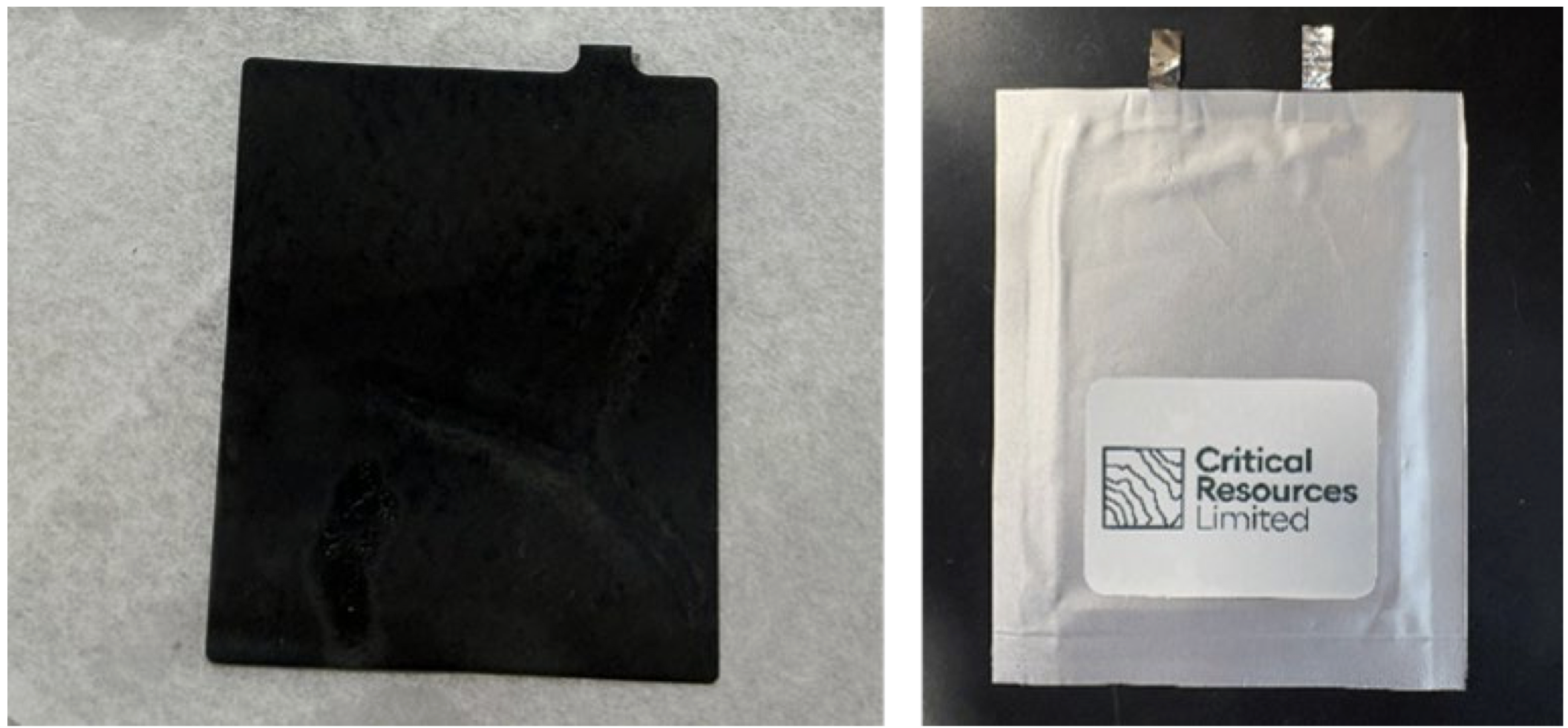
LEFT – Post-test inspection of the cell: the lithium-metal anode shows heavy degradation, consistent with reaction with the liquid electrolyte, while the DSD-deposited cathode appears stable and intact on visual inspection. RIGHT – The full-format test cell.
Engineering optimisation becomes next focus
Critical Resources will now focus on improving cell assembly, formation protocols and electrode-electrolyte interfaces, including measures to protect the lithium-metal anode.
It will also refine DSD deposition parameters, layer thickness and conductive-network loading, supported by Digital Twin modelling being undertaken with CSIRO at its Lab22 facility.
An optimised baseline cell is planned to undergo independent third-party electrochemical testing before the company moves to replace the liquid electrolyte with its proprietary ASE thin-film solid-state electrolyte.
Managing director Tim Wither said the extended test represented an important step in moving the technology from laboratory reference cells toward full-format cells.
“More than a month of continuous cycling in a full-format, hand-built laboratory cell, with the cathode chemistry active in every single cycle, is exactly the result this stage of the program needed.”
He also emphasised that the result did not represent a finished commercial cell, with optimisation and integration of the ASE electrolyte still required.