Cancer immunotherapy has reshaped the oncology landscape over the past decade, but the next phase of development is increasingly focused on finding new immune checkpoints that can extend the benefits of existing treatments to patients who either do not respond or eventually relapse.
That search is particularly relevant in difficult-to-treat blood cancers such as acute myeloid leukaemia (AML), where initial responses to treatment can be relatively high but durable outcomes remain challenging.
Around 20,000 people are diagnosed with AML each year in the United States, making it the most common form of leukaemia in adults. Standard intensive chemotherapy produces an initial response in roughly 60%-80% of patients, according to Percheron Therapeutics Ltd (ASX:PER, OTC:PERCF), but around half of those patients ultimately relapse. Five-year survival is estimated at between 10% and 35%, depending largely on the patient’s health at diagnosis.
Against that backdrop, Percheron is positioning its lead drug HMBD-002 as a potential new approach to stimulating the immune system against cancer, with the company preparing to move the therapy into a Vanderbilt Health-sponsored clinical study in AML.
Expanding the checkpoint inhibitor playbook
Immune checkpoint inhibitors work by removing signals that cancer cells use to suppress the body's immune response.
The best-known checkpoint drugs target proteins such as PD-1 and CTLA-4. Keytruda, Opdivo and Yervoy are among the therapies that have demonstrated how powerful this approach can be across multiple forms of cancer.
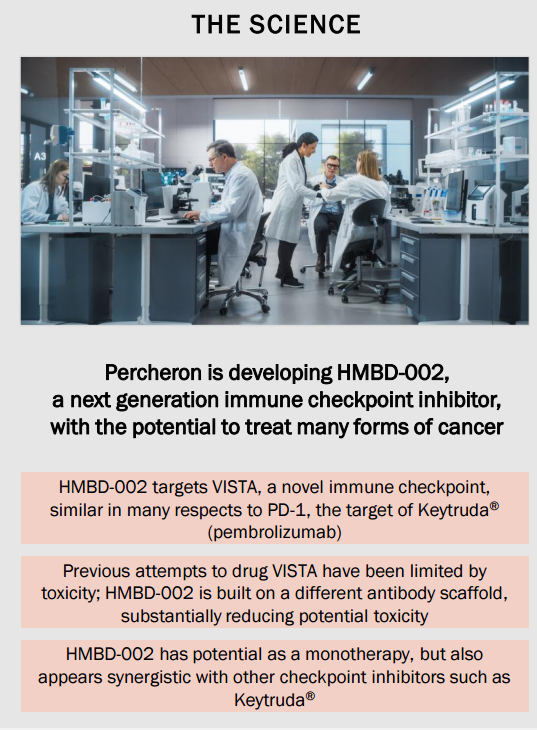
Percheron is targeting a different checkpoint known as VISTA.
The company says VISTA inhibition may be particularly interesting because it can help attract immune cells into the tumour microenvironment, potentially converting so-called “cold” tumours into “hot” tumours that are more visible to the immune system.
VISTA inhibition also appears to attract myeloid cells, which Percheron says are less susceptible to existing checkpoint inhibitors.
That mechanism gives HMBD-002 potential both as a standalone therapy and in combination with established treatments.
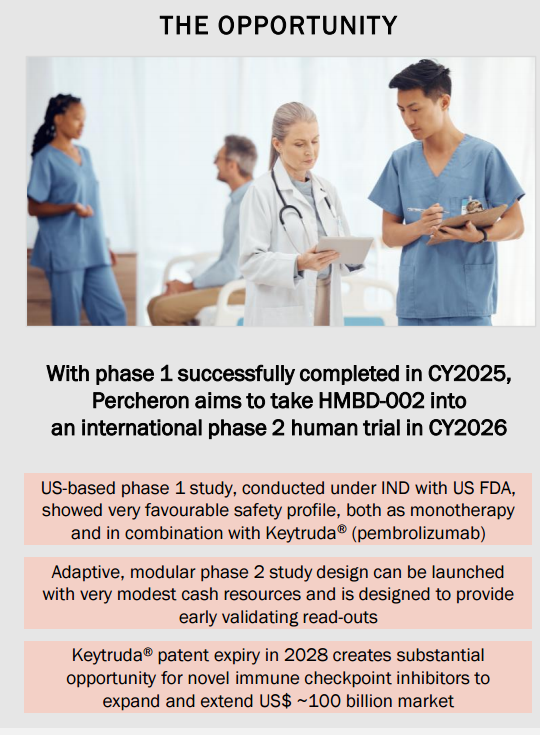
Percheron points to a broader commercial opportunity as well, with Keytruda’s patent expiry in 2028 potentially creating room for new checkpoint inhibitors and combinations within a market the company estimates at around US$100 billion.
Why VISTA could matter in AML
The decision to move HMBD-002 into AML is supported by emerging research around the role VISTA may play in the disease.
Percheron highlights preclinical work showing that VISTA is expressed at substantially higher levels on AML tumour cells than cells from healthy donors.
Higher VISTA expression has also been associated with worse survival in AML models, while treatment with an anti-VISTA antibody significantly slowed tumour growth in an animal model.
That creates a biological rationale for evaluating HMBD-002 in a disease where relapse remains a major unmet need.
HMBD-002 itself is designed differently from several other VISTA antibodies investigated previously.
Percheron describes the candidate as an IgG4 antibody, whereas many competing VISTA approaches have used IgG1 antibodies.
IgG1 antibodies can activate antibody-dependent cellular cytotoxicity, recruiting immune cells to destroy targets, but that mechanism can also contribute to toxicities including cytokine release syndrome.
HMBD-002 is intended instead to block VISTA signalling without necessarily destroying VISTA-positive cells, an approach Percheron believes could result in a more favourable safety profile. The company describes HMBD-002 as arguably the most advanced VISTA antibody currently in clinical development and likely the only active member of the IgG4 class.
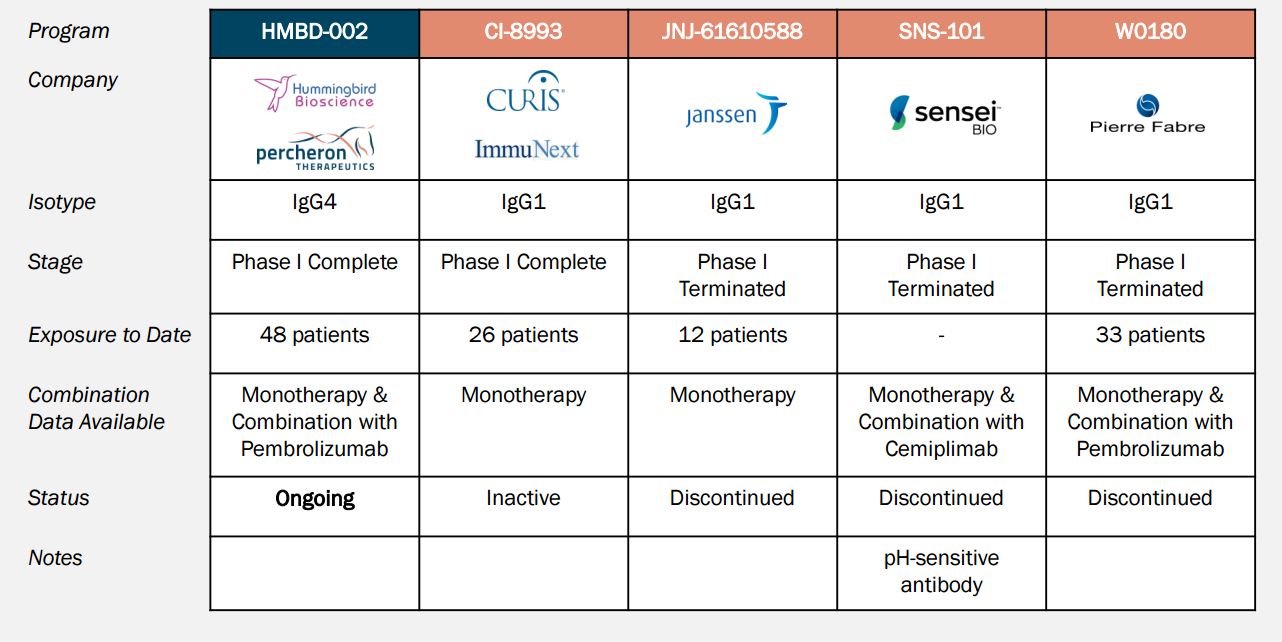
HMBD-002 is arguably the most advanced VISTA antibody in clinical development, and
likely the only active member of the IgG4 class.
Phase 1 provides platform for next study
HMBD-002 completed a US-based Phase 1 study conducted under a US Food and Drug Administration investigational new drug application in 2025.
The company says the study showed a favourable safety profile both as a monotherapy and when HMBD-002 was combined with pembrolizumab, the active ingredient in Keytruda.
Percheron is now moving the program into a multi-centre AML study to be conducted by Vanderbilt Health.
Importantly for a small biotechnology company, the trial is structured as an investigator-sponsored study. Percheron’s obligations are limited to providing a financial grant, study drug and advisory support rather than assuming the full cost and operational burden of running the trial itself.
Following a $2.3 million capital raise in August, the company says its commitments associated with the AML study are fully funded.
Vanderbilt trial designed for early signals
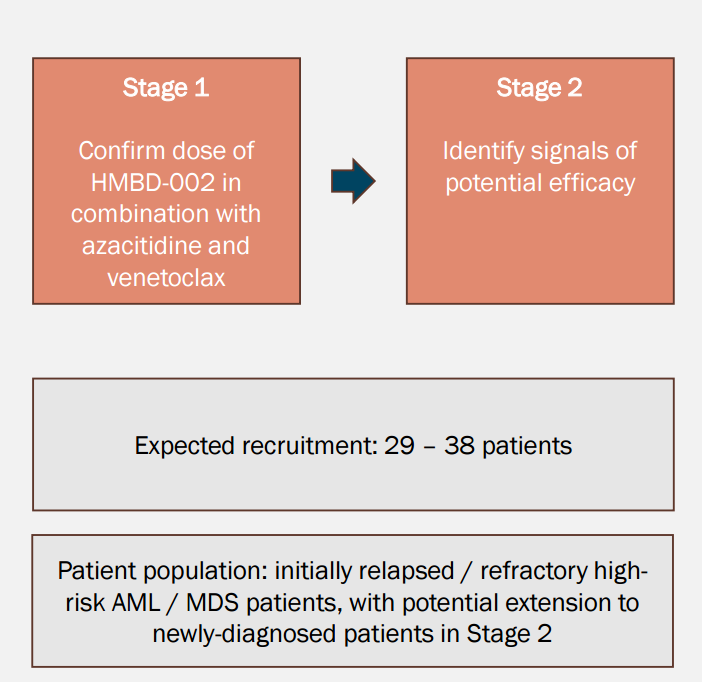
The proposed open-label study is expected to recruit between 29 and 38 patients and run in two stages.
Stage 1 will seek to confirm the dose of HMBD-002 when combined with azacitidine and venetoclax, two treatments already used in blood cancers.
Stage 2 is designed to identify potential efficacy signals.
Initially, recruitment is expected to focus on relapsed or refractory high-risk AML and myelodysplastic syndrome patients, with the potential to expand into newly diagnosed patients during the second stage.
The structure gives Percheron an opportunity to generate clinically meaningful information without immediately committing to a large, expensive late-stage development program.
Lean model preserves capital
Capital efficiency is an important part of the Percheron strategy.
At June 30, the company held A$4.05 million in cash and reported 3.9 quarters of funding based on its Appendix 4C, before the subsequent A$2.3 million placement.
The company describes its operating model as “ultra-lean”, with the majority of cash outlays directed toward research and development.
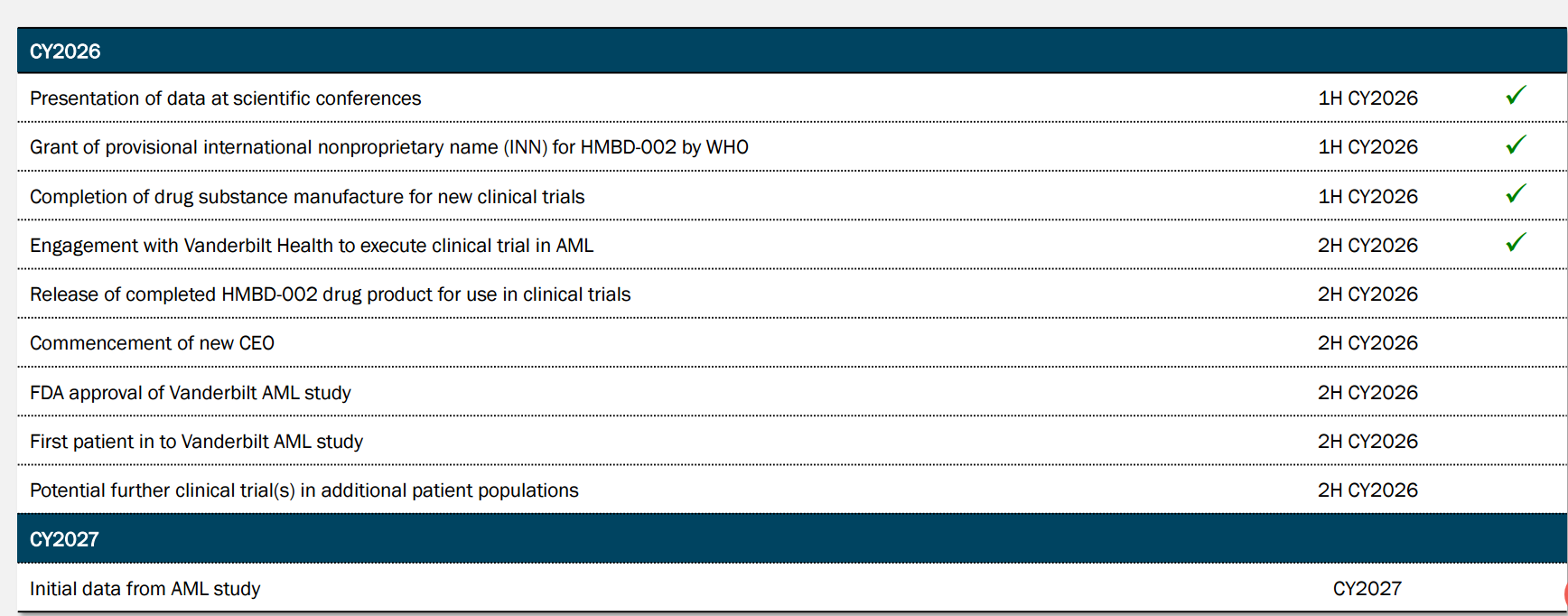
Manufacturing work is also progressing ahead of the new clinical program. Drug substance manufacture has been completed, with new clinical material expected to be available for shipment to trial sites during the second half of 2026.
At the same time, Percheron is preparing for a leadership transition. Dr Michael Baker will become chief executive officer and managing director on October 5, while outgoing CEO Dr James Garner will remain on the board as a non-executive director.
Next steps
The immediate catalysts are concentrated around getting the Vanderbilt AML study into the clinic.
Percheron expects to release completed HMBD-002 drug product for clinical use, see Baker commence as CEO, secure FDA approval for the Vanderbilt study and dose the first patient during the second half of 2026.
The company is also considering potential additional clinical trials in other patient populations.
Initial data from the AML study is targeted for 2027, although Percheron stresses that all development timelines remain indicative and subject to review.