
Australia’s emerging gas supply challenge is turning undeveloped northern resources from a long-term proposition into a matter of national energy planning.
The Australian Energy Market Operator expects declining production from southern fields to create supply risks from 2030 under most weather conditions, with new investment in gas, storage, and transport required to keep the east coast market adequately supplied. Greater access to northern Australian gas is one of the potential solutions identified by the market operator.
International demand adds another dimension. Shell expects global liquefied natural gas demand to rise by around 65% by 2050 to almost 700 million tonnes annually, driven in part by economic growth and energy security requirements across Asia.
Sitting between Australia’s tightening domestic market and the LNG facilities of Darwin is the Beetaloo Basin — and at the centre of its commercial development is Tamboran Resources Corporation (NYSE:TBN, ASX:TBN, OTC:TBNRL, FRA:O8R).
Tamboran is now approaching the point where the Beetaloo begins generating revenue rather than simply drilling data, with first gas sales from the Shenandoah South Pilot Project described as imminent in its latest site tour presentation.
Gas prices signal need for supply
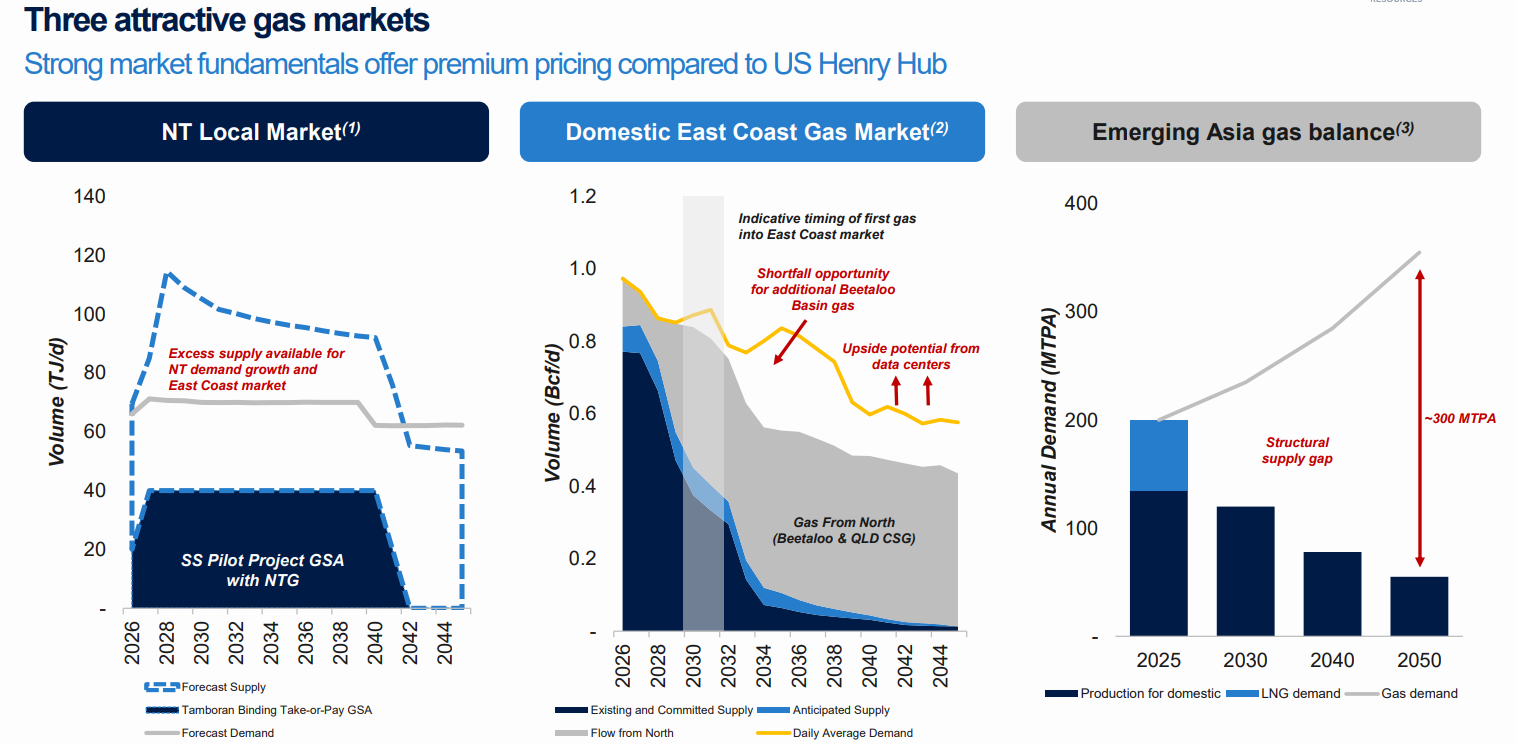
The east coast gas market is already offering a price signal for new development.
The Australian Competition and Consumer Commission analysis showing an average contracted east coast producer price of about US$9.20 per thousand cubic feet for gas supplied in 2027. That represented a premium of about 158% to the average Henry Hub price over the corresponding contracting period.
While near-term supply conditions have improved, the underlying problem remains the decline of established fields in southern Australia. Transporting gas from Queensland, importing LNG or developing new sources such as the Beetaloo all require substantial capital and long lead times.
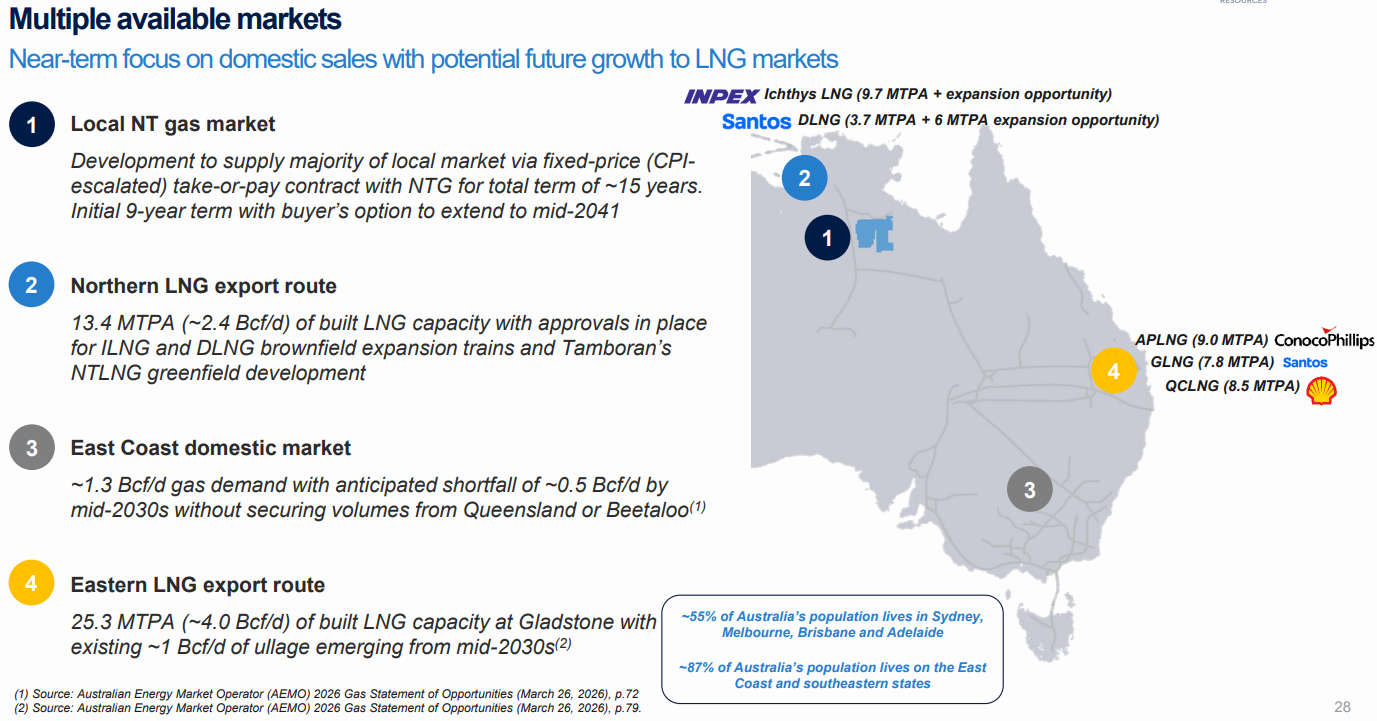
For Tamboran, that market backdrop creates three potential destinations for its gas: the Northern Territory, Australia’s east coast and, over the longer term, Asian LNG buyers.
The first of those markets is about to become operational.
First gas changes Tamboran’s profile
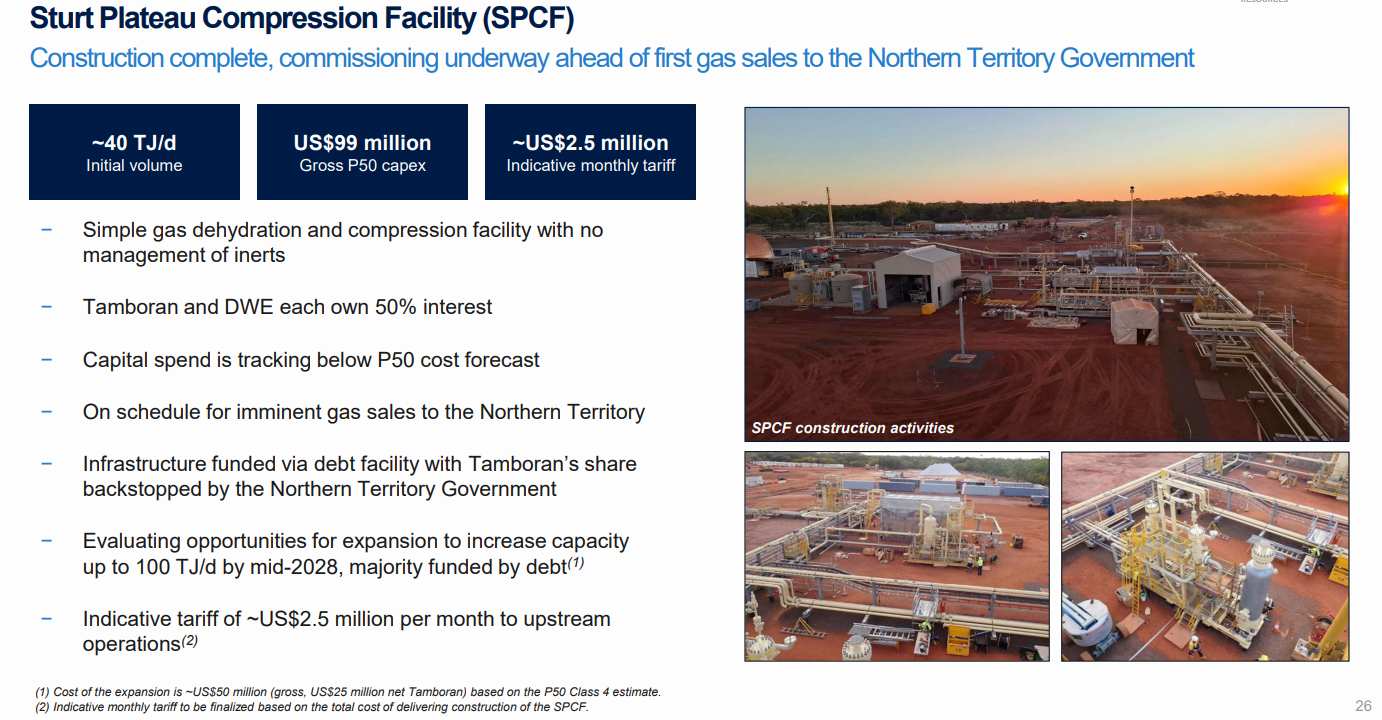
Tamboran has completed construction of the Sturt Plateau Compression Facility and is commissioning the plant ahead of initial sales to the Northern Territory Government.
The Shenandoah South Pilot Project is contracted to supply around 40 terajoules per day on a gross basis under a fixed-price, inflation-linked take-or-pay agreement. The contract has an initial nine-year term, with an option that could extend supply to mid-2041.
The compression facility carries a gross capital estimate of US$99 million, with Tamboran and Daly Waters Energy each holding 50%. Tamboran reports that construction was completed on schedule and below the project’s P50 cost estimate.
An expansion to as much as 100 terajoules per day is under evaluation for mid-2028, although that would require further investment and approvals.
More importantly, sustained production from the pilot will give Tamboran long-duration performance data for the Mid-Velkerri B Shale. That information will help determine decline rates, recoverable volumes and the economics of a much larger development.
The transition to sales therefore represents more than an initial revenue stream. It is the next major technical test of whether the Beetaloo can support repeatable shale development at scale.
Building a basin-scale position
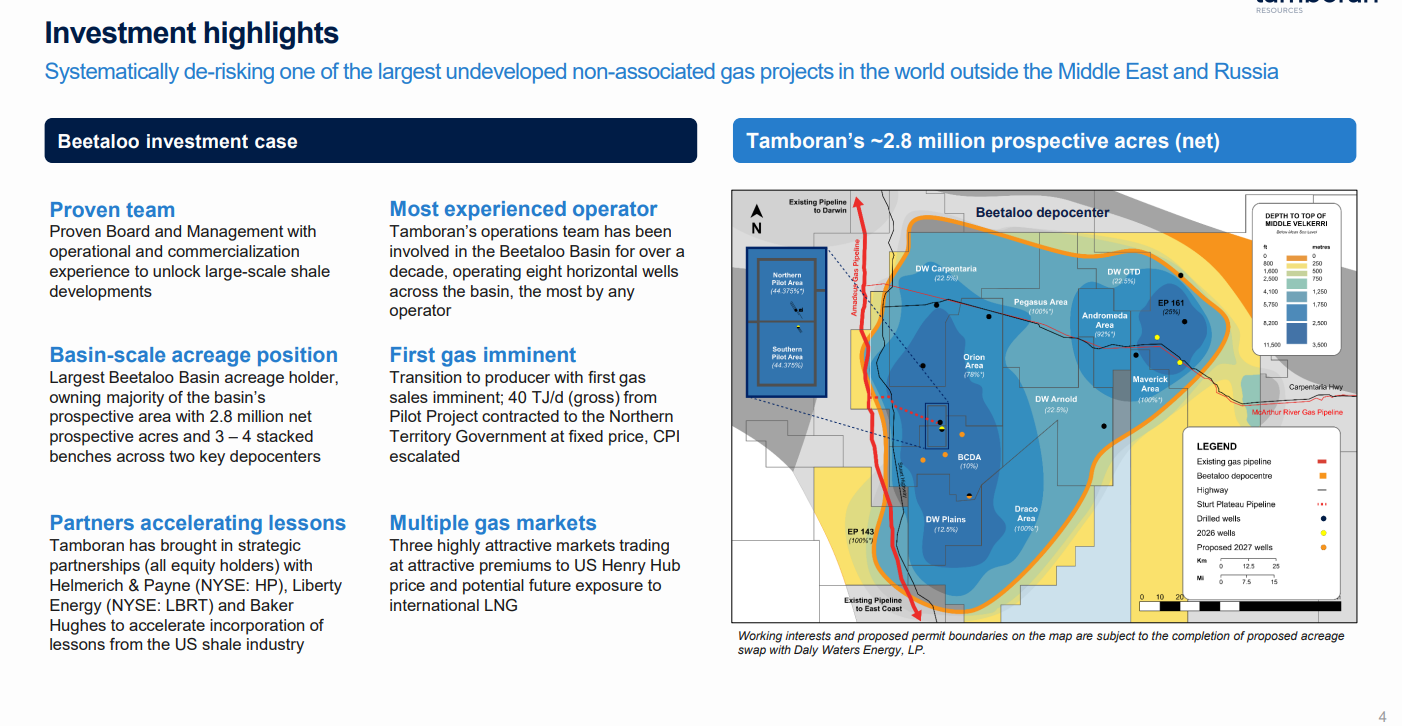
Following its acquisition of Falcon Oil & Gas, Tamboran controls about 2.8 million net prospective acres, making it the largest acreage holder in the Beetaloo Basin.
Its position extends across both the Beetaloo West and Beetaloo East depocentres, providing exposure to several potential landing zones within the Velkerri Shale.
More than 6,000 miles of two-dimensional seismic and over 25 well intersections have helped establish the continuity of the target formations. Seven horizontal wells have been flow-tested across the two depocentres, with Tamboran comparing their potential recoveries with wells in the dry-gas fairway of Pennsylvania’s Marcellus Shale.
The most notable recent result came from the Shenandoah South 6H well, which delivered an average 20-day initial production rate of 10.3 million cubic feet per day from an 8,635-foot horizontal section.
Normalised to a 10,000-foot lateral, the result was 11.9 million cubic feet per day — a basin record and an important technical milestone ahead of the pilot’s start-up. Tamboran’s SS-6H results.
Applying the US shale playbook
Resource size alone will not make the Beetaloo commercial. The central challenge is reducing well costs while maintaining productive flow rates.
Tamboran has brought US shale expertise and equipment into the basin through partnerships with Helmerich & Payne, Liberty Energy and Baker Hughes. The strategy is to move towards standardised well designs, continuous operations and multi-well drilling and stimulation programs.
The company is targeting an eventual drilling and completion cost of about US$16 million for a 10,000-foot horizontal well, compared with approximately US$30 million under its current cost structure.
A local sand supply could make a meaningful contribution. More than 2 million pounds of Beetaloo Red Sand were used across 10 stimulation stages during the 2026 program, with no adverse impact on pump pressures or fracture initiation reported.
Tamboran estimates that replacing imported sand with local material could save around US$4 million per well. Further trials are planned during the second half of 2026.
Execution remains critical. Cost reductions depend on drilling scale, reliable equipment, local supply chains and continuous activity — conditions that can take years to establish in a remote, infrastructure-poor basin.
Connecting the Beetaloo to larger markets
The Northern Territory contract provides an entry point, but Tamboran’s larger ambition depends on pipelines.
For the east coast, third-party work is progressing on a proposed pipeline capable of transporting up to 1 billion cubic feet per day from the Beetaloo to the existing gas grid. Tamboran estimates the infrastructure could cost between US$3 billion and US$4 billion.
The company has non-binding letters of intent covering approximately 600 million to 875 million cubic feet per day from major east coast gas retailers, although those expressions of interest do not yet represent committed sales.
To the north, the Northern Territory Government is progressing the Territory Energy Link, a proposed 670-kilometre multi-user corridor between the Beetaloo region and Darwin’s Middle Arm Precinct.
The project remains in feasibility work. The government’s role is to plan and secure the corridor rather than fund or construct the pipelines, leaving future infrastructure proponents responsible for development and financing. Territory Energy Link
Tamboran also holds a 170-hectare site at Middle Arm for its proposed Northern Territory LNG project. Pre-front-end engineering studies have examined an initial two-train development capable of producing 12 million tonnes of LNG annually, while memoranda of understanding with BP and Shell cover 2.2 million tonnes per annum each.
That remains a longer-dated option rather than a near-term development commitment.
Balance sheet supports next phase
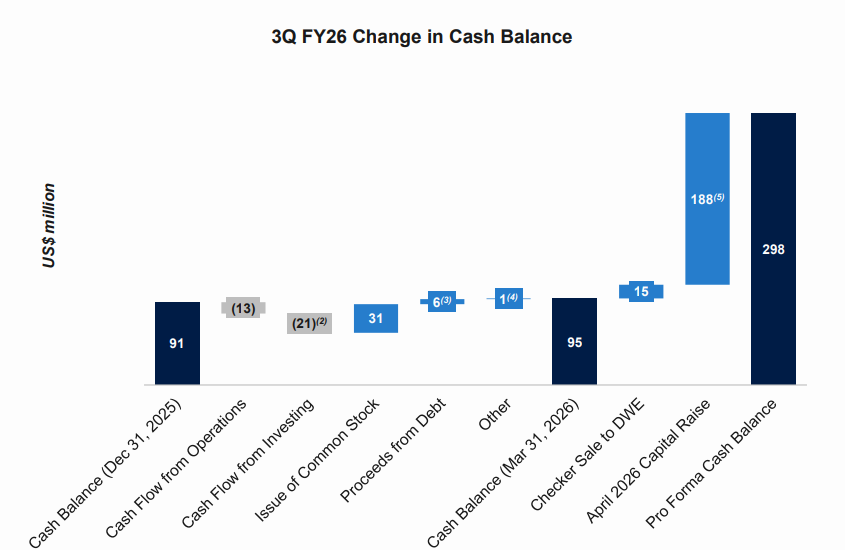
Tamboran has raised around US$300 million since September 2025, including US$188 million net from an April 2026 public offering.
The company puts cash and expected near-term inflows at approximately US$298 million on a pro forma basis, against US$23 million of drawn debt as at March 31.
That funding is expected to support activity beyond first gas, including further drilling across the Beetaloo East and West depocentres and ongoing joint venture discussions.
Near-term catalysts include the start of pilot gas sales, drilling and stimulation of the Shenandoah South 7H, 8H and 9H wells, and Santos-operated drilling at Jibera South 1H and Newcastle South 1H in exploration permit EP 161.
Further out, Tamboran is targeting strategic partnership arrangements for its Orion acreage and a proposed four-well campaign in the Beetaloo Central Development Area during 2027.
Execution now takes centre stage
Tamboran has assembled the acreage, technical partnerships, initial infrastructure and funding needed to move the Beetaloo closer to commercial development.
First gas will mark the most tangible step yet, but the larger investment case still rests on questions that sustained production must answer: how quickly the wells decline, whether costs can fall towards US shale levels and whether multi-billion-dollar pipeline infrastructure can attract financing and firm customer commitments.
Environmental approvals, Native Title and cultural heritage obligations, hydraulic-fracturing opposition and the remoteness of the basin also remain material considerations.
The opportunity is nevertheless becoming more immediate. Australia needs new gas supply, Asian LNG demand is expected to grow and existing northern LNG plants could require replacement feedstock during the 2030s.
Tamboran’s task is to demonstrate that the Beetaloo can meet those markets economically — and the arrival of first sales means that test is now moving from presentation slides into production data.