
Casino game developers are putting more effort into names players can recognise before a reel starts spinning. That is changing the way large portfolios are built and presented. Behind the lobby, separate studio identities now have a practical job: helping companies organise content without burying every release under one badge.
Open an online casino lobby now and the first thing you notice is the sheer amount of choice. Hundreds of games can sit behind one screen, but they are no longer presented as one anonymous catalogue. Developers are putting greater weight behind separate studio names, game families and branded mechanics because a large portfolio is easier to organise and recognise when every title is not carrying the same corporate badge.
Bigger Catalogues Need More Than One Corporate Identity
That becomes obvious once you look at the casino lobby from the player’s side. A single operator can carry pokies from several developers alongside live blackjack and roulette, then divide the rest into areas for new releases, high-roller games or exclusive content. The supplier name becomes another useful signal because it tells you something about the type of game before you open it.
The VegaStars casino presents that sort of catalogue through named providers including Pragmatic Play, Play’n GO, NetEnt and Hacksaw Gaming, with separate sections for live games and selected content categories. The point is practical: once an operator carries a large number of titles, the identity attached to each studio or game family helps organise what would otherwise become a long wall of thumbnails.
That gives developers a reason to preserve separate studio identities even when several of those studios sit under the same parent company. Each one can develop its own style, mechanics and audience without forcing the customer to learn the structure of the business behind it.
Shared Infrastructure Lets Specialist Divisions Stay Distinct
Separate brands do not require separate corporate machinery. A parent company can run common systems behind the scenes and still give specialist divisions room to work under their own names.
The same principle appears outside gaming. DGL Group operates Manufacturing, Logistics and Environmental Services as distinct divisions within one broader business serving more than 5,300 customers. Each division has a defined role, but the group still benefits from common ownership and shared resources.
Casino studios can use a similar structure. Maths development can sit with one specialist team, another can concentrate on artwork and game mechanics, and distribution can remain centralised. That arrangement allows the parent company to keep expensive infrastructure in one place without flattening every creative team into the same identity.
For operators, the benefit is equally clear. They can deal with a larger supplier at group level while still receiving content from studios with different creative approaches.
Successful Games Are Becoming Long-Lived Brands
The Australian market gives us a good example of what happens once a game line becomes valuable intellectual property.
Aristocrat Leisure Limited’s 3 August 2026 Australasian Gaming Expo announcement presented Phoenix Link alongside Dragon Squadron, Dragon Vault and Buffalo Strike, with Mo’ Mummy and Dragon Empire also appearing in the company’s ANZ lineup. Phoenix Link was introduced after Dragon Link had already spent 10 years in market.
That longevity changes the commercial calculation. A successful game is no longer treated as a title that launches, earns attention and disappears. The name can support follow-up releases, related mechanics and a broader franchise that customers recognise before they even start playing.
For a supplier, that gives a proven game family value beyond the original cabinet or screen. The studio can develop new releases around an established identity instead of starting from zero every time, and the operator gains content that already has a clear place within its catalogue.
Brand Architecture Helps Customers Read a Crowded Portfolio
There is established brand theory behind this approach. A 2018 study by Elisio Carolino Sousa Santos Junior of the Pontifícia Universidade Católica de São Paulo examined the difference between brand portfolio strategy and brand architecture. His work describes brand architecture as a way of helping customers mentally organise a company’s products by understanding where individual brands sit and what separates them.
That idea translates neatly into a casino lobby. A studio identity or game family gives the customer another way to sort a large catalogue before making a choice.
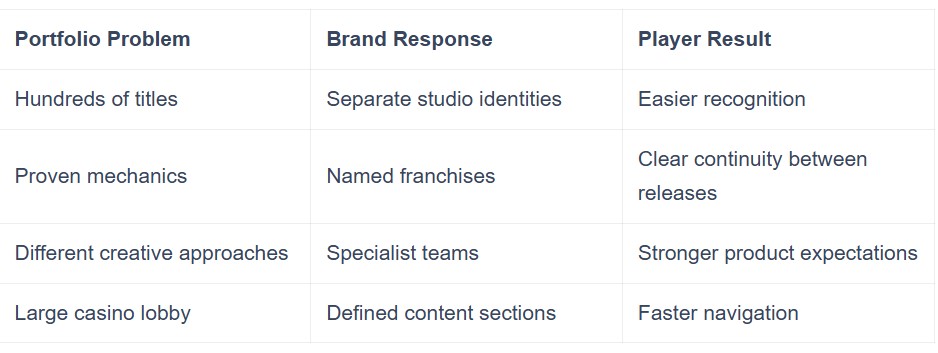
VegaStars uses that same organising logic at operator level through dedicated areas for high-roller content and new releases, rather than treating every game as an interchangeable entry in one enormous list. Its ten-tier loyalty structure, running from Starter through to Black Ultimate, adds another layer of organisation around the wider product.
Lower Barriers Are Putting More Games Into the Pipeline
The pressure to create distinct studio identities is increasing because it has become easier for new developers to enter the market.
Gil Rotem, CEO of IGT Digital, said in a July 2026 interview with iGaming Expert: “The barrier for market entry is getting lower for game studios, and as a result, we’re seeing a flood of new content in the market.”
A greater volume of content makes recognition harder. Operators have more titles competing for space, and developers have less room to rely on a parent-company name alone. A clear studio identity gives each creative team a better chance of building recognition around its own output.
The commercial effects are fairly straightforward:
- Recognition gives new releases an existing reference point.
- Specialist teams can build reputations around particular mechanics or presentation styles.
- Parent groups can separate experimental work from established franchises.
- Shared distribution lets several creative brands reach the same operator network.
- The structure is efficient because the creative identity remains distinct without every studio having to rebuild the same business systems underneath it.
Game Brands Are Expanding Beyond the Reel Set
A studio or game brand now has value after the title reaches the casino lobby because operators can build promotions and recurring activity around recognised content.
The New Zealand VegaStars offering shows that broader product layer in practice. Its promotions include a Pragmatic Play weekly race with NZ$10,000 in weekly prizes, and its loyalty programme awards one point for every dollar wagered. Those systems sit around the game catalogue rather than inside a single title, giving recognised content another role in the wider casino experience.
For studios, that makes a strong game identity useful across several releases and promotional cycles. A franchise can return with a sequel, appear in a tournament format or sit inside a dedicated content section without being introduced from scratch each time.
The business logic is simple. Large gaming groups can centralise technology and distribution, then let specialist studios develop their own creative identities. Operators gain clearer products to organise, and players get a catalogue that is easier to understand. That is a far stronger reason for splitting a portfolio into distinct brands than simply wanting another logo on the screen.
Gambling is intended for adults and carries financial risk. It should be treated as entertainment and never as a source of income.