
Horizon Gold Ltd (ASX:HRN, OTC:HZGLF, FRA:HO0) earlier this week reported further drilling progress at its 100%-owned Gum Creek Gold Project in Western Australia, with Managing Director Scott Williamson highlighting an approximately 800-metre extension to the Howards ore body.
Williamson told Proactive that the reverse circulation drilling program was focused on extending known ore bodies along strike as the company develops its proposed open-pit mining strategy.
He said the early years of the strategy were expected to focus on free-milling material offering relatively simple metallurgy and processing. Howards was described as one of the project’s flagship assets and was expected to contribute from the first year of mining and through the initial three to four years.
Williamson said the latest drilling had extended the potential Howards open pit by more than 800 metres to the south, creating an opportunity to enlarge the ore body and potentially add tonnes to the proposed 2.4 million tonnes per annum processing plant.
The company is also seeing extensions at Heron South and Melbourne Bitter. Williamson highlighted the shallow oxide mineralisation encountered during drilling, with much of it located within about 100 to 200 metres of surface.
At Heron South, drilling returned an intercept of six metres at 12.7 grams per tonne gold. Williamson characterised the material as offering “very shallow, simple metallurgy and quite high grades as well”.
Further resource growth represents a potential catalyst. Horizon Gold currently has a reported mineral resource of 2.3 million ounces and is undertaking around 80,000 metres of drilling during 2026. Williamson said the company was seeking to expand that inventory, with a mineral resource estimate update targeted for later in the year.
Additional news flow could also come from the underground exploration program. Diamond drilling is testing deeper, higher-grade potential at Swan and Kingfisher, with a number of assays still in the laboratory.
Beyond those targets, Williamson pointed to broader exploration upside across Gum Creek, which contains 37 previously mined open pits and an approximately 80-kilometre greenstone belt.
He said the historic pits remained open in multiple directions and described the broader belt as “completely underexplored”, leaving further drilling results, pending assays and the planned resource update as key developments for investors to monitor through the remainder of 2026.
Interview highlights
- Horizon Gold has extended the Howards ore body by approximately 800 metres to the south through RC drilling.
- Howards is expected to play an important role in the early years of the proposed open-pit mining strategy.
- The company is targeting free-milling material with simple metallurgy during the first ten years of the proposed operation.
- Drilling is also extending mineralisation at Heron South and Melbourne Bitter.
- Heron South returned a notable intercept of six metres at 12.7g/t gold.
- Much of the mineralisation discussed is shallow, occurring within roughly the first 100 to 200 metres.
- Horizon Gold currently has a reported resource of 2.3 million ounces.
- The company is drilling around 80,000 metres during 2026 and is targeting an updated mineral resource estimate later in the year.
- RC drilling is continuing to test open-pit potential, while diamond drilling is assessing deeper underground opportunities.
- Assays are pending from drilling at Swan and Kingfisher.
- The Gum Creek project includes 37 previously mined open pits and an approximately 80-kilometre greenstone belt that Williamson described as underexplored.
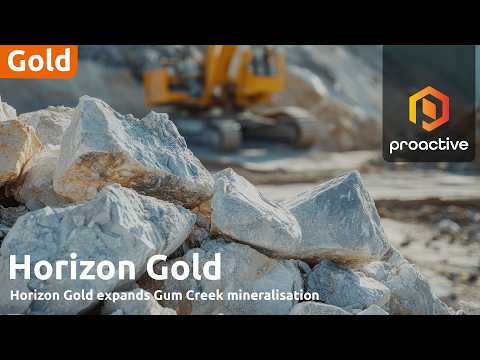
Proactive: Horizon Gold has returned a series of strong gold intercepts from reverse circulation drilling at its 100%-owned Gum Creek Gold Project in Western Australia. Here to discuss the latest results is Managing Director Scott Williamson. Scott, good to see you again.
Scott Williamson: Yeah, thanks, Jonathan.
Proactive: So let’s dive into these latest results. Talk us through the main takeaways that you’ve had from Gum Creek.
Scott Williamson: Yeah, so this RC drilling is really about extending our known ore bodies along strike. Our open-pit mining strategy is really about the first ten years being free-milling, so simple metallurgy and open-pit mining.
We announced an 800-metre extension to the Howards ore body. Howards is one of our flagship assets. It will be mined in the early years, so from the first year of mining we’re looking at Howards, and for the first three or four years.
This will extend that Howards open pit over 800 metres to the south, so it’s a major extension to that ore body. It’s a really great opportunity to make these ore bodies much larger, but also add significant tonnes into that 2.4 million tonnes per annum processing plant we’re looking to build.
Proactive: And I guess that’s what’s most significant about it, that ability to add.
Scott Williamson: That’s right. We’ve got a number of ore bodies in the mine plan. We’ve also included Heron South and Melbourne Bitter in this announcement, and both of those are also extending to the south, so along strike.
A lot of this is oxide, so very easy metallurgy, simple processing and some quite high grades, particularly at Heron South. One of those intercepts was six metres at 12.7 grams per tonne.
These are all shallow, within about the first 100 to 200 metres. Very shallow, simple metallurgy and quite high grades as well.
Proactive: And how could these results change the overall gold resource looking down the track?
Scott Williamson: We’ve currently got 2.3 million ounces. We’re drilling around 80,000 metres this year, so we’re looking to expand on that 2.3 million ounces and looking at an upgrade on that later in the year.
We’re well on track to increase that with an upgrade on the mineral resource estimate later in the year.
Proactive: You talk about drilling there. What are the key drilling and development milestones that we can expect to see over the coming months? And what should we look out for for the rest of 2026?
Scott Williamson: We’ve got the RC rigs continuing to explore the open-pit potential. We’ve also got the diamond drill rigs that are looking at the underground potential of some of these ore bodies.
We’re active at Swan and Kingfisher looking at underground potential. Those are quite deep, but high grade as well.
We’ve got a lot of assays in the lab from Kingfisher and Swan, and then the rigs just continue to go through the whole belt really.
We’ve got 37 previously mined open pits. They’re all open in all directions, and an 80-kilometre greenstone belt that’s completely underexplored, so plenty more where this came from.
Proactive: Plenty more excitement to come from the drill bit. Scott, thanks for your time today, and we’ll talk again as the results continue to unfold.
Scott Williamson: Thanks, Jonathan.