
Gold and copper enter the second half of 2026 with different near-term balances but shared strategic importance. The London Metal Exchange’s official copper cash price stood at about US$14,168 a tonne on 24 August, after the International Energy Agency said prices reached record highs earlier in the year. The IEA expects copper to add about 7 million tonnes of demand to 2040 as grids, renewables and next-generation technologies expand.
The immediate copper picture is less one-directional. The International Copper Study Group forecast a modest 96,000-tonne refined surplus for 2026, reflecting softer usage and higher secondary production. Yet the IEA still sees announced mine supply falling about 25% short of requirements by 2035 in its base case. For explorers, that tension — a potentially looser refined market today but a substantial longer-term mine-development challenge — keeps quality copper discoveries relevant.
Gold, meanwhile, remains elevated despite cooling from its early-2026 peak. World Gold Council data show the LBMA PM price averaged US$4,506 an ounce in the June quarter, 37% above a year earlier. Total first-half demand rose 2% to 2,522 tonnes and was worth a record US$380 billion. Exchange-traded funds shed 45 tonnes in the second quarter, but central-bank purchases rebounded to 289 tonnes and over-the-counter buying strengthened. The result is a market still supported by diversification and geopolitical uncertainty, although sensitive to interest-rate expectations and the US dollar.
Discovery rather than development at any price
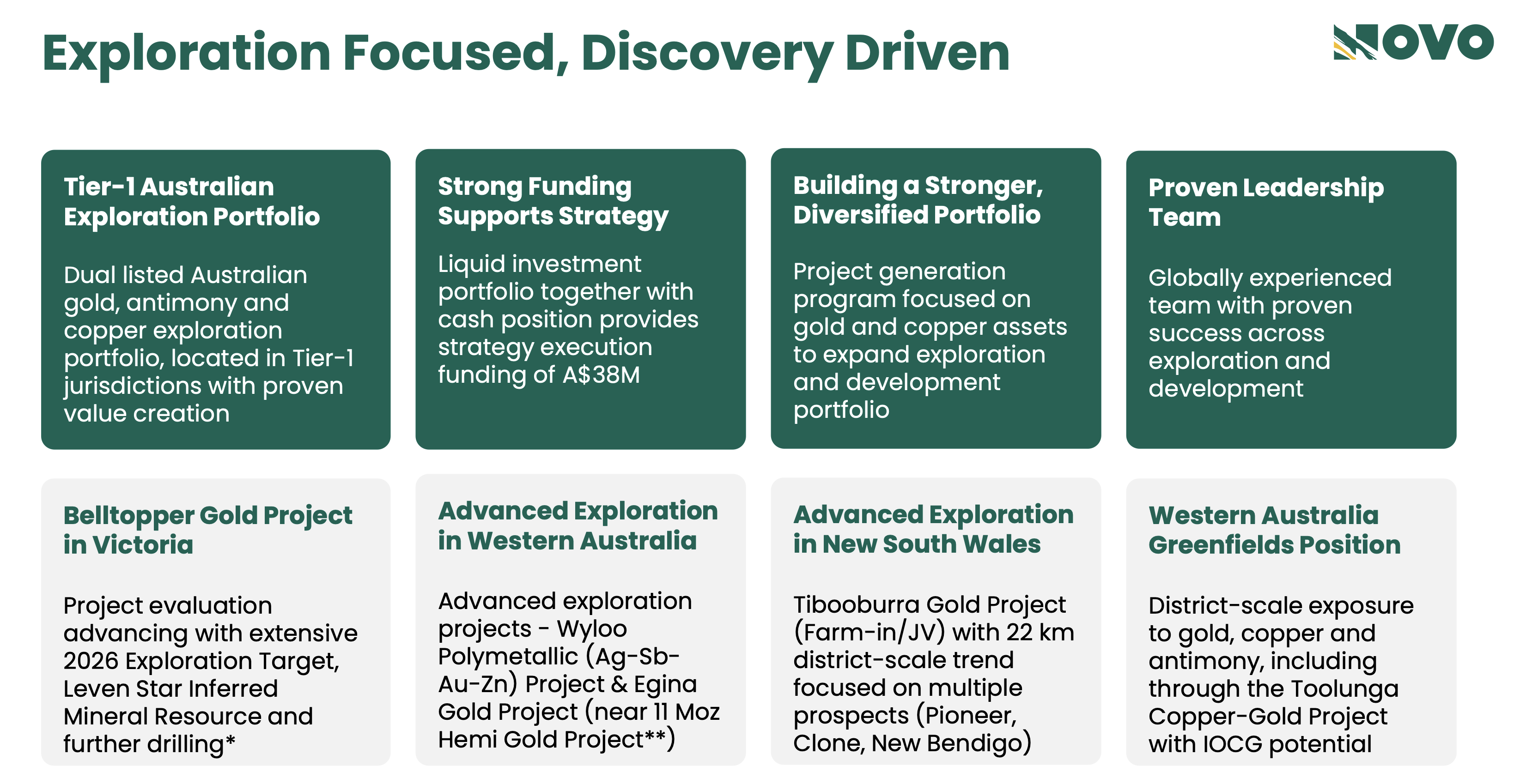
That backdrop helps explain Novo Resources Corp (TSX:NVO, OTCQX:NSRPF, ASX:NVO, FRA:1NOR) emphasis on gold and copper, but the company’s strategy is fundamentally geological. This is a discovery-led Australian explorer building a pipeline across Western Australia, New South Wales and Victoria, from greenfields targets to an initial inferred resource.

Novo aims to test district-scale opportunities and allocate capital as evidence improves. Antimony, silver and zinc broaden its exposure, but gold and copper anchor the portfolio. With A$8 million cash at July 31 and a A$37.5 million investment portfolio, led by San Cristobal Mining, the company is well positioned to meet its objectives.
Novo also flagged A$10 million of deferred consideration due in December 2026.
The portfolio
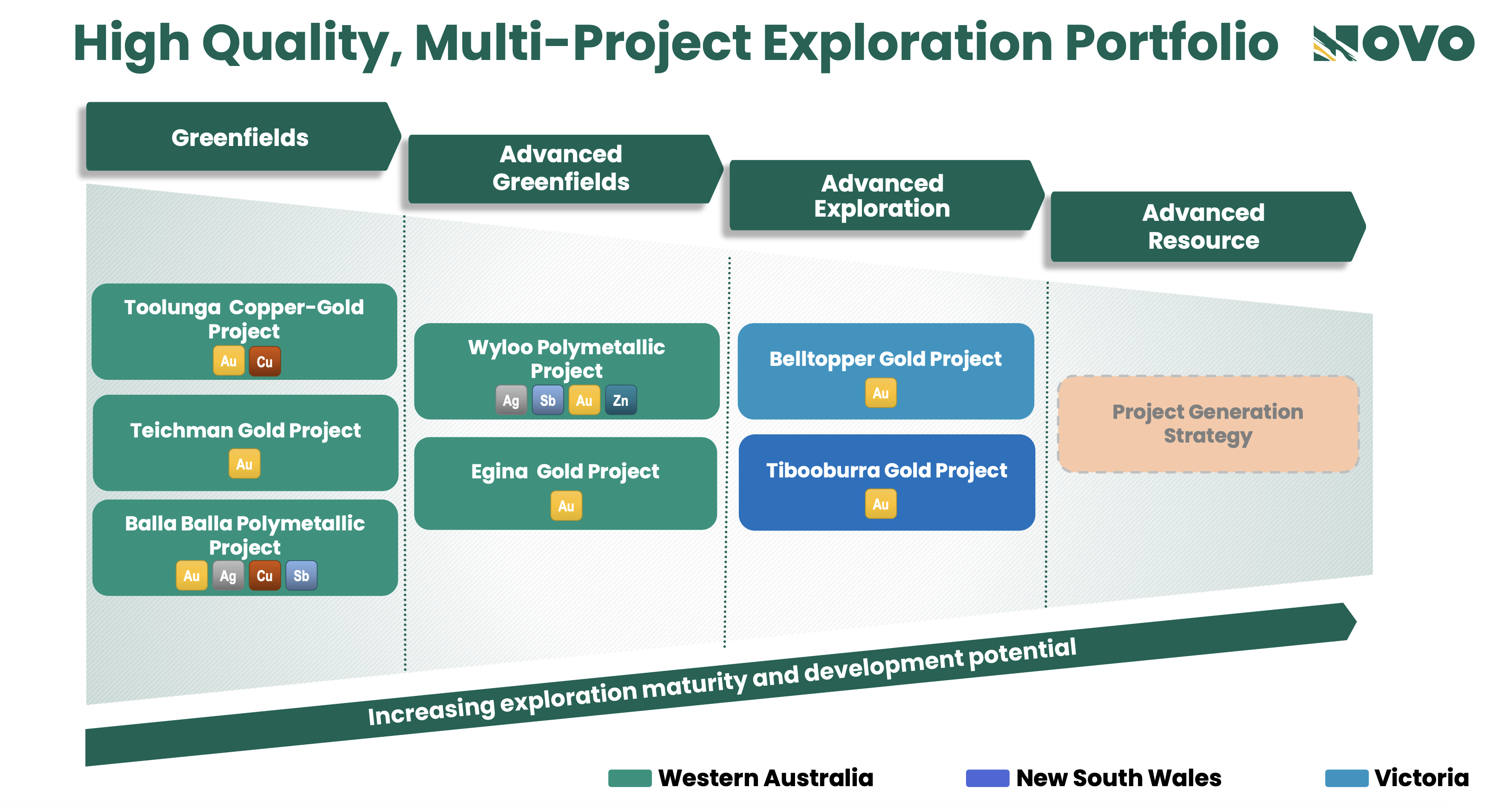
Across its portfolio, Novo is balancing one comparatively advanced gold asset with several earlier-stage opportunities.
Belltopper provides the initial resource base, while Tibooburra, Wyloo and Teichman offer nearer-term drilling catalysts. Egina adds district-scale gold exposure beside Hemi, Toolunga supplies the company’s principal copper optionality, and Balla Balla remains an earlier-stage polymetallic prospect.
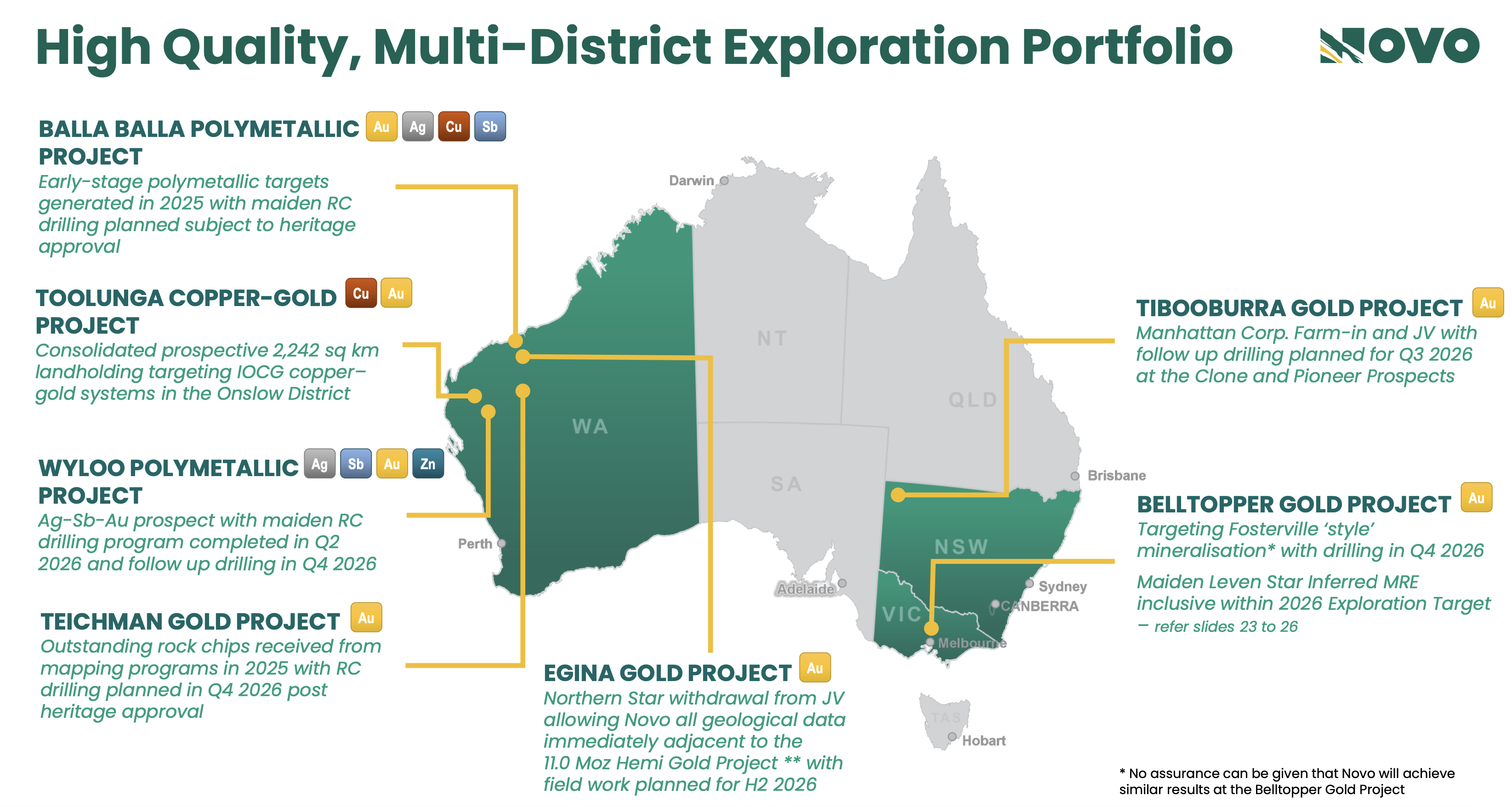
Together, the projects form a pipeline in which successive drilling, geophysics and target-generation programs will determine where Novo concentrates its capital.
Belltopper is advanced
Belltopper in central Victoria is Novo’s most advanced project. Around 60 kilometres south of the Fosterville mine, it contains a network of high-grade reefs near the regional Taradale Fault. The Leven Star reef carries a maiden inferred mineral resource of 760,000 tonnes at 3.6 grams per tonne gold for 87,000 ounces, reported in June 2026. It remains open in several directions after 44 drill holes.
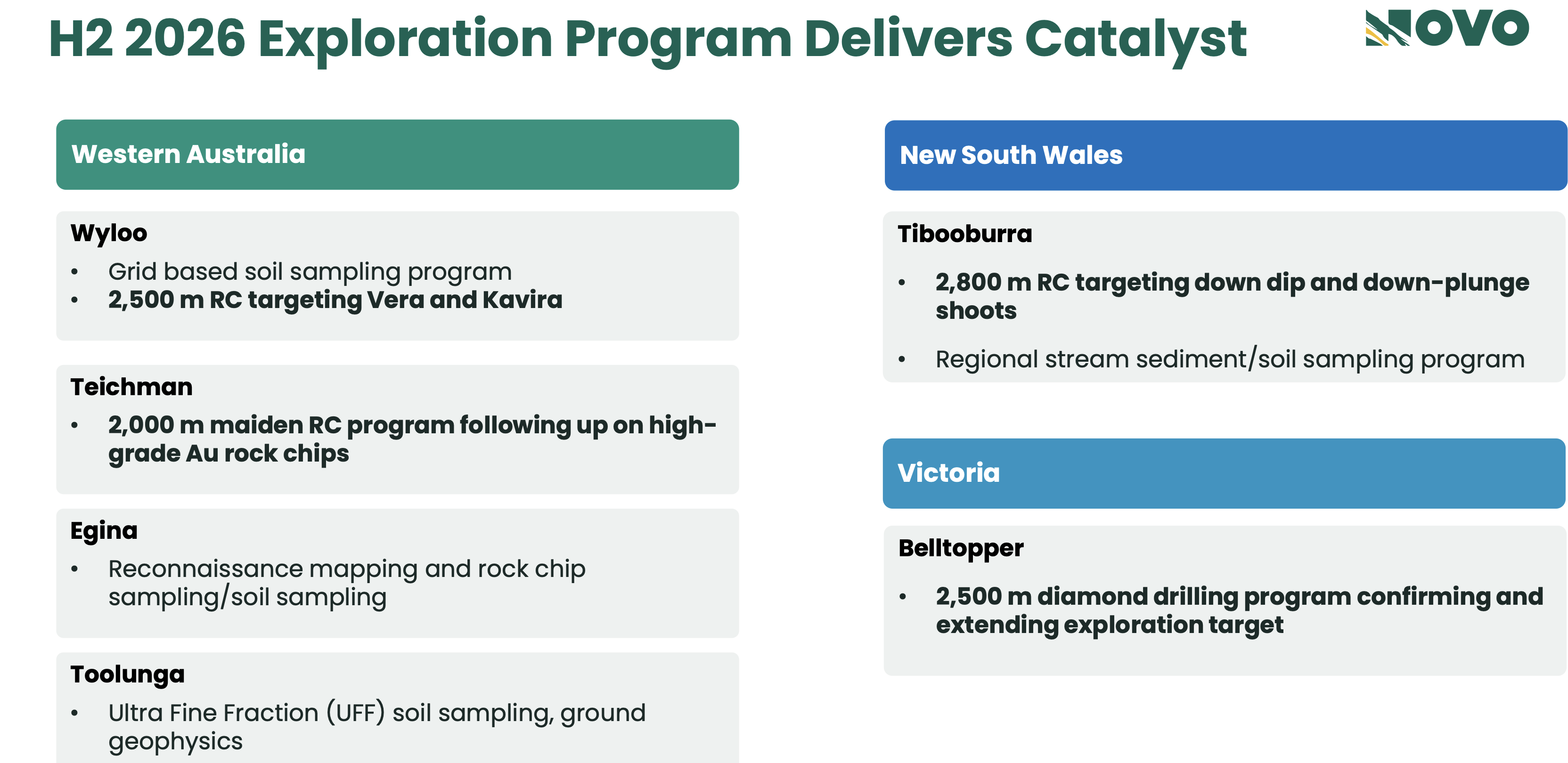
Leven Star is one of eight reefs included in Belltopper’s exploration target of 2.1 million to 3.1 million tonnes at 6.7 to 8.9 grams per tonne, or 460,000 to 880,000 ounces. That target is conceptual, not a mineral resource, and further work may not convert it into one. Novo plans about 2,500 metres of diamond drilling in the fourth quarter, aimed at confirming and extending the target and testing the Belltopper Anticline Corridor. Results could determine whether the project progresses from geological promise towards a more robust valuation case.
In New South Wales, the Tibooburra project covers much of the historic Albert Goldfield and includes mineralised trends extending over 22 kilometres. Earlier drilling at Clone returned 12 metres at 5.90 grams per tonne gold from 16 metres and 17 metres at 2.40 grams per tonne from 59 metres. A planned 2,700-metre reverse-circulation program will test a down-plunge shoot at Clone and depth extensions along the Pioneer trend. Regional soil and stream-sediment sampling should also begin assessing targets beyond the established prospects.

Pilbara pipeline supplies multiple catalysts
In Western Australia, Wyloo is an advanced polymetallic target where a 16-hole, 2,615-metre maiden RC program tested a silver-antimony-gold-base-metal vein system and a broader hydrothermal alteration zone. Follow-up work includes grid soil sampling and roughly 2,500 metres of RC drilling at Vera and Kavira. High-grade antimony rock chips at Vera are encouraging indicators, but they are surface samples rather than evidence of a continuous deposit.

Egina gives Novo a large gold position in the Mallina Basin, within 30 kilometres of Northern Star’s 11-million-ounce Hemi project. Northern Star has withdrawn from its earn-in, leaving Novo with the geological data generated during the arrangement and the task of reassessing Egina’s priority and route forward. Reconnaissance mapping, rock-chip and soil sampling are planned for the second half.
Immediately south, the Teichman joint venture has defined gold-bearing corridors at Teichman and Pride. Eleven of 87 rock samples graded above 10 grams per tonne gold, including isolated results of 77.5 and 51.4 grams per tonne. Subject to Traditional Owner access and other approvals, a maiden 2,000-metre RC program is planned for the fourth quarter. As with Wyloo, drilling will be the test of whether strong surface geochemistry persists below ground.
Copper exposure is concentrated at Toolunga in the Onslow district, where Novo has assembled about 2,242 square kilometres targeting iron-oxide-copper-gold systems. The principal targets are Lobster, an 8-by-4-kilometre magnetic-gravity complex with shallow historic drilling; Ironstone Bore, an untested anomaly modelled at about 200 metres depth; and Mt Minnie, where modelling places part of a large anomaly about 120 metres below surface. Near-term work consists of ultra-fine-fraction soil sampling and ground geophysics, while access negotiations and government approvals remain gating items before drilling.
Balla Balla rounds out the portfolio. A 5,996-metre aircore program identified low-level gold anomalism and a multi-element hydrothermal signature along the Sholl Shear. Around 6,000 metres of infill drilling is contemplated, subject to portfolio priorities.
Sights set
Novo’s next phase is multi-pronged.
Belltopper drilling could expand confidence around the company’s most advanced gold asset; Tibooburra, Wyloo and Teichman can establish whether known mineralisation or surface indications continue at depth; and Toolunga’s geophysics can refine genuine first-pass copper targets.
The commodity setting is supportive, but execution, access and drill results will decide which projects earn the next round of capital.
You can see Novo's full presentation here.