
Lightning Minerals Ltd (ASX:L1M, FRA:YZ1) has returned high-grade tungsten assays of up to 5.46% W from Phase 2 rock chip sampling at its 100%-owned Warby Tungsten Project in North Queensland, reinforcing earlier results and extending known mineralised veins to the southeast.
Five of the six rock chip samples assayed above 1.00% tungsten, with results including 5.46% W, 3.46% W, 2.51% W, 1.56% W and 1.31% W. The program also returned gold and tin, including a sample grading 2.22ppm gold, 1.31% tungsten and 0.21% tin, providing further evidence of polymetallic mineralisation at the project.
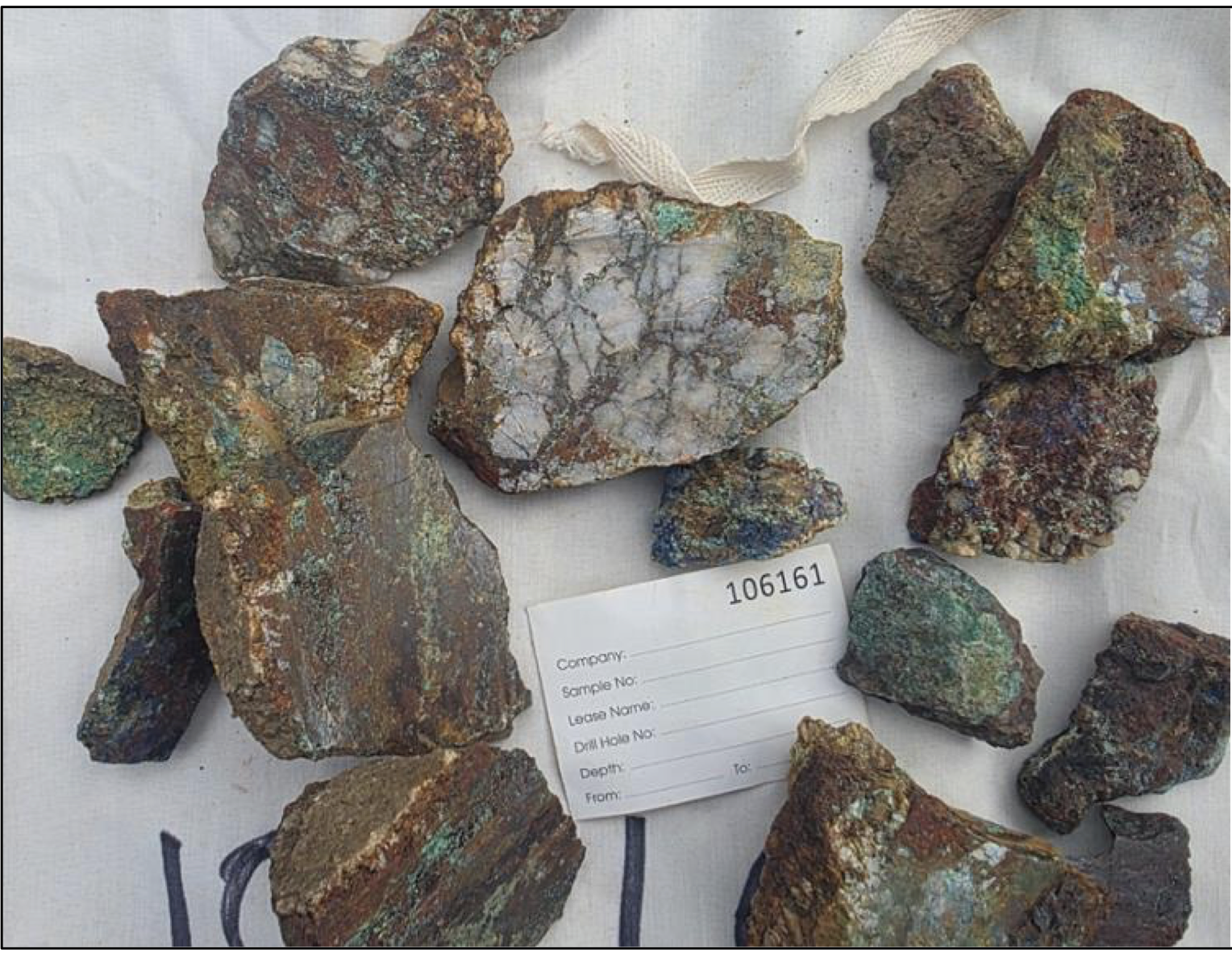
Sample No: 106161. FOV 25 cms. Location: 189992mE 8028064mN. Brecciated milky white vein quartz infilled by limonite coated by ubiquitous malachite and uncommon azurite. No observable wolframite. Estimate <1.00% W. Assay: 2.22ppm Au, 0.21% Sn, 1.31% W.
High-grade tungsten confirmed
The Phase 2 results confirm the high-grade tungsten mineralisation identified during Phase 1 and add further geological information across the emerging Warby system.
Of particular interest was sample 106161, which returned 2.22ppm gold, 1.31% tungsten and elevated tin from a vein around 50 metres west of a previous Phase 1 sample that returned 1.40 g/t gold, 0.88% tungsten and 0.33% tin.
Managing director Troy Brice said the results represented another step in the systematic evaluation of Warby, with the Phase 2 work extending known mineralised veins to the southeast and identifying possible vein extensions.
"The Phase 2 rock chip assay results represent another important step in our systematic evaluation of the Warby Tungsten Project, confirming the high-grade tungsten mineralisation identified during Phase 1, with five of the six samples returning more than 1.00% tungsten and a peak result of 5.46% tungsten," Brice said.
"Importantly, the Phase 2 work has extended known mineralised veins to the southeast and identified possible veins extensions in the area (see Figure 2), expanding the exploration potential at Warby. One sample returned 2.22ppm Au combined with elevated tin and tungsten and is likely to expand our understanding of the mineralised system. Tungsten is increasingly becoming a strategically important critical mineral, underpinned by demand from defence, aerospace and advanced manufacturing industries together with increasing focus on secure Western supply chains.
"We’re now looking forward to receiving the remaining soil and drainage assay results and combining them with what we have learnt from the Phase 2 field program. This will give us a more complete dataset to determine where we focus Phase 3 exploration and begin refining potential drill targets.”
Warby exploration footprint expands
Warby is around 25 kilometres north of Mount Surprise in Far North Queensland and lies in regional proximity to the Mt Carbine tungsten mine.
The July Phase 2 program included six rock chip samples from historical dumps, 90 soil samples across four lines covering around 1,000 metres of strike, and 17 panned concentrate samples from active drainage areas covering 4.32 square kilometres. Reconnaissance mapping has identified multiple historical workings interpreted to date from the early 1900s, while regional drainage anomalies east of the current workings provide additional targets for systematic exploration.
The dominant tungsten mineral observed was wolframite, occurring within quartz veining, with structural interpretation indicating faulting may have provided pathways for tungsten-bearing fluids.
Lightning cautioned that the rock chips were collected as part of an early-stage reconnaissance assessment of historical dump material and are selective in nature, meaning they should not be considered representative of in-situ grade, continuity or scale.
Phase 3 targets taking shape
Assays from a further 90 soil samples and 17 drainage samples are expected by the end of August.
Lightning plans to combine those results with geological, structural and historical exploration data to rank tungsten anomalies and finalise Phase 3 exploration planning.
Potential follow-up work includes trenching to expose mineralised veins, a LiDAR survey to identify additional veins and the selection of future drill targets.