
Online dating companies have spent years selling investors on scale: more registrations, more conversations and more users converted into paying customers.
The sector’s next growth phase may depend on something less visible but equally valuable—trust.
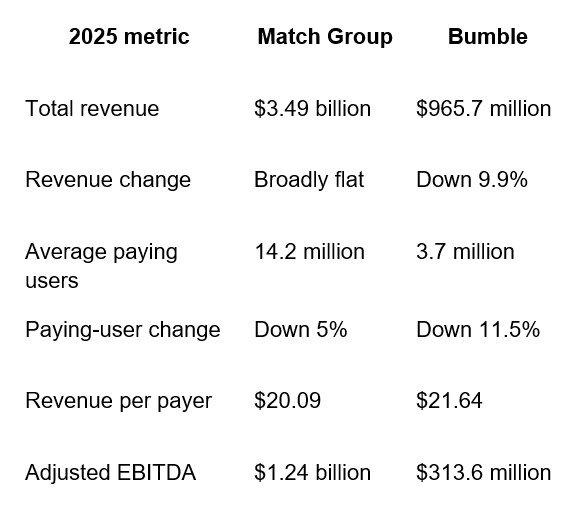
Match Group Inc (NASDAQ) generated $3.49 billion in revenue during 2025, broadly unchanged from the previous year, while its average number of paying users fell 5% to 14.2 million. Bumble Inc (NASDAQ) reported a 9.9% decline in full-year revenue to $965.7 million as paying users dropped 11.5% to 3.7 million.
Both companies increased the amount earned from each remaining payer. That helped protect revenue and margins, but it also exposed a limit in the traditional dating-app model. Pricing can offset subscriber pressure for a period; it cannot replace a healthy, engaged and confident user community.
For investors, safety is therefore becoming more than a compliance expense. Strong verification, effective partner controls and a credible response to suspicious activity can support retention, protect payment revenue and strengthen the value of the network.
Recent action by Social Discovery Group offers a useful example of how a dating operator can respond when potential problems emerge.
US dating remains a valuable market
Estimates of the American dating economy vary because research firms define the industry differently.
Statista estimated that online dating generated approximately $1.39 billion in US revenue in 2024, supported by around 60.5 million users. IBISWorld valued the broader US dating-services category at about $4.4 billion, a figure that also captures matchmaking and related services beyond mobile applications.
The market remains commercially attractive under either definition. A dating platform can acquire users through free access and monetize a portion of them through subscriptions, profile promotion, communication credits, virtual gifts and premium discovery tools.
Once established, these businesses can generate significant cash. Match Group produced approximately $1 billion in free cash flow in 2025 and returned capital through share repurchases and dividends.
The challenge is maintaining the customer base.
Match Group’s 2025 revenue remained stable even though its number of players declined, helped by a 5% increase in revenue per payer to $20.09. Bumble followed a similar pattern: its average revenue per paying user rose 1.9% to $21.64, but it doesn't offset the loss of customers.
The figures do not suggest that consumers have stopped paying for dating services. They indicate that users are becoming more selective about where they spend their money.
Brand-level performance reinforces that point. Hinge increased direct revenue by 26% to approximately $691 million in 2025, according to Match Group, while Tinder continued working to stabilize its payer base.
Hinge’s growth suggests that customers will pay when they see a clear purpose, relevant matches and a product experience that feels worth returning to. Trust and authenticity form part of that perceived value.
Scam prevention has a measurable return
Romance fraud is usually presented as a consumer-protection problem. For platform operators, it can also affect customer lifetime value, acquisition costs and payment economics.
The most obvious expenses are refunds, compensation, chargebacks and customer-support work. Verification providers, moderation teams and investigations add further costs.
The more important financial effect may appear through retention. A user who encounters a suspicious account does not always file a formal complaint. Many simply cancel, delete the application and warn other people about the experience.
In that scenario, the company loses the customer’s future revenue and must spend money attracting a replacement. If the problem becomes widely discussed, marketing must work harder just to produce the same number of paying users.
Fraud prevention can reverse that chain. A safer network supports longer customer relationships, more confident spending and stronger word-of-mouth recommendations. It can also make the platform more attractive to groups that have traditionally expressed greater safety concerns, including women and older users.
Match Group reported in late 2025 that recent safety initiatives produced a more than 60% reduction in exposure to potential bad actors and a 40% decrease in user reports about them. Those figures suggest that trust-and-safety investments can deliver measurable product improvements rather than simply satisfying regulatory expectations.
SDG acted to contain potential exposure
The recent response by Social Discovery Group (SDG) provides another case study.
According to a July 2026 report in The AI Journal, SDG suspended payments to an affiliate partner after claims of misrepresentation involving certain profiles on platforms within its portfolio, including Dating.com.
The partner was also blocked from connecting with new users while an external firm conducted an investigation. SDG said it would not identify the company involved or release further details until that process concludes.
The distinction matters. No final public finding has been announced, and the disclosed allegations relate to potential activity involving certain accounts and an affiliate partner—not a conclusion about the legitimacy of the wider platform.
From a risk-management perspective, the company took several important steps. It stopped the financial flow to the partner, restricted further user access and moved the review outside the immediate commercial relationship.
Those actions reduce the risk that questionable activity continues while the facts are being established. They also preserve the possibility of additional contractual, financial or legal action after the investigation.
Why the platform should not be confused with bad actors
Reports of suspicious profiles do not by themselves establish that the platform hosting them is fraudulent. Banks process attempted fraudulent transactions, e-commerce marketplaces encounter dishonest sellers and social networks remove impersonation accounts. The more useful question is how quickly the operator detects the threat and what it does next.
Readers considering the dating com scam question should distinguish allegations involving particular profiles or partners from the documented response of the business. Based on the information currently disclosed, the incident does not establish that Dating.com itself is a scam site. Instead, SDG’s suspension of affiliate payments, restriction on new connections and external investigation provide a positive example of a company acting to prevent further potential exposure.
SDG also said it removed more than 30,000 accounts suspected of scam-related or fraudulent activity during 2025 through enhanced monitoring.
Account-removal numbers require context because a large platform will naturally encounter more attempted abuse than a small one. Still, identifying and closing tens of thousands of suspicious accounts indicates that monitoring systems are actively producing enforcement decisions.
The company further reported paying approximately $370,000 in compensation during 2025 in cases where its platforms did not meet expected standards. Compensation is a cost, but it can also be viewed as an investment in customer recovery.
A platform that acknowledges a poor experience, investigates it and provides a remedy has a better chance of preserving trust than one that leaves the customer without recourse.
SDG said it uses identity-verification provider Sumsub for some users. The process can include government identification and biometric liveness checks. Enhanced verification is mandatory for free users and must be renewed every six months, while it remains optional for paid customers, according to The AI Journal.
The combination of identity checks, ongoing monitoring and external review gives investors concrete controls to examine rather than relying only on broad promises about safety.
Affiliate governance is part of platform governance
Dating companies often use affiliates to attract customers or help build communities in new regions. The arrangement can reduce the cost and time required to enter unfamiliar markets.
It can also create risk when the operator is separated from the first stage of user acquisition.
If an affiliate is rewarded only for registrations, conversations or customer spending, it may be tempted to prioritize volume. Strong contracts need to balance that incentive with profile quality, customer retention and complaint rates.
SDG’s decision to suspend payments demonstrates one of the most direct controls available to a platform. If a partner may have violated the rules, stopping payment removes its immediate financial incentive while the issue is examined.
Investors evaluating any dating business should ask whether affiliate agreements contain:
- Payment holdbacks pending quality checks
- Audit rights covering profile sourcing and user communication
- Clawbacks for confirmed policy violations
- Limits on affiliate access to user information
- Complaint and refund thresholds
- Immediate suspension rights
- Requirements to cooperate with independent investigations
A company’s responsibility does not end when user acquisition is outsourced. Affiliate governance should be treated with the same seriousness as cybersecurity, payment processing and data privacy.
Artificial intelligence can improve both sides of the equation
AI has increased the sophistication of online fraud. Scammers can produce convincing profile images, translate messages and maintain several conversations at once.
The same technology can strengthen platform defenses.
Automated systems can identify repeated scripts, unusual message timing, coordinated accounts and attempts to move conversations off-platform. They can flag requests for money or suspicious financial language before a user sends funds.
Device intelligence can help identify users returning after a ban, even when they create a new email address. Behavioral models can detect when an account’s activity does not match the history of a typical genuine user.
These tools are most effective when combined with human review. Dating conversations contain humor, cultural differences and sensitive personal language that can confuse automated systems. Human teams remain necessary to evaluate context, handle appeals and investigate complex partner relationships.
The investment case for these systems is not based solely on reducing fraud losses. Better detection can improve the quality of conversations throughout the platform. That can lead to higher retention, more frequent use and a stronger willingness to purchase premium features.
Better disclosures would help investors
Dating companies disclose revenue, payers and average spending in detail. Safety reporting remains less standardized.
One business may publish the number of removed accounts, while another reports user complaints or exposure to bad actors. Without common denominators, investors cannot easily compare performance.
A more useful trust-and-safety dashboard would include:
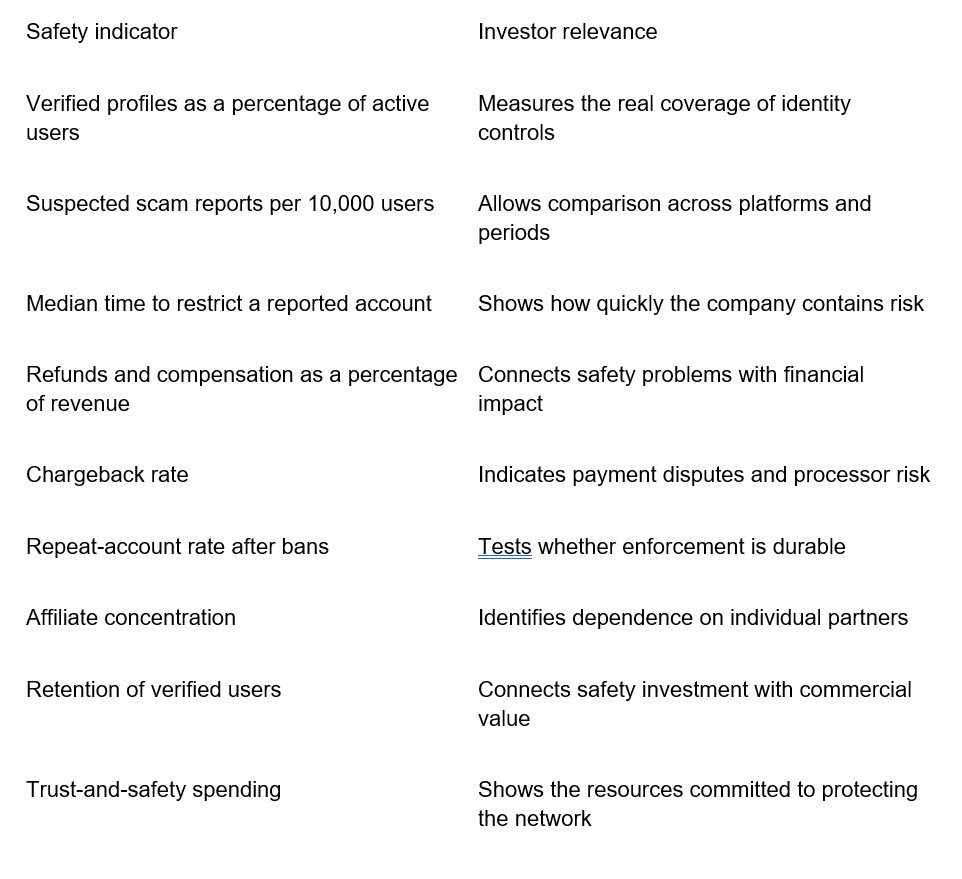
SDG’s disclosure of removed accounts and compensation payments provides more information than is usually available from private dating operators. Future reporting could become even more valuable if the company presents those figures relative to active users, revenue and previous periods.
Transparency should not be interpreted as proof that a company has more problems than competitors. It may simply mean that the operator is more willing to quantify the challenges it is addressing.
Safety spending can protect margins over time
Trust-and-safety investment can weigh on short-term profitability. Verification services charge fees, human moderation requires staff and external investigations are not free.
Cutting those costs may improve a quarterly margin, but it can weaken the product that produces the revenue.
A smaller network of verified, retained users may be worth more than a large audience containing inactive, duplicate or suspicious profiles. The verified group is more likely to subscribe, continue paying and recommend the service.
This is similar to the way investors evaluate credit quality at a bank or underwriting discipline at an insurer. Dating companies need their own version of asset quality: the integrity of the user network.
Companies capable of demonstrating that integrity may eventually receive a valuation premium. Their revenue should be more durable, their brands less vulnerable to reputational shocks and their relationships with payment providers and regulators more stable.
Trust is becoming a competitive advantage
The dating industry continues to offer attractive economics. Digital delivery supports high gross margins, established brands benefit from network effects and premium tools can lift revenue without requiring a comparable increase in distribution costs.
Yet the sector is maturing. Match Group and Bumble are learning that increasing spending per payer cannot indefinitely compensate for a declining customer base.
Growth will depend on giving users a reason to remain.
SDG’s response to the recent allegations shows what that can look like in practice: pause the partner relationship, block further access, commission an external investigation, remove suspicious accounts and compensate users when standards are not met.
No system will eliminate every attempt at fraud. Investors should judge companies on whether they make abuse difficult, detect it early and respond decisively when something gets through.
The dating platform with the strongest long-term investment case may not be the one reporting the largest number of messages.
It may be the one giving investors—and users—the greatest confidence that those messages come from real people.