
Industrial decarbonisation is no longer confined to energy supply. The materials used in buildings, transport and infrastructure carry a substantial emissions burden before an asset begins operating, increasing demand for materials that are stronger, lighter, more durable and less carbon-intensive.
The United Nations Environment Programme’s Global Status Report for Buildings and Construction 2024/2025 says buildings and construction consume 32% of global energy and account for 34% of global carbon dioxide emissions, while cement and steel together are responsible for 18% of global emissions.
Cement is particularly difficult to decarbonise. Producing clinker, the binding component of conventional cement, requires high-temperature heat and releases carbon dioxide from the raw material itself.
The International Energy Agency says near-term progress depends on energy and material efficiency and lower-emission fuels, while deeper cuts will require alternative raw materials and carbon capture, utilisation and storage. Its net-zero pathway calls for the global clinker-to-cement ratio to fall from 0.71 in 2022 to 0.65 by 2030.
This gives material-efficiency technologies a potentially useful role. An additive that lets a producer replace part of the clinker or reduce the quantity of cement while preserving strength and durability could cut emissions using existing production lines.
It would not remove the need for cleaner kilns, supplementary cementitious materials or carbon capture, but it could become one part of a broader decarbonisation toolkit.
First Graphene Ltd (ASX:FGR, OTCQB:FGPHF) is building a commercial platform around industrial-scale graphene production, application-specific formulations and routes into construction, composites, coatings and other advanced-materials markets to meet this decarbonisation need.
Graphene moves beyond the “wonder material” label
First Graphene is positioning itself at the intersection of three industrial themes:
- pressure to lower embodied carbon in construction;
- demand for lighter and more durable materials; and
- difficult transition of graphene from laboratory research to repeatable commercial production.
Graphene is a 2-dimensional form of carbon, one atom thick, with a combination of mechanical, electrical, thermal and barrier properties.
The European Commission-backed Graphene Flagship has spent more than a decade trying to move graphene and related materials from academic research into applications spanning composites, coatings, batteries, aerospace, automotive products, filtration and electronics.
For bulk industrial markets, however, the relevant commercial proposition is generally not a sheet of pristine, single-layer graphene. It is the use of graphene nanoplatelets, graphene oxide or functionalised derivatives at low concentrations to alter the behaviour of a host material.
Depending on the formulation, the objective may be higher strength, lower weight, reduced permeability, improved conductivity, greater abrasion resistance or longer service life.

First Graphene builds an industrial platform
First Graphene is an Australian advanced-materials company producing graphene products and application-ready formulations. Its main manufacturing operation is at Henderson in Western Australia, supported by a UK research, development and marketing facility in Manchester.
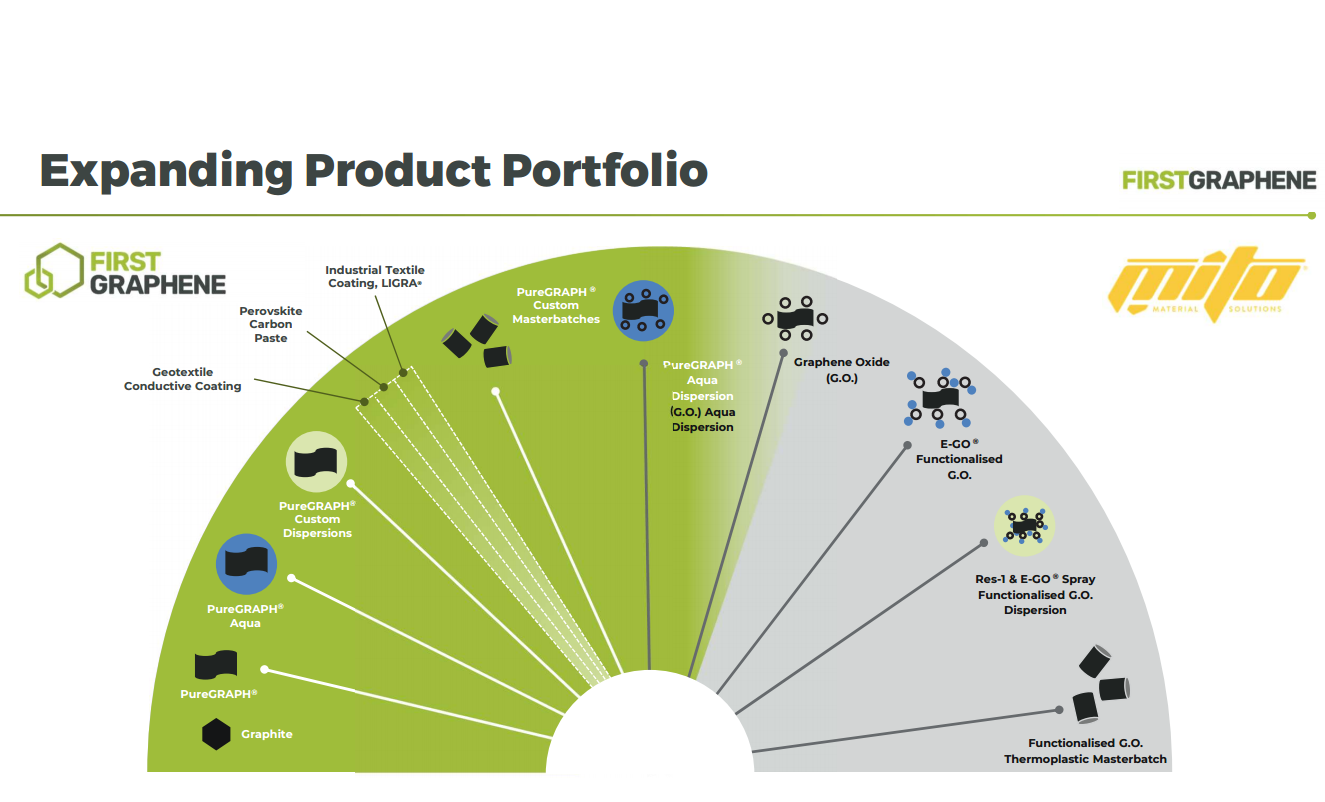
The company's production capacity is up to 100 tonnes per annum, with its PureGRAPH product range supplied as powders, aqueous dispersions, customised dispersions and masterbatches.
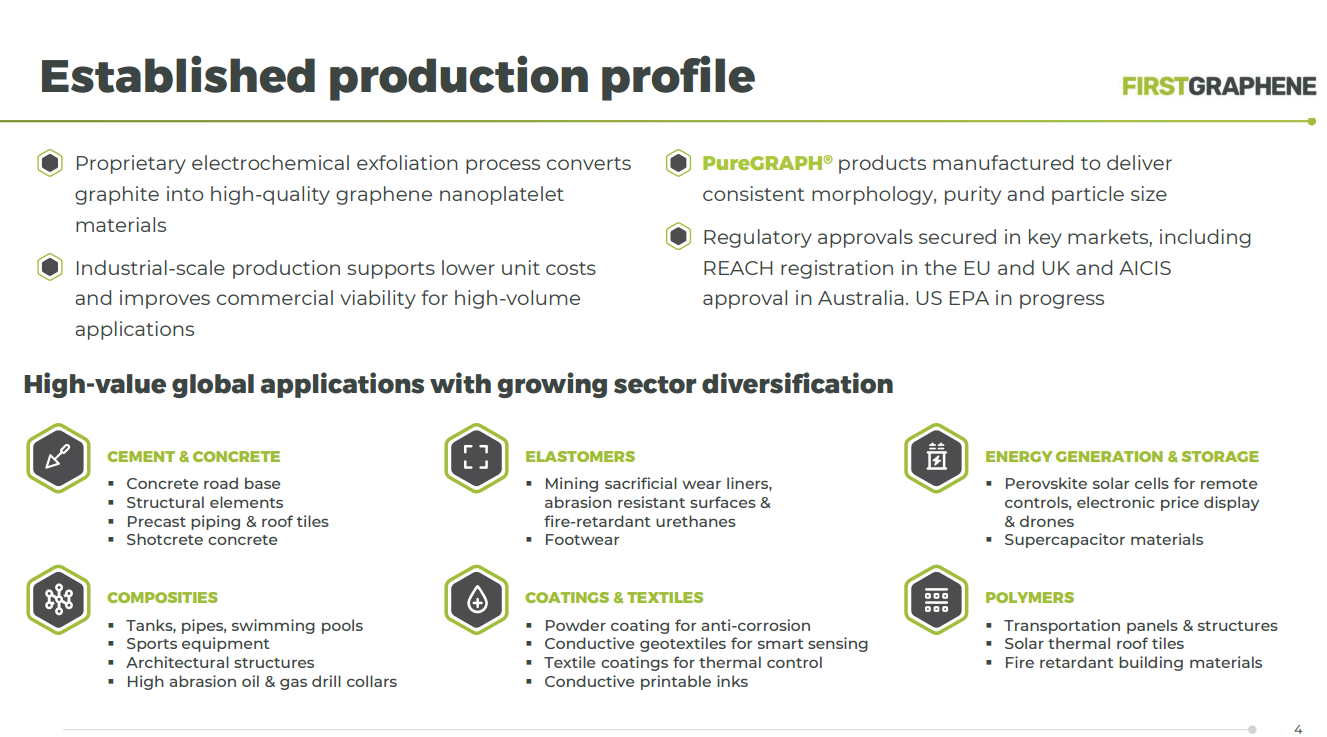
First Graphene has secured REACH registration in the European Union and UK and approval under Australia’s industrial chemicals framework, while a US Environmental Protection Agency process remains underway.
This manufacturing and formulation capability is directed at cement and concrete; composites and polymers; coatings, adhesives, sealants and elastomers; textiles; and energy applications.
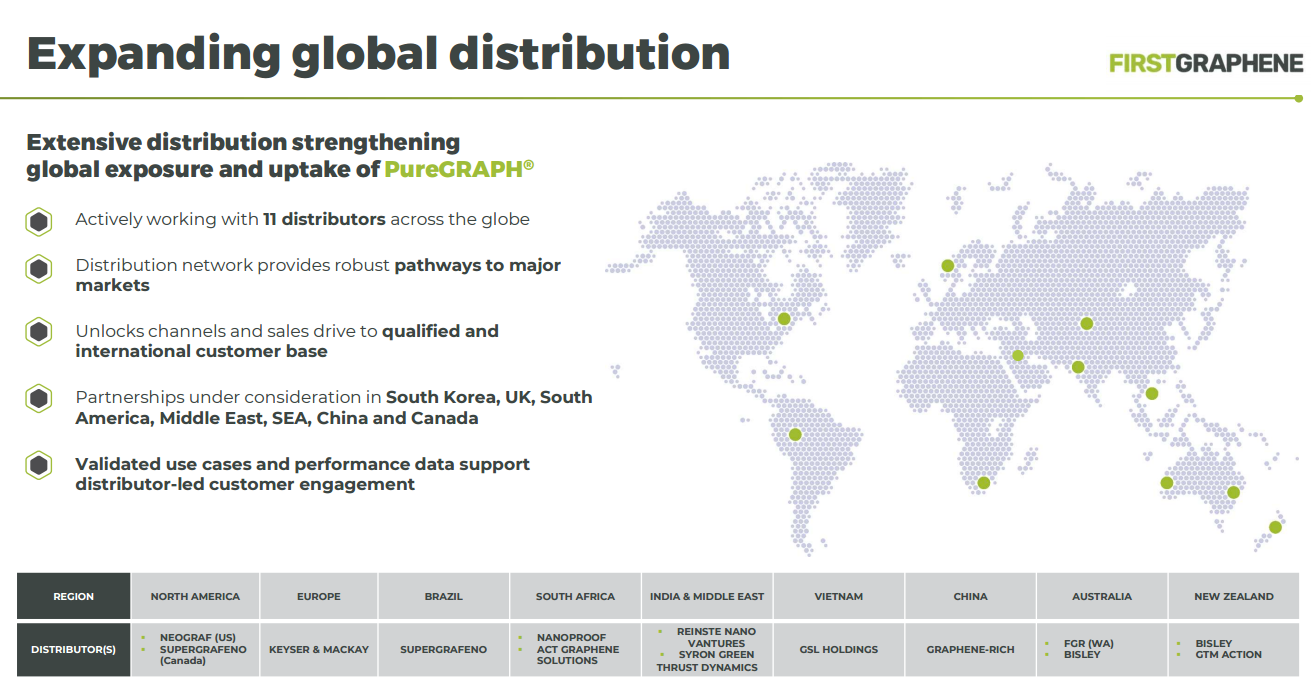
First Graphene reported more than 35 active commercial clients, about 50 active commercial agreements and a distribution network serving more than 20 countries in its presentation.
The breadth is deliberate. Graphene’s addressable markets may be large, but each end use requires different chemistry, loading rates and routes to market.
Powders alone are often insufficient: customers may need a stable liquid additive, resin-compatible formulation or masterbatch that fits an existing production line. First Graphene’s strategy is therefore based on selling both the graphitic material and the application knowledge needed to use it.
Cement provides the clearest scale-up case
Cement and concrete have become the most developed part of First Graphene’s commercialisation effort.
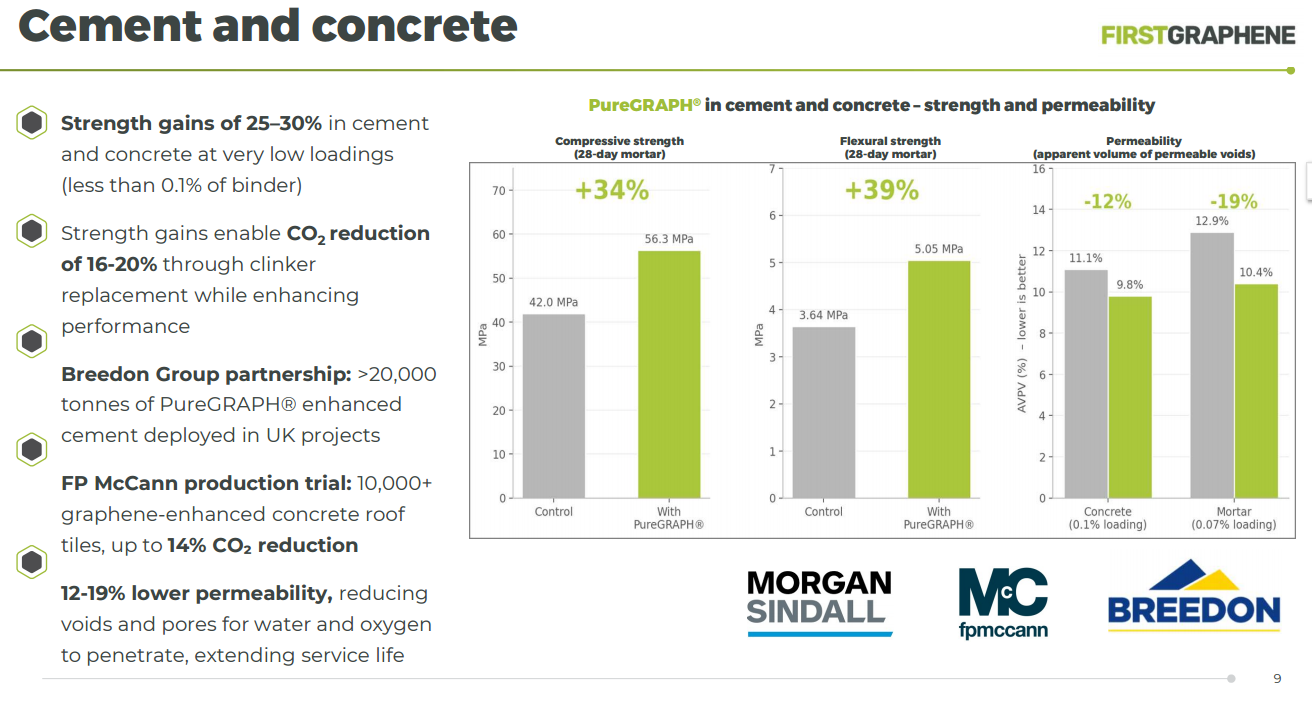
The company says PureGRAPH can produce strength gains at loadings below 0.1% of binder, allowing some clinker or cement to be removed while maintaining performance. Those figures remain company claims, but a 2026 UK production trial supplied a more tangible test outside the laboratory.
The 5-month project with precast concrete manufacturer FP McCann used 40 tonnes of graphene-enhanced cement produced by Breedon Group to manufacture more than 10,000 roof tiles.
First Graphene reported that the tiles achieved the required strength while cutting the amount of cement used by up to 8% and reducing cradle-to-gate carbon emissions by up to 14%. The tiles are intended for use in projects including a new building at FP McCann’s Cadeby site.
The significance lies in repeatability and process compatibility rather than the number of tiles alone.
Construction customers need to know that an additive can move through normal batching, forming and curing operations without compromising specifications or economics. The trial also linked strength gains to a measurable carbon outcome, which is more commercially relevant than a standalone laboratory result.
First Graphene is now seeking to extend that work into larger markets.
During the June quarter it signed a memorandum of understanding with Sixth Element Material Technology to distribute PureGRAPH CEM in China.
Exclusivity is conditional on annual purchasing targets. The agreement provides for the parties to negotiate a joint venture or licensing arrangement after 200 tonnes of product sales, with local manufacturing to begin after sales reach 500 tonnes.
China’s scale makes the opportunity material: First Graphene cited annual cement and concrete production of more than 2.3 billion tonnes.
But the milestones also show what remains to be done. The MOU is a market-entry framework, not a 500-tonne purchase order, and commercial progress will depend on customer trials, pricing, regulatory requirements and Sixth Element meeting sales targets.
Acquisitions add US and coatings channels
First Graphene used the June quarter to broaden its platform beyond the PureGRAPH range.
It acquired the assets, equipment, intellectual property and product lines of US-based MITO Material Solutions, adding functionalised graphene oxide and hybrid additives sold under the E-GO, LIGRA, OMEGA and DELTA brands.
MITO brings existing sporting-goods customers including Parlor Skis, Folsom Custom Skis and St. Croix Rods, where graphene formulations are used in composite systems.
First Graphene said it received initial orders following completion and that the acquired business came with more than 25 customers in late-stage testing across several sectors.
The consideration combines cash and shares, with much of the equity component tied to MITO product sales targets over 24 months.
The acquisition also gives First Graphene a direct US commercial presence and a possible toll-manufacturing route.
The company is targeting defence and aerospace applications where lightweighting, toughness, conductivity, thermal management and electromagnetic shielding can carry higher value than commodity-volume uses.
It has submitted an application to the US Defense Advanced Research Projects Agency relating to aerospace composites, although an application should not be treated as a contract or revenue.
A separate A$250,000 cash-and-shares acquisition covered the manufacturing, intellectual property and development assets of Ionic Industries and subsidiary Imagine Intelligent Materials.
The main near-term attraction is graphene coating technology for geotextiles used in water containment, tailings storage, landfill barriers and construction.
First Graphene plans to focus on coatings formulation and production rather than becoming a fully integrated geotextile manufacturer, reducing the capital intensity of the route to market.
The company is relocating and commissioning Ionic’s coating line and will need to rebuild customer and supply relationships.
If successful, the assets could add revenue-generating formulations and applications in conductivity, sensing, environmental infrastructure and energy storage. The integration work is nevertheless another execution task alongside the US expansion and cement commercialisation.
Distribution extends reach, but conversion is the test
First Graphene has updated its agreement with long-term distributor Bisley, giving the partner broader exclusive rights for PureGRAPH in Australian and New Zealand cement and concrete markets.
Bisley will also help introduce liquid additives now in evaluation and customer trials, with commercial release targeted for the second half of 2026.
The wider distribution network reduces the need for First Graphene to build a direct sales organisation in every geography. It also places products with partners that already understand local customers and industrial formulations.
The trade-off is that progress depends on distributors converting technical interest into repeat orders.
That conversion remains the central investment issue.
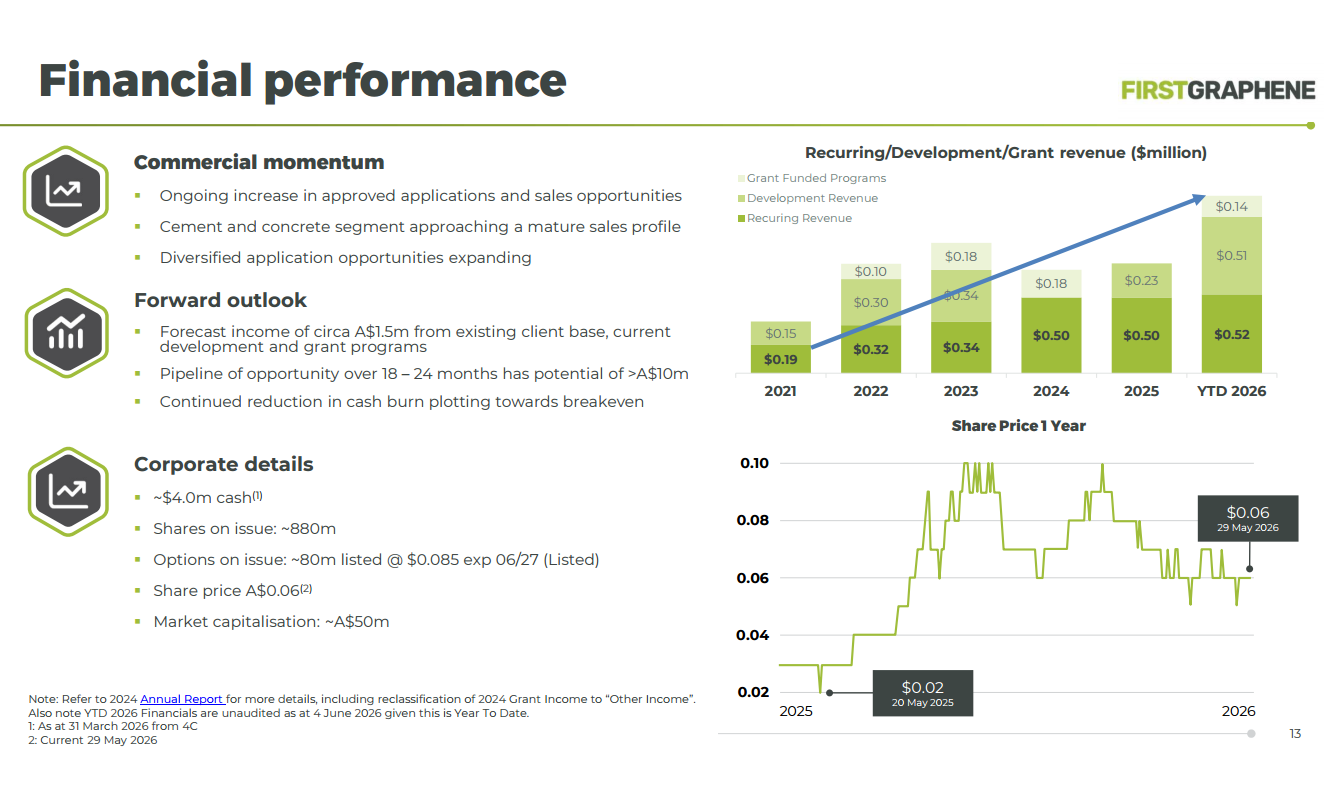
First Graphene’s June 2026 quarterly report recorded unaudited income of about A$135,000, comprising roughly A$103,000 in graphene sales, mainly from composites, and A$32,000 from development and grant-funded programs.
Customer receipts were A$109,000, while net operating cash outflow was A$734,000.
For FY2026, operating cash burn was A$2.394 million, 12% lower than the prior year, and the company expected revenue to rise 13%.
It ended June with A$2.867 million in cash and no reported financing facilities, equivalent to an estimated 3.9 quarters of funding at the June-quarter operating cash-flow rate.
About A$1.5 million of income is forecast from the existing client base and current development and grant programs and identified more than A$10 million of potential pipeline revenue over 18 to 24 months.
What happens next
The next stage of First Graphene’s development will be determined by its ability to convert technical validation and distribution agreements into recurring sales.
In cement and concrete, the immediate objective is to turn the FP McCann roof-tile results into commercial supply arrangements and apply the production data to other concrete products and geographic markets.
In China, progress will be measured through customer trials, initial PureGRAPH CEM sales and movement towards the 200-tonne threshold for joint venture or licensing negotiations.
In the US, the company must retain MITO’s existing customers, secure repeat orders and advance the acquired pipeline of more than 25 late-stage opportunities. Progress with US EPA registration will also influence the range of markets First Graphene can address directly.
For the Ionic and Imagine assets, the priorities are commissioning the coating line, rebuilding the customer pipeline and demonstrating that the geotextile formulations can generate sales without requiring substantial additional capital.
Across the business, the most important financial measure will be whether revenue growth begins to outpace operating expenditure and reduce reliance on external funding.