
Employment dropped by 15,800 against expectations for a 12,000 increase, while weaker labour force data pushed the Australian dollar and bond yields lower.
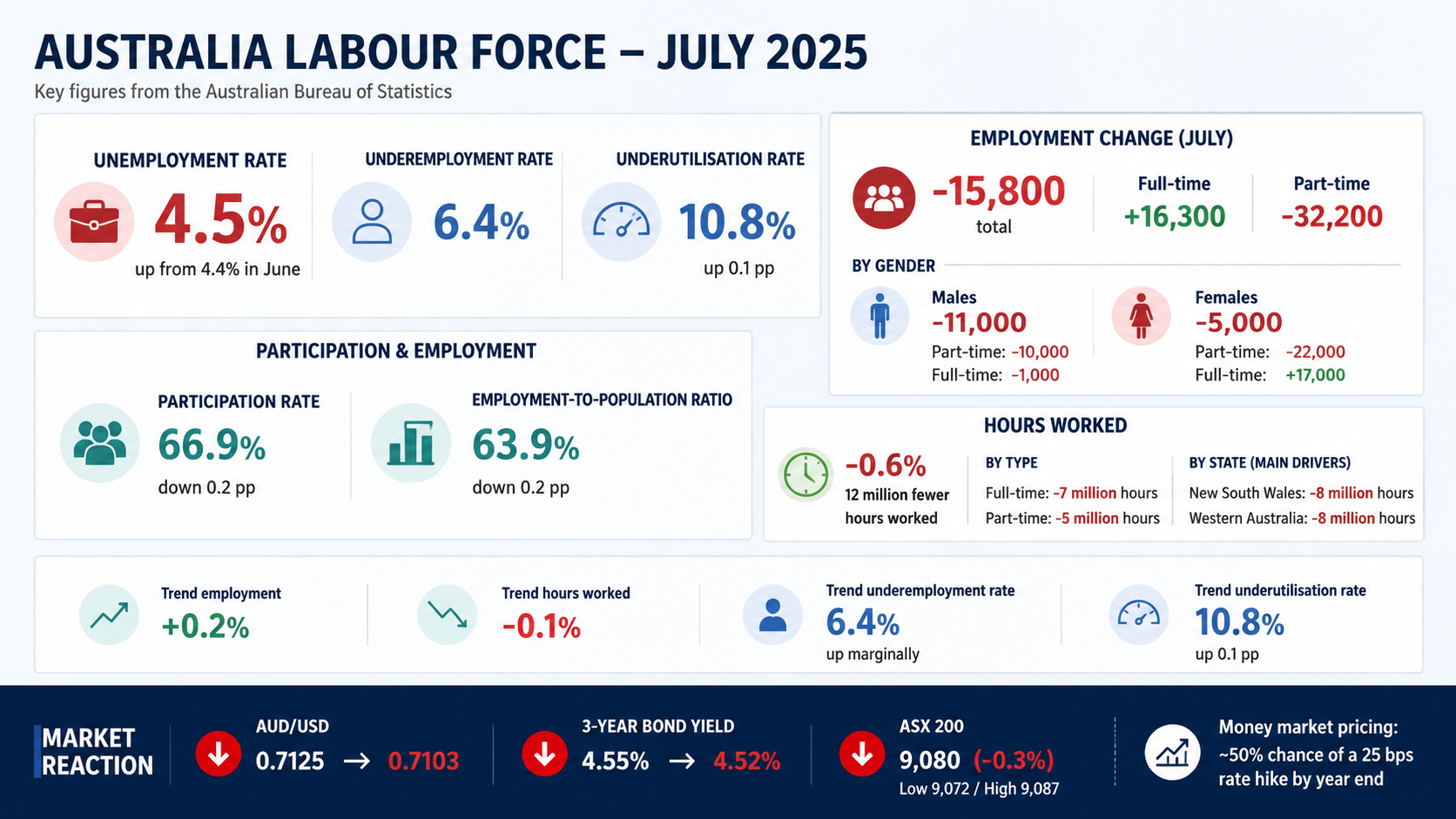
Australia’s seasonally adjusted unemployment rate rose to 4.5% in July as employment fell, according to the latest Australian Bureau of Statistics (ABS) labour force data.
Employment declined by 15,800 people over the month, compared with market expectations for a rise of 12,000, while the number of unemployed people increased by 4,000.
The unemployment rate had been expected to remain unchanged at 4.4%.
ABS head of labour statistics Sean Crick said the majority of the decline in employment came from males.
“In July, we recorded a 16,000 person fall in employment, whilst the number of unemployed people rose by 4,000,” Crick said.
“The majority of the fall in employment came from males, which fell by 11,000 people. There were 10,000 fewer males employed part-time, and 1,000 fewer in full-time employment in July.”
Female employment fell by 5,000, with part-time employment down 22,000 but full-time employment increasing by 17,000.
Overall, full-time employment rose by 16,300 while part-time employment fell by 32,200, indicating that the weakness was concentrated in part-time work.
Participation and hours worked decline
The participation rate slipped by 0.2 percentage points to 66.9%, in line with expectations, while the employment-to-population ratio also fell 0.2 percentage points to 63.9%.
The underemployment rate was 6.4%.
Hours worked fell by 0.6% in July, equivalent to 12 million fewer hours.
“There were 12 million less hours worked this month, with those employed full-time working 7 million less hours, and those employed part-time working 5 million less hours,” Crick said.
New South Wales and Western Australia were the main contributors to the decline, with hours worked falling by 8 million in each state.
In trend terms, employment increased by 0.2% while hours worked fell by 0.1%.
The trend underemployment rate edged up to 6.4%, while the underutilisation rate rose 0.1 percentage points to 10.8%.
Australian dollar, bond yields fall
Financial markets reacted to the weaker-than-expected jobs figures, with the Australian dollar and government bond yields moving lower.
AUD/USD fell from US$0.7125 to US$0.7103 following the release, while the 3-year Australian government bond yield declined from 4.55% to 4.52%.
The ASX 200 was down 0.3% at 9,080, having recovered slightly from 9,072 to 9,087 after the data were released.
Money markets were pricing in roughly a 50% chance of a 25-basis-point interest rate increase by the end of the year.
The stronger full-time employment result may temper some of the market reaction to the headline decline in jobs, given the overall fall was driven by part-time employment.