
Gordon Neal has a formula, and he doesn't pretend otherwise: find the smartest geologists in the room, follow their instincts, and let grade and tonnage do the talking. It worked at MAG Silver, which he helped grow to a multibillion-dollar valuation. It worked at New Pacific Metals, where he took the company from roughly $75 million to more than $1.5 billion. Now he's betting it will work a third time at Domestic Metals Corp (TSX-V:DMCU, OTCQB:DMCUF, FRA:03E0), a junior explorer advancing the Smart Creek copper-gold-silver project in southwestern Montana.
Neal joined as CEO in December 2025, but the pull toward Smart Creek started earlier and came from an unusual source: Rio Tinto. The mining giant retains a 40% interest in the project and, according to Neal, has repeatedly declined offers to sell down its stake. For a company with a market capitalization in the $15 million to $17 million range, that kind of persistence from a major is hard to ignore.
Rio Tinto also connected Domestic Metals with veteran porphyry geologists Dan MacNeil and Alan Wainwright, whose read on the property helped convince Neal to take the job. Their assessment was reinforced, he said, by a conversation with Peter Megaw, widely regarded as a leading authority on carbonate replacement deposits and a co-founder of MAG Silver. "He said, 'Geez, those are high results. I think you probably have a carbonate replacement deposit,'" Neal recalled. Megaw has since visited the property and floated an even bigger idea: that Smart Creek could host a cluster, or what he calls an "octopus," of carbonate replacement deposits feeding off a central porphyry system.
A project Rio Tinto wouldn't let go
Domestic Metals acquired Smart Creek in August 2024. The 8,000-hectare property sits about 100 km southeast of Missoula and 20 km north of Philipsburg, Montana, roughly 50 km northwest of the Butte mining district, one of the most productive copper camps in U.S. history, credited with 24.8 billion pounds of copper produced between 1880 and 2004.
Rio Tinto drilled 26 of 40 permitted sites at Smart Creek over two and a half years, vectoring toward what it believed was a porphyry centre. Its best hole, drilled in 2022, returned 109.73 metres grading 0.75% copper, including 89 metres at 0.97% copper. Notably, that hole was vertical and, based on subsequent work, appears to sit distal to the main mineralized source.
Since taking over the project, Domestic Metals has layered on geological mapping, surface sampling and an induced polarization geophysics program. A 2025 field campaign collected 310 surface samples, with standout results including 102 g/t gold, and a sample returning 74.7 g/t gold alongside 13.8% copper and 3,810 g/t silver. Geophysics has since identified five areas of interest, all pointing toward a central zone the team believes hosts the porphyry core.
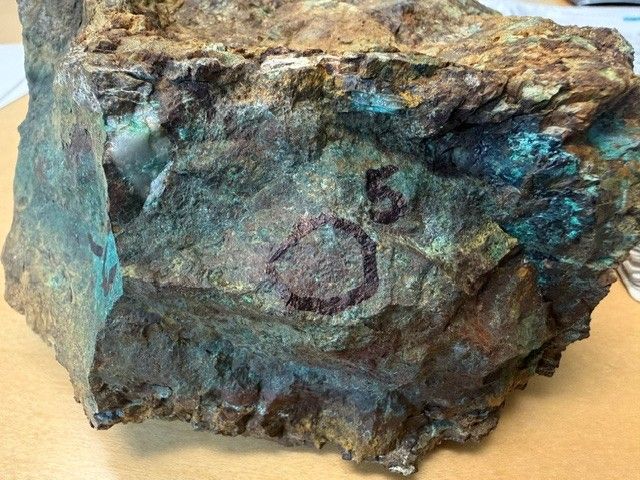
Neal points to a single field visit as a turning point. Megaw picked up a rock during a site visit and estimated it at roughly 12% copper. Internal results came back at 38%.
Drilling with a different angle
Domestic Metals is preparing to launch a 9,000-metre, six-to-eight-hole diamond drill program in late August, fully funded through existing treasury. The first phase targets three holes of 600 to 800 metres near Rio Tinto's historic discovery hole, expected to take about 45 days. The second phase shifts west to the Sunrise target, a past-producing gold-copper mine, for four additional holes.
The key difference from Rio Tinto's approach, Neal said, is geometry. Where the major drilled vertically, Domestic Metals plans to drill at an angle, based on evidence that mineralization dips to the west.
"You do not want to drill a vertical hole into a dipping structure because, if you catch it in the wrong place, you are not getting a true representation of the mineralized width," Neal said.
The Sunrise area carries its own appeal. McNeil and Wainwright identified a four-gram-gold porphyry dyke exposed at surface there, a target Neal said Rio Tinto had missed.
Building in a mining state
Montana ranks sixth among US jurisdictions on the Fraser Institute's investment attractiveness index, and Neal describes it as a working mining state rather than a contested one.
“Montana is a mining state,” Neal said, pointing to a warm reception from local officials and business owners in Philipsburg, near the project, as well as engagement with the state's governor. “Getting us to the next phase and working in Montana is going to be quite exciting. It is not going to be easy, but I think it is going to be a place where the investing public, or at least the stakeholders in the area, are certainly welcoming us.”
Broader US policy attention on critical minerals, including a recent White House meeting between President Trump and major mining CEOs, adds a tailwind Neal expects Domestic Metals to eventually benefit from. “If we find what I think our geologists are telling me is there, this could be a major economic discovery. It is in the same geology, the same rocks and the same batholith area of Montana as the Butte mine.”
He's careful not to promise a timeline the rocks can't keep. "You have to take your time. It does not happen overnight," he said. But with permits secured, a drill rig now under contract, and assay labs quoting faster turnaround than expected, Domestic Metals is entering the phase where Neal's thesis, that Smart Creek's geology, jurisdiction and technical backing add up to something Rio Tinto was unwilling to walk away from, gets tested against actual drill core.
For a company trading at a fraction of the valuations Neal has delivered before, the next set of assays will tell investors whether history is repeating itself.