
Pinnacle Silver & Gold Corp (TSX-V:PINN, OTCQB:PSGCF, FRA:P9J) has reported assay results from its ongoing underground drilling program at the Potrero gold-silver property in Durango, Mexico, with drilling at the historic Pinos Cuates mine extending the known strike length of mineralization to at least 70 metres.
The company has drilled 58 of a planned 108 holes to date, with assays received for the first 37. The program consists of short, closely spaced holes drilled from historic mine workings to better define the size, shape and average grade of the mineralized zones.
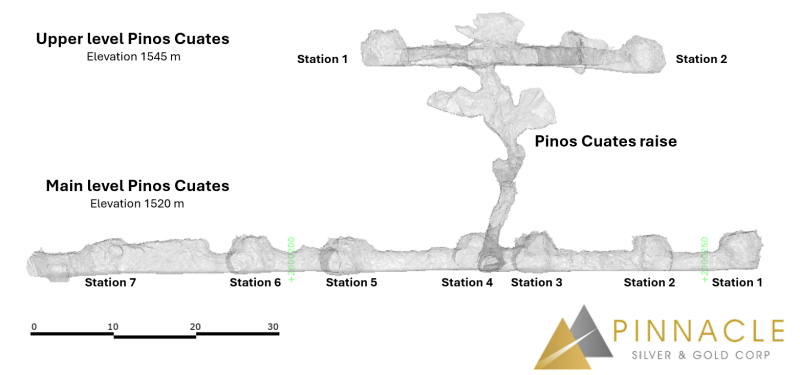
Among the results, hole EPUG26035 was drilled horizontally from the upper level of the Pinos Cuates mine to test for mineralization extending northwest along the vein. The hole confirmed mineralization for at least another 20 metres in that direction, including a 13.18-metre core-length interval grading 9.69 grams per tonne gold and 143 grams per tonne silver.
A 1.07-metre portion of the interval contained fine-grained visible gold and returned 59.2 grams per tonne gold and 424 grams per tonne silver. Pinnacle noted that the orientation of the hole makes it difficult to determine the actual width of the mineralized zone.
Drilling also extended the mineralization toward the southeast. Hole EPUG26025 returned 0.97 grams per tonne gold and 16 grams per tonne silver over 4.50 metres, while EPUG26026 returned 9.54 grams per tonne gold and 134 grams per tonne silver over 1.5 metres. Based on these results, the company estimates the Pinos Cuates upper-level mineralized zone now has a strike length of at least 70 metres.
“The first results from the Pinos Cuates mine are extremely encouraging,” Pinnacle CEO Robert Archer said in a statement. “As we have recently demonstrated from the underground channel sampling at the Dos de Mayo mine, higher-grade mineralization occurs in sub-vertical ‘shoots’ separated by lower-grade vein material.”
Archer added that because the underground drilling is being conducted either within or adjacent to the vein, some of the mineralization has already been mined.
He said that the drill holes are nevertheless “proving to be invaluable in improving our understanding of the El Potrero mineralizing system.”
The company also reported that underground drilling, drift mapping and channel sampling indicate an estimated true thickness of the Dos de Mayo vein of between 6.5 and 7 metres at the upper Pinos Cuates level. However, Pinnacle noted that the drill holes do not cut the entire structure, so the estimate does not represent the full vein width.
Pinnacle also cautioned that oxidation and fractured rock resulted in poor core recoveries in some holes, locally averaging as low as 20%. The company is conducting additional panel sampling and resampling of portions of some holes and noted that some holes could be redrilled if the additional work results in higher assay grades.
The Dos de Mayo vein is the principal mineralized structure in the northern portion of the Potrero property. The company describes it as a complex breccia structure containing quartz and quartz-calcite veinlets, with silicification and oxidation. Fine-grained visible gold has also been observed locally.
Surface drilling is expected to begin in September or October, with the program planned to test gaps between the historic mines, as well as areas up and down dip and along strike to the northwest on the Dos de Mayo vein. Pinnacle also plans to drill the El Capulin and La Estrella mineralized veins for the first time.
The company intends to use the combined drilling results to prepare an internal resource estimate and subsequently develop a preliminary mine plan.
Shares of Pinnacle added 9.5% in Toronto on Tuesday.