
Shane Bishop started his career the way most pharmacists do: behind a counter, handing over a bottle of pills with a short list of warnings. "Take this with food." "This may cause drowsiness." Two minutes, maybe less, then the next patient in line.
It didn't take long for him to see the limits of that model. Working inside long-term care and skilled nursing facilities early in his career, Bishop watched pharmacy and nursing teams struggle to stay in sync. Medication orders moved through clumsy systems. Communication broke down between the pharmacy counter and the nursing station. Errors crept in.
"There were a lot of inefficiencies, miscommunications and errors happening between the pharmacy and nursing teams," Bishop told Proactive. "The systems were clumsy, the communication was not there, and it was clear there had to be a better way."
That conviction became the founding idea behind Custom Health Holdings Inc (TSX:CHLT), the company Bishop now leads as CEO. What began as software to tighten medication workflows inside nursing facilities has grown into a national platform that follows a single tablet of medication from the pharmacy shelf to a patient's kitchen counter, and increasingly, into the hands of the physician managing that patient's care.
From the nursing station to the living room
Custom Health's first innovation was built for institutional settings: technology that tracked medication as it moved from pharmacy to nurse to patient, complete with image capture and an accountability trail designed to eliminate errors. That groundwork, laid years ago, raised an obvious next question for Bishop and his team. Could the same discipline that made nursing stations safer be recreated in a patient's own home, without a nurse present?
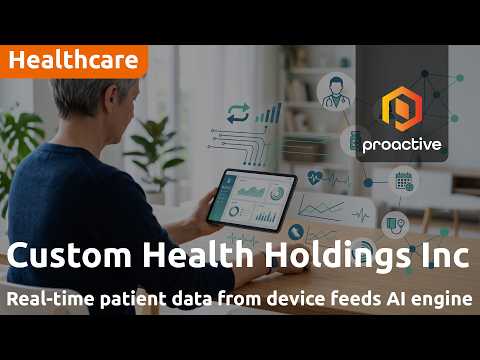
The answer is the company's in-home dispensing device. Patients plug it in, and it releases medication on a schedule, photographs each dose as it dispenses for chain-of-custody tracking, and prompts the patient with a short set of questions. Bishop is quick to point out that the hardware itself isn't the innovation. "It is about the interaction," he said.

That distinction matters, because Bishop is skeptical of how the broader industry talks about medication adherence. Reminder apps and pill-tracking gadgets are common, but Bishop argues they miss the deeper problem. "If an individual does not believe their medication is working, they will stop taking it. If they have side effects, they will stop taking it," he said. "And honestly, no one really knows."
The evidence sits in medicine cabinets across the country: bottles filled 90 days ago, barely touched, while doctors remain unaware anything has gone wrong. Custom Health's device is built to surface exactly that gap, asking patients in real time how they're feeling and whether the medication seems to be working, then routing that information, along with adherence data, to a clinical team.
Data with somewhere to go
Collecting patient feedback is only useful if someone acts on it, and this is where Bishop says artificial intelligence stands to change what's possible. The goal is for AI to help the company's remote clinical team sort through the flow of daily patient data and flag the cases that need attention, effectively serving up patterns "on a silver platter" for clinicians to review and escalate.
From there, recommendations move directly into physician records and workflows, closing a loop that Bishop describes as the ultimate goal: pharmacists, clinicians and doctors working from the same data set. "When you bring pharmacists and doctors together, in my opinion, looking at the same set of data, you can really improve patients' lives," he said.
Pain management has become an early proving ground. By capturing a daily pain scale directly through the device, Custom Health has been able to provide clinicians with more timely information to support medication-management decisions rather than waiting for a follow-up visit months later. Bishop says the company has seen a 27% reduction in opioid usage among the patients it works with in this segment.
Owning the technology stack
Custom Health has worked with Spencer Health Solutions' device technology for several years, and has now signed a binding agreement to acquire the company outright. Bishop framed the move as a natural next step rather than a pivot. "Once that model became ingrained in the company's operations, it made sense to acquire Spencer Health Solutions," he said, adding that bringing the technology and engineering team in-house allows Custom Health to align the product more closely with its pharmacy and clinical operations.
The financial logic is straightforward: owning the hardware is expected to reduce device costs and eliminate duplicated support functions, from patient support lines to cellular connectivity, improving margins on a per-patient basis. It also hands Custom Health full control over the product roadmap, including the newly developed Gen2 device, which Bishop says will bring expanded AI capabilities and improved voice interaction.
Betting against the volume model
Bishop is candid about swimming against the current of an industry built on volume. Large retail pharmacy chains, he argues, generate margin by filling as many prescriptions as possible, leaving little room, or reimbursement, for pharmacists to spend time actually understanding a patient's condition. "Our model is not about that at all," Bishop said. "Let's actually take the time, use the technology and deliver an outcome."
That model depends on a specific kind of acquisition target: closed-door, non-retail pharmacies in geographies where reimbursement frameworks, including US programs like remote therapeutic monitoring and chronic care management, already support the company's approach. Bishop says roughly 80% of near-term growth is expected to come from the US, where those reimbursement structures are further along, with Canada representing a smaller but real opportunity.
For Bishop, the payoff shows up in the stories that reach his team, including a Parkinson's patient who told the company the daily attention from its clinical staff outpaced what came from quarterly neurology visits. "The reason is simple," he said. "The neurologist may be getting data every 90 days, while we are getting it every day."
The next 12 to 24 months are a groundwork phase focused on capacity, with Custom Health continuing to acquire closed-door, non-retail pharmacies in markets where reimbursement already supports its model. The goal is to build out infrastructure while growing revenue and EBITDA. From there, Bishop sees the larger data sets driving a new healthcare model built around outcomes, provider collaboration, and lower total cost of care.
"Ultimately, as we get larger sets of data, it is really about driving a new healthcare model: looking at the data, looking at the outcomes, and working with providers and health plans to innovate," he said.
It is, Bishop says, the mark he hopes to leave. "I would love to be able to look back one day and say, 'Yeah, we changed the way things were done, and we actually left our mark on healthcare.’"