
Junior miners spend most of their existence chasing grade. Nine Mile Metals Ltd. (CSE:NINE, OTCQB:VMSXF, FRA:KQ9) has the opposite problem at parts of its Bathurst Mining Camp land package: ore so rich that the region's processing infrastructure isn't built to handle it.
It's a strange complaint for a resource company to have. At Nine Mile Brook, drilling has returned intervals grading as high as 15% copper alongside significant lead, zinc, silver and gold. That grade is high enough that the company has entered an agreement with commodities giant Glencore to test whether some of the material could bypass conventional milling altogether and go straight to a smelter.
As Nine Mile CEO Patrick Cruickshank explains, a mill is optimized around a specific type of ore, so it would need to make adjustments for different material.
"The biggest concern is impurities, because the milling process typically helps separate and remove those elements," Cruickshank told Proactive.
Whole drill core has already been shipped to Glencore for direct-to-smelter testing, while two additional bulk samples are undergoing metallurgical and gravity separation testing, a roughly three-month process. Depending on the outcome, the lead-zinc component could ultimately be routed to a Glencore facility in Quebec, with copper-gold material potentially destined for the Horne Smelter.
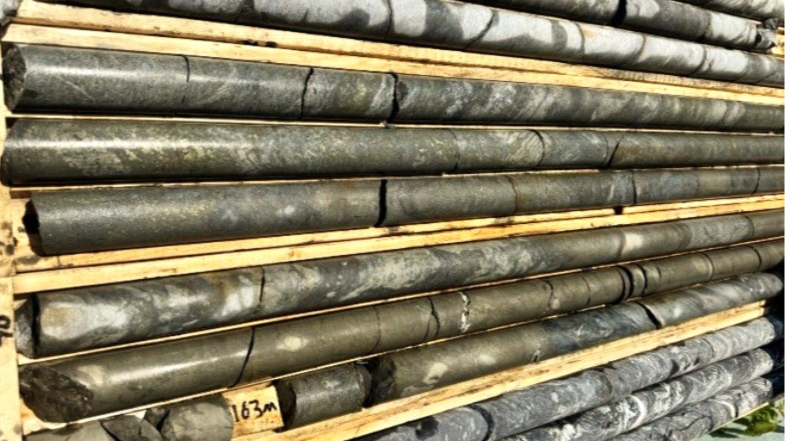
Even logistics become a variable at this scale. A 3,000-tonne bulk sample carries an estimated contained metal value of roughly $4,000 per tonne, by Cruickshank's estimate, but shipping that tonnage to a facility like Kidd Creek in northern Ontario could cost close to $1 million on its own, and most mills want closer to 10,000 tonnes to justify dedicating a processing shift to unfamiliar ore. "Bulk sampling is not intended to be a revenue-generating activity, so it's a sensitive topic from a regulatory standpoint," Cruickshank noted. "The purpose is to test and validate the metallurgy and processing options."
The grade problem is really a symptom of a broader thesis Cruickshank has been building for two and a half years: that the Bathurst Mining Camp's most efficient path to new production doesn't run through greenfield discovery alone, it runs through mines that were shut down decades ago for reasons that no longer apply.
The Wedge Mine is the clearest example. Operated by Cominco through the 1950s and into the early 1960s before Teck took it over, Wedge produced an estimated 1.5 to 2.5 million tonnes of ore, almost entirely valued for lead and zinc. Silver was trading near $1 an ounce at the time, copper wasn't especially valuable, and gold assays weren't routinely run. "If miners couldn't see the gold, they generally ignored it," Cruickshank said.
Operations ended not because the deposit was exhausted, but because a support pillar collapsed after roughly a third of the vertical deposit had been mined. Repairing it wasn't economical at the commodity prices of the era, so the mine was abandoned with an estimated two-thirds of the system still in the ground.
Six decades later, Nine Mile is revisiting that resource with tools the original operators never had. Drone surveys and geophysical work over the past two years have effectively produced what Cruickshank calls a treasure map of the property. Drilling on the mine's undrilled eastern side added several million tonnes of mineralization, and last year's drilling on the southern portion of the deposit returned copper grades up to 8%. Borehole electromagnetic crews will soon be on site to survey seven holes, generating three-dimensional imagery that extends 300 to 400 metres in every direction from each hole and can distinguish new mineralization from old workings and voids.
The company has already identified three mineralized lenses at Wedge where historically only one was recognized. Cruickshank's stated goal is to demonstrate five to 10 million tonnes remaining, at grades strong enough, when combined with the silver and gold values showing up in recent drilling, to support a return to production.
The same logic underpins the company's approach at Nine Mile Brook, home to what Cruickshank describes as the highest-grade VMS lens ever discovered in the Bathurst camp, and at Canoe Landing, where Nine Mile's ground abuts a 32-million-tonne deposit owned by Wolfden Resources. "Whoever ultimately develops that deposit will almost certainly have to work with us, or vice versa, because together we control the full mineralized system," Cruickshank said, adding that a joint venture or acquisition are both options the company is watching.
It's a strategy built on a simple mining adage Cruickshank likes to repeat: the best place to find a new deposit is in the shadow of an existing one. With 45 known deposits already mapped across the Bathurst camp, he sees more value in applying modern geophysics and AI-assisted target modeling to old, well-understood ground than in searching blind.
Underlying all of it is a change in Nine Mile's financial position that Cruickshank argues is as important as any drill result.
Having raised just over $5.6 million recently, Cruickshank says the company doesn't expect to need additional financing for more than two years, freeing it to run a multi-target drill program across Wedge, Nine Mile Brook, California Lake and Canoe Landing Lake without the dilution pressure that has historically capped its share price rallies. A second drill rig is being mobilized directly to the West Wedge and Tribag targets, part of six priority drill targets identified since January.
That funding also changes the company's appetite for risk. "Previously, we didn't want to start drilling every target because our funding was limited," Cruickshank said. "Now we're fully funded, and we have access to better technology and more advanced algorithms, which gives us the confidence to be much more aggressive."
The bigger picture
Nine Mile's approach is unfolding against a favourable backdrop in New Brunswick, where the provincial government has stated its ambition to become Canada's leading jurisdiction for critical minerals and has pointed to the planned restart of the Lake George antimony project as evidence of that commitment. Cruickshank also points to the arrival of Kinross in the district, growing interest from companies like Rio Tinto and Glencore, and roughly 15 public companies now active in the camp as signs that capital is returning to a region long defined as a lead-zinc district but increasingly valued for its copper, silver and gold.
Whether that momentum translates into a producing mine at Wedge, a fifth lens at Nine Mile Brook, or a resolution to the Canoe Landing overlap with Wolfden, Cruickshank frames the company's task in straightforward terms: "At this point, it's about execution: drilling the programs, delivering results, and creating value."