
The global iGaming industry is expected to have a growth rate of 10.5% in the run-up to 2030, according to Delasport’s 2026 iGaming Trends Report. Investment in the sector is an obvious attraction. Yet it is not just growth that should be looked at. How developers gain revenue from pokies has also changed, operating on subscription-style models that can include revenue shares. This recurring income is proving extremely lucrative.
The Mechanics of the Pokie Franchise
When discussing nuances of pokie franchises, it helps to know who plays what part in the sphere of casino operations. Most players will deal directly with the operators. These are the platforms such as Spinbit, which have a library of online pokies and other casino games they have acquired from developers. Essentially, these people are the franchisee, supplying games to those who sign up and pay to use their platforms.
The franchisor is the master studio or developer. Sometimes, this is done through a middleman in certain regions. Yet in others, platforms can go directly to the developer who oversees these partnerships. Using this revenue architecture, it is the franchise that deals with player acquisition and cash flow. The franchisor gets a fixed payment or a percentage of the recurring revenue. In Australia, this is big business. Australia has long had a history of slot innovation, with the world's second-largest manufacturer of gaming machines, Aristocrat, being housed there.
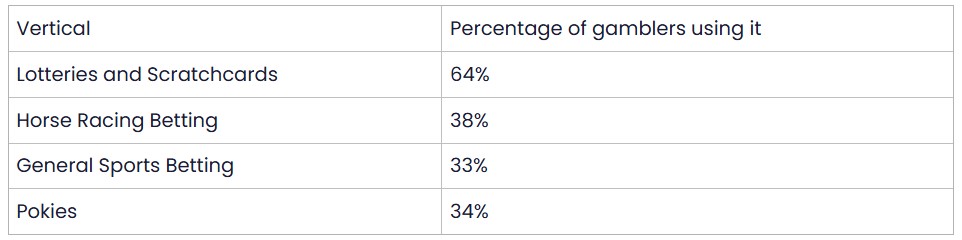
According to the Australian Institute of Health and Welfare, 93% of pubs in the country have poker machines. Three in four Australians gamble in a year. The table below shows what is gambled on.
The Third Party License
In many circumstances, the bond between franchisor and franchisee would keep the money flowing. Yet a new party is on the scene, in the form of the third-party licensee. In fact, this concept has been around for some time in iGaming. Way back in 2004, Microgaming released a pokie game based on the Eidos Tomb Raider franchise. Since then, everyone from chat show hosts to real-world gameshows have been scrambling to get their own slot made.
These licenses are also branching out from slots into table games and other verticals. In January at the ICE Barcelona Conference, Evolution Gaming unveiled its new line of titles in conjunction with Hasbro. The company has already pioneered a range of slots and live games based on its Monopoly franchise. Chief product officer Todd Haushalter noted that “In 2006, we started out dealing Roulette in front of a single camera to just a few online players on desktop computers in Europe. Today, tens of millions of players worldwide play our games and game shows, streamed in HD from our multiple state-of-the-art broadcasting studios around the globe. We also now offer RNG games from eight dedicated brands. We have changed the face of gaming forever, and now, with unlimited access to Hasbro’s world-famous brands, we look forward to evolving the space even further.”
iGaming SaaS
By using this model, iGaming businesses are providing a service akin to a subscription. This is different to how traditional gambling games and machines were sold. Consider the sale of a traditional pokie machine to a casino. After the initial purchase, no money is made for the manufacturer. Even if it is part of a revenue share, this income fluctuates. Seasons and other factors mean more or less footfall in casinos, making income hard to predict.
This is not the case with online pokies, which do not suffer the impact of weather or seasons. Instead, using return to player metrics and data from across the range of casinos carrying the game, a reliable revenue forecast can be made. Recurring usage fees can also keep this going.
Lastly, the data provided by players can continually improve and optimise these games, giving them extreme longevity. By making improvements, adding more of what players want, operators can keep players returning to a game. They have the ability to spawn multiple sequels that keep people coming back. Consider the Big Bass franchise, a fishing-themed slot that is now up to its 18th iteration and counting.
Brand Loyalty
In pokies specifically, brand loyalty shows up as a measurable behavior pattern rather than just an emotional preference: players searching for a franchise name directly rather than browsing a lobby, and studios tracking this via branded-search volume and "return visit to specific title" metrics rather than general site traffic. A player who searches "Big Bass Bonanza" by name is a different acquisition cost than one who lands on it through a lobby recommendation, and franchisors can price royalty and licensing deals accordingly, since a title with strong direct-search demand justifies a higher revenue share than one relying entirely on operator placement. The benefits of brand loyalty to a business are listed below.
- Lower acquisition costs
- Increased spending over a lifetime
- Provide consistent income
- Give word of mouth referrals
- Geographical and Regulatory Considerations
- Strong competitive positioning
There are several ways this is achieved when it comes to pokies. The themes and names of the games themselves do this: Book of Dead, Big Bass Fishin, Rainbow Riches, all slots that have built their own intellectual property and spawned intense loyalty from fans. Yet even certain game mechanics like Megaways and Slingo can foster the same loyalty.
When operators market these games, it is a win for those who license the franchise. They benefit from hands-free marketing, with none of the associated costs. This becomes even more powerful when these franchises become multi-platform, working across mobile, tablets, social gaming, and eventually working their way onto video slot machines in casinos themselves.
Operators that curate these franchise titles well can build their own brand loyalty on top of the games. Spinbit, for example, structures its lobby around franchise recognition, grouping titles together so players can follow a franchise across its sequels rather than hunting for it title-by-title. This kind of curation turns the platform itself into part of the discovery experience, rather than just a neutral marketplace for whatever games a developer supplies.
Operational Risks
While this all sounds like a win-win situation, with a growing sector and recurring revenue, there are pitfalls. Primarily, this comes from regulatory compliance and changing laws. As the franchisor acts as a software supplier, they have very little input on frontline sales. If regulations suddenly change in a jurisdiction, like banning slot games, then there is not much control they have over the casinos that operate their games and their traffic.
If these can be addressed, the developers acting as franchisors are onto a winner. With a growing sector and a demand for the product, all that can undo them is market saturation. Like the videogame crash of the eighties, when cartridges flooded shelves and destroyed the console industry, slot game developers must be careful not to do the same.
It's worth noting that this investment analysis relates to the business models of pokie developers and operators, not to gambling itself as a personal financial strategy. Gambling carries genuine financial and psychological risks for players, and those risks are a core part of the regulatory and reputational exposure discussed above.
Responsible Gambling Disclaimer –Gambling should always be viewed as a form of entertainment, never a way to make money. Age restrictions apply, and everyone using these systems should be 18+. Should gambling become an issue, or you feel you are gambling beyond your financial means, seek help.