
Dalaroo Metals Ltd (ASX:DAL) delivered a productive June 2026 quarter, extending the gold-in-soil corridor at its Bondoukou Gold Project in Côte d’Ivoire to around seven kilometres and advancing preparations for maiden reverse circulation drilling.
The company also expanded its Blue Lagoon critical minerals footprint in Greenland, mobilised its most comprehensive field campaign at the project to date and resumed systematic exploration at the Watheroo nickel-copper-PGE project in Western Australia.
Gold Ridge emerges as priority drilling opportunity
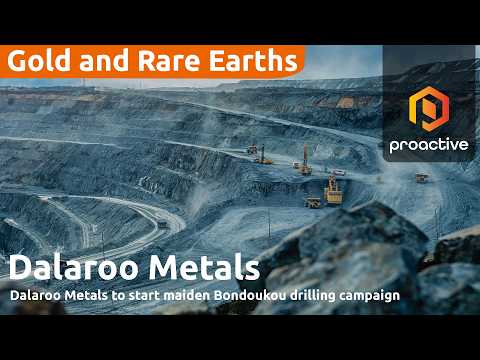
Exploration during the quarter focused on the Gold Ridge prospect within Bondoukou, where systematic soil geochemistry outlined a continuous mineralised corridor across the Mag, Wilfred and Ali target areas.
The program comprised about 194.5 kilometres of sampling lines and 3,612 primary soil samples, with 4,363 samples dispatched for analysis when channel, grab and quality-control samples were included.
Results extended the coherent gold anomaly from an initial 4.3 kilometres to approximately seven kilometres, with the system remaining open.
Peak soil assays included 23.26 g/t gold, 3.25 g/t, 2.54 g/t, 2.09 g/t, 1.96 g/t, 1.72 g/t and 1.21 g/t.
Across the combined dataset, 529 samples returned more than 25 parts per billion gold, including 127 samples above 100 parts per billion and 19 above 500 parts per billion.
The anomalies are associated with interpreted structural corridors, folded metasedimentary units, favourable lithological contacts, quartz veining and widespread artisanal workings, providing Dalaroo with a more coherent framework for drill targeting.
“The June quarter was a highly productive period for Dalaroo, led by the rapid advancement of Gold Ridge from a 2.5-kilometre exploration target to a coherent gold corridor extending approximately seven kilometres,” CEO John Morgan said.
“The strength, continuity and tenor of the soil results, together with the alignment of geochemistry, structure, geophysics and artisanal workings, have provided three clear priority target areas for systematic drill testing.”
Three targets defined across corridor
The northern Mag target extends for about 1.5 kilometres and is defined by a 100-parts-per-billion gold contour, with several of the strongest soil assays recorded in this area.
Wilfred, in the central portion of the corridor, extends for approximately 3.5 kilometres and is defined by a 50-parts-per-billion contour, while the southern Ali target covers around two kilometres of strike and is up to 1.2 kilometres wide.
Dalaroo secured three auger rigs and commenced a minimum 5,000-metre program during June to improve anomaly definition beneath transported cover, characterise the regolith profile and prioritise targets for RC drilling.
The company plans to begin with a staged 10,000-metre RC campaign, followed by a proposed 10,000-metre diamond drilling program, subject to results, final program design and funding.
Bondoukou lies within Côte d’Ivoire’s Birimian Greenstone Belt, around 35 kilometres northwest of Endeavour Mining’s Tanda-Iguela Project and adjacent to Koulou Gold’s Gontougo Project. Dalaroo holds the right to earn up to an 80% interest in the granted PR 825 permit.
Blue Lagoon footprint expands in Greenland
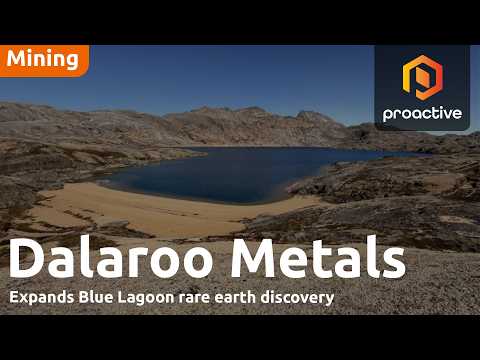
At the 100%-owned Blue Lagoon Project in southwest Greenland, Dalaroo completed the acquisition of exploration licence MEL 2022-07, consolidating ownership and operational control over the core project area.
The Greenland Government also approved exploration licences M-516 and M-517, expanding the company’s coverage of interpreted alkaline source rocks, sediment transport pathways and depositional environments.
Blue Lagoon is prospective for rare earth elements, zirconium, niobium and hafnium. Previous surface exploration defined a mineralised corridor of about 2.7 kilometres, with all 113 samples returning anomalous critical mineral values and peak results of 4.42% zirconium oxide, 99 parts per million hafnium and 0.81% total rare earth oxides.
Mobilisation began in June for an integrated program incorporating geological mapping, surface and sediment sampling, ground-penetrating radar, bathymetric profiling and nearshore sampling.
The work is designed to test Dalaroo’s source-to-sink exploration model, under which heavy minerals derived from alkaline intrusions may have been naturally concentrated in terrestrial, lagoonal and nearshore sediments.
“At Blue Lagoon, the approval of two additional licences and mobilisation of our expanded 2026 field campaign materially increased both the scale of the opportunity and the quality of the datasets being collected,” Morgan said.
Watheroo exploration resumes
Dalaroo also commenced a 466-sample soil geochemistry program at its 100%-owned Watheroo Project in Western Australia.
The work is targeting the Watheroo Chonolith prospect, an interpreted mafic-ultramafic intrusive system represented by a magnetic feature measuring about seven kilometres by three kilometres.
The target is considered prospective for magmatic nickel-copper-platinum group element mineralisation.
Stage-one collection was completed during the quarter, with 106 samples prepared for laboratory analysis. The program will help assess the scale and internal zonation of the intrusive system and refine potential follow-up geophysical and drilling targets.
Funding position and next steps
Dalaroo ended the quarter with A$211,000 in cash after spending A$1.58 million on exploration and evaluation activities. Note, they are currently raising $2.5 million.
The company reported estimated funding equivalent to 0.12 quarters based on the June-quarter expenditure rate. It said the period included planned exploration and one-off costs and that discretionary expenditure would be managed while further funding was pursued through an equity issue.
During the September quarter, Dalaroo plans to complete and interpret the Bondoukou auger program, finalise RC collar positions and begin the initial staged drilling campaign.
In Greenland, the company will complete the 2026 field program, submit samples for analysis and process its ground-penetrating radar and bathymetric datasets. At Watheroo, soil sampling and multi-element analysis will continue.