
Long gone are the days when a win on the pokies ended right there. New mechanics have increased game volatility to unprecedented levels. Now, a win can trigger multipliers, jackpots and myriad other mechanics to amp up the total. One popular tactic is the use of a cascading reel, in which winning symbols vanish and are replaced by new ones.
How Cascading Reels Work
Australians love pokies. Estimates are that the country has around 0.33% of the world population but a fifth of its pokies. This has been embodied in the proliferation of operators like Spinbet AU, who have evolved to serve the population of gamers with online digital games. Log on to these operators, and you will find a huge array of games from classic slots like those played in pubs and clubs, to advanced mechanics more akin to casual mobile games. One of the most popular of the latter is the cascading reel.
A typical cascade sequence unfolds in three steps. First, the initial spin lands and any winning clusters or lines pay out. Second, instead of a fresh reel spin, only the winning symbols disappear, and everything else stays in place. Third, the empty spaces are refilled, usually with symbols dropping down from above (hence 'cascading' or 'avalanche'), though some titles like Big Time Gaming's Bonanza series pull new symbols in from the sides depending on the grid orientation. This refill can trigger another win, and the cycle repeats until a spin produces no new matches, at which point the game resets for the next wager.
The Origins of Cascading Reels
The appeal isn't just visual; it's a shared psychological hook. In match-three and falling-block puzzle games, a single move triggering a cascade of clears creates a sense of momentum and escalating reward that the player didn't have to work for beyond the initial input. Slot developers noticed the same thing applied to wagering: a cascade reframes a single spin as a multi-stage event, stretching out the anticipation and making each subsequent tumble feel like a bonus on top of an already-resolved win. That's a large part of why the mechanic migrated so cleanly from free-to-play puzzle apps into real-money slots, where prolonging engagement per stake matters commercially.
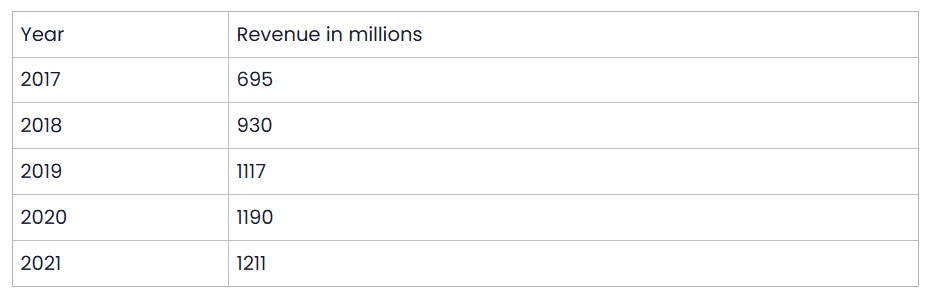
In the modern age, where mobile casual gaming has boomed due to smartphone adoption, bringing in these familiar elements makes a lot of crossover sense. Take Candy Crush, one of the most obvious places in which tumbling mechanics exist outside the iGaming world. Provided by Priori Data, you can see how much revenue this game has taken. Now consider that this was on a free-to-play mobile game.
Modern slots can trace the concept back to 2011's Gonzo’s Quest by NetEnt. This is a developer who has long looked to trends in other gaming markets and brought them into slots. Even in Gonzo's Quest, they were introducing a narrative element, turning their games into a story as opposed to a simple game of chance.
Since then, the cascading reel mechanic has had several names, depending on the developer who employs it. Below are a few of the monikers you may find it under
- Cascading reels
- Avalanche mechanic
- Rolling Reels
- Tumble Features
- Swooping reels
With only slight variations, many of these will operate in the same manner. Certain names may also be trademarked by a particular developer.
Added Features
In an online interview from August 2024 by Martyn Hannah, Anders Lokrantz, the Head of Game Studios at Relax Gaming, described the concept as follows: “We carefully design our games to integrate the tumble mechanic with a variety of bonus features. For example, free spins can be enhanced with an increased likelihood of tumbles, or certain symbols can become wild during tumbles, boosting potential wins. Some bonuses, like progressive multipliers or cascading wilds, complement the tumble mechanic exceptionally well, creating a more thrilling and rewarding experience for players.”
Thus, you will find cascading reels often come alongside a wide range of other mechanics. They are almost always attached to the famous Megaways games, where the number of symbols on a reel can change with each spin. When added to the shifting grid of this system, it literally creates thousands of ways to win.
Progressive multipliers are also popular with cascading reels. With this, every time a win occurs, a multiplier is added. If subsequent wins form due to the cascading reels, then higher multipliers get added. This means a second win could have x2 the wager, with the third going to x5. This makes wins bigger as they chain together, increasing volatility.
This chaining effect is part of what makes cascading titles with progressive multipliers so popular on platforms like Spinbet AU, where players can sort games by feature to find ones built specifically around this escalating multiplier structure. It also explains why these titles tend to sit at the higher end of the volatility scale covered further down, since a multiplier that keeps stacking through a long cascade chain is exactly the kind of mechanic that produces the big, infrequent wins high-volatility players are chasing.
Another feature that has utilised them is cluster pays. This is a concept in which the linear lines of the reels give way to a grid. Wins are formed when symbols cluster together, as opposed to forming in neat lines. This is another take from gaming culture, and when combined with cascading reels, can form extremely interesting titles more akin to strategy games.
Lastly, some titles actually use cascading reels to unlock access to special features. They may need three cascading wins to put you into a bonus round, for example, or to gain entry to a jackpot prize.
Utilising Volatility and RTP
As wins are often so big, this means volatility tends to be in the medium to high range with cascading reels. Volatility is the measure of how often a game pays out. Low volatility games pay often, but in small amounts. High ones are the opposite, and they pay out less frequently but in big explosive bursts. Think of it as paying a loan back. If you pay it in small amounts regularly, then you are low volatility. Pay it back in huge two lump sums, then it’s high volatility.
While this may feel like wins are actually bigger, it does not change the return to player rating. These big wins are factored into the game's RTP and reflected in the figure given. This is a measure of how much a game pays back over a given period of time, and is usually a probability calculated over thousands of spins. A game with an RTP of 97% would still give back 97% to players, regardless of its volatility, or how big the cascading reel wins were.
Thus, cascading reels are now a key feature of slot games. They don't alter how much the game pays out, or increase your chance of winning. Yet they do provide huge levels of excitement when they hit, often resulting in chains of wins. For fans of slots in Australia, they have really refreshed the genre and, with new additions, will continue to do so for some time.
Responsible Gambling Disclaimer – If you believe gambling may be a problem, then get help. There are lots of tools you can use, such as setting limits, self-exclusion schemes and taking breaks. It should only ever be viewed as a form of entertainment, not a way to make money. Gambling is strictly 18+.