
Which ASX-listed companies will profit from Australia’s online casino expansion without operating a single casino themselves? The supply chain behind digital gambling is deeper than it looks, and the investment case for gaming technology will strengthen heading into the second half of 2026.
Australia’s online gambling market was valued at USD 5.5 billion in 2025, according to IMARC Group. Projections place it at USD 9.0 billion by 2034, with a compound annual growth rate of 5.67%. Casino operators are the obvious winners from that trajectory. The less obvious ones are the companies supplying software, game content, data infrastructure, and payment rails that online casinos need to function.
Investors call this the “picks and shovels” approach. The phrase goes back to the California gold rush, where the reliable profits went to those selling equipment rather than panning for gold.
On the ASX, a version of that logic applies to online gambling in 2026. Platforms like SpinBit AU – an online casino with 2,000+ pokies, live dealer tables, and crypto deposits for Australian players – represent the demand side of that equation. And behind every platform like SpinBit, a chain of ASX-listed technology suppliers is collecting revenue on content, hosting, and transactions.
Aristocrat Leisure Is the Clearest Example
Aristocrat Leisure (ASX: ALL) reported AUD $6.3 billion in revenue for FY2025, an 11% increase on the prior year. Net profit before amortisation climbed 12% to AUD $1.6 billion. And in the first half of FY2026, profit after tax rose a further 16%.
But the faster-growing division is Aristocrat Interactive – the regulated online real money gaming business formed in April 2024 after the USD $1.2 billion NeoGames acquisition. Interactive revenue grew over 50% during the year, and management has flagged a USD $1 billion revenue target for the segment by FY2029.
CEO Trevor Croker addressed this at Aristocrat’s February 2026 investor briefing.
He called online real money gaming “the largest single opportunity in front of us,” adding that the company’s AI investment is focused on content creation and prototyping to improve speed to market, according to Asia Gaming Brief. Croker also noted that operators are increasingly focused on a unified view of the player as land-based and online converge.
Aristocrat doesn’t need any individual casino brand to succeed – it profits regardless, because it supplies the games and platform technology they all deploy.
Light & Wonder Picked the ASX Over the Nasdaq
In November 2025, Light & Wonder (ASX: LNW) delisted from the Nasdaq and moved its sole primary listing to the ASX, citing Australia’s deep understanding of the gaming sector.
Full-year 2025 revenue was USD $3.31 billion, with record consolidated AEBITDA of USD $1.44 billion.
Its iGaming segment has been the standout. In Q1 2026, iGaming revenue grew 18% year-on-year, with AEBITDA up 22%, driven by first-party content proliferation and an expanding partner network in the US. Light & Wonder also completed its acquisition of Grover Gaming during the quarter, adding over 660 premium units.
Light & Wonder is a picks-and-shovels play on exactly this basis: it supplies the games and systems, not the gambling operation itself. A player at SpinBit’s live casino spinning a Pragmatic Play or Quickspin title generates revenue for the content provider and platform layer – win or lose, the supplier collects its cut.
The Infrastructure Beneath the Games
Content suppliers attract the analyst coverage, but the infrastructure layer underneath them is a quieter story on the ASX.
Online casinos process real-time transactions around the clock. They store player data, need uptime guarantees comparable to financial services, and handle traffic surges during promotional windows. All of that requires physical data centre capacity.
NextDC (ASX: NXT), Australia’s largest listed data centre operator, reported net revenue of AUD $189.2 million in the first half of FY2026, up 13% year-on-year. Contracted utilisation surged 137% to 416.6 megawatts.
As of mid-2026 the company operates 17 data centres across Australian cities and opened its first international facility in Kuala Lumpur in May 2026.
NextDC doesn’t position itself as a gambling infrastructure company, and its share price won’t move on a single casino operator’s quarterly update – the revenue base is too diversified for that. But its co-location services – secure, carrier-neutral facilities connecting enterprises to cloud providers – are the type of infrastructure that high-traffic, latency-sensitive platforms require.
Gambling, fintech, and streaming are all capacity-hungry verticals growing in Australia, often competing for rack space in overlapping facilities. As a proxy for total infrastructure demand, NextDC illustrates how far the online casino supply chain extends beyond the casino itself.
Australia’s credit card ban for online gambling, introduced in August 2024, shifted transaction volume toward crypto and alternative methods – one factor behind the IMARC Group projection of continued 5.67% annual growth through 2034. SpinBit, for instance, accepts Bitcoin, Ethereum, Litecoin, and Tether alongside traditional card deposits – and each of those channels involves payment processors and settlement infrastructure provided by third-party vendors outside the casino itself.
Comparing the ASX Picks and Shovels Plays
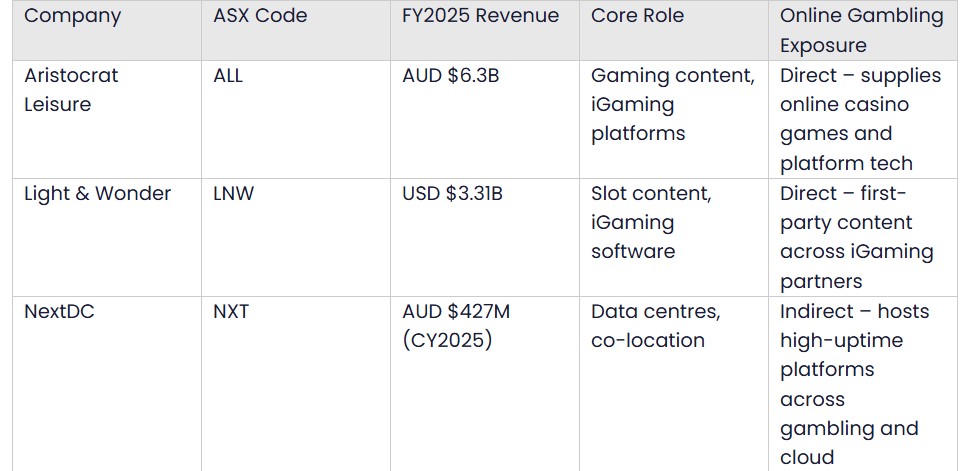
Exposure levels differ. Aristocrat and Light & Wonder are direct beneficiaries of online gambling growth. NextDC benefits from digital infrastructure demand more broadly, with gambling being one vertical among others. For investors, this translates to different risk profiles – but all three are positioned on the supply side of a market that continues to expand on the ASX.
SpinBit AU’s own catalogue illustrates the depth of that supply chain.
Its 2,000+ titles come from providers including Pragmatic Play, Hacksaw, Play’n GO, and Evolution – names that appear on the balance sheets of ASX-listed content aggregators. The platform also provides responsible gambling tools including deposit limits, loss limits, and self-exclusion, all of which involve software layers developed by third-party vendors. For an investor mapping the value chain, a single session at an online casino like SpinBit AU touches game developers, platform operators, payment processors, and data centre providers before a single pokie even spins.
Where This Goes From Here
A handful of developments to watch in the second half of 2026:
- Aristocrat has weighted its FY2026 gains toward H2, with product launches in both its Gaming and Interactive divisions expected before September
- Light & Wonder’s iGaming unit is forecast to continue double-digit revenue growth, particularly in the US and Canadian markets
- NextDC’s 297-megawatt forward order book is expected to convert progressively through FY2029, creating visible long-term revenue
- SpinBit and comparable online casinos continue to add titles from ASX-listed content providers, while the shift toward crypto banking creates new transactional volume for payment infrastructure companies
For investors considering the online casino sector on the ASX, the obvious approach – buying a casino operator – comes with customer acquisition costs and regulatory exposure, on top of margin pressure from bonuses and promotions.
The picks-and-shovels approach sidesteps that.
Gaming content companies and infrastructure providers generate revenue regardless of which operator wins market share, because they profit from the total volume of play across the entire sector.
Responsible Gambling Notice
Gambling involves risk and is intended for entertainment purposes only. Please gamble responsibly and only wager what you can afford to lose. 18+ only.