
Walk into any conversation about what makes an online casino succeed long-term, and player behaviour data will come up quickly. Not because it's a buzzword, but because the operators using it well are pulling ahead of those who aren't.
When you log onto a streaming service, personal recommendations are a given. They are something we have come to expect, be that on Netflix, Spotify or the PlayStation store. Thus, it stands to reason we would want the same from any online casino operators. By using player data, these platforms have the ability not only to provide a great service, but they can also use it to minimise the harms associated with gambling.
What is Behaviour Data
Behaviour data is the key metrics that tell an operator how a player acts and what choices they make. Pointers include session lengths, deposit amounts, game preferences, login times, and the devices they play from. This can be used to optimise both the players' experience and the platform.
Take a casino brand familiar to Australian players, such as Voltrush Casino. When you log in, you are placed in front of the most popular games. This is gleaned from the most simple of player behaviours: What is being used most. Yet the more you play and search, the more personalised these choices will become. Titles similar to those already experienced before will be suggested, optimising them for you as an individual.
Yet this also goes beyond suggestions for games that have been played. Even their deeper mechanisms, such as volatility, can be taken into account. With this, people may prefer games that pay out frequently in small amounts, or they may prefer huge, explosive payouts that come less often. This could even involve mechanics they prefer, like Megaways or Hold and Win features.
Why Is Behaviour Data Important?
All this data serves some very real-world purposes. These insights into customers and a business allow operators to make more informed decisions. The key benefits can generally be broken down into the three areas listed below:
- Personalisation and user experience
- Marketing strategies and campaigns
- Data-driven decision-making
The world of Gaming is extremely competitive. According to responsiblewagering.com.au, around $1.016 billon is spent by Australians each year on offshore gambling websites. This means that the offers and marketing methods used to gain new customers are also fiercely competitive. Having data available on which of these convert, and which impact an operator's margins the least, is imperative.
This also influences the decision-making processes online casinos must make. When it comes to spending a budget on a new library of games, they can delve into data to see which are the most played. What kind of mechanics do people want? Who are the most popular developers? This prevents them from spending money on titles that may not reap the rewards they desire, or crucially provide them with products customers don’t want.
What Types of Behaviour Data are Available?
Behavioural data does not just come from actions on a gambling platform either. The sphere of Australia's iGaming influence covers a multitude of locations, both in the real world and digital. This provides a wide net to cast when looking for player behaviours. It may be found in the following places:
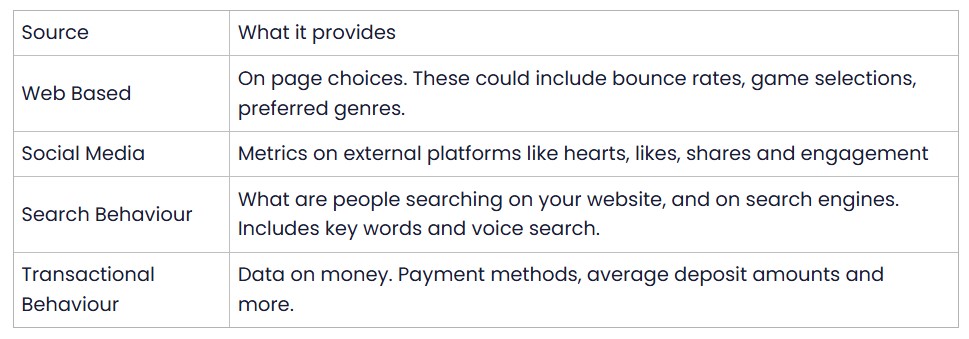
Not only has this influenced individual operators. This data has shaped how the industry has evolved over time. A perfect example is in its use of payment methods, moving from simple Visa and Mastercard deposits to modern methods such as e-Wallets, geo-specific models such as PayID, and, in other global locations, local prepaid voucher options. Platforms like Voltrush Casino have adapted accordingly, expanding their payment options to reflect exactly these kinds of behavioural shifts among Australian players.
Personalisation and Retention
When personalisation occurs, players are less likely to go elsewhere. This is known as retention, and is just as valuable as onboarding new customers. If players are satisfied, then they stay with an operator, spending more money and crucially, spreading the word by mouth. This can be more cost-effective than any amount of free spins or match deposits could ever be.
Getting quality behaviour data right may be more important than we think. In a world of AI and large language learning models, the systems we are building are only as effective as the data we put in. If this is incorrect, the AI could be incorrect, and it could be at scale. In the online casino world, this means that platforms could begin creating processes and products that people just don’t want or need. In further instances, they could become harmful and promote irresponsible gambling.
Ross Dickie is a Learning and Experience Consultant at Consultancy.uk.
Of this, he noted that “AI works best when layered over strong professional judgement. Experienced practitioners know how to spot flawed data, question assumptions and design for behaviour change. The risk lies with individuals who haven’t yet built that depth of expertise. For them, AI’s output can feel authoritative, even when it’s built on shaky inputs. In the wrong hands, the technology can normalise low-quality analysis.”
Responsible Gambling and Fraud Prevention
This data can also solve some of the problems associated with gambling. The most robust platforms are now employing these methods to track player behaviours and spot irregularities. This can be an early indicator of issues regarding problem gambling. Once spotted, they can make the appropriate moves, such as blocking deposits, or directing customers to take breaks, set limits or sign up to self-exclusion schemes.
In 2024, a study was conducted by Niklas Hopfgartner and Michael Auer in association with Neccton GmbH in Müllendorf, Austria and the Institute of Interactive Systems and Data Science at Graz University of Technology. They obtained data from 1,743 individuals across the UK, Canada and Spain. Using machine learning, it found that player behavioural indicators, such as the frequency of deposits in a session, were much better indicators of problem gambling than monetary indicators, such as the overall amount deposited. They also found that five machine learning models showed ‘promising results in predicting problem gambling’ and also improved when country-specific data was added.
Thus, behavioural data is imperative. It allows platforms to be fully modern endeavours, personalising in a world in which it has become a given. Yet it can also go much further, providing solutions to issues such as problem gambling. Moving forward into an AI-driven future, this data must be accurate and overseen by human elements if other concepts are to work effectively. By embedding these principles now, it points to a future that is both personalised and safe for those who inhabit it.
Responsible Gambling Disclaimer – Gambling should only be conducted by those who are 18+. This should never be viewed as a way to make money, only as entertainment. If you feel gambling is becoming too much, then get assistance. This can come in the form of limits, taking breaks when contacting third-party gambling help.