
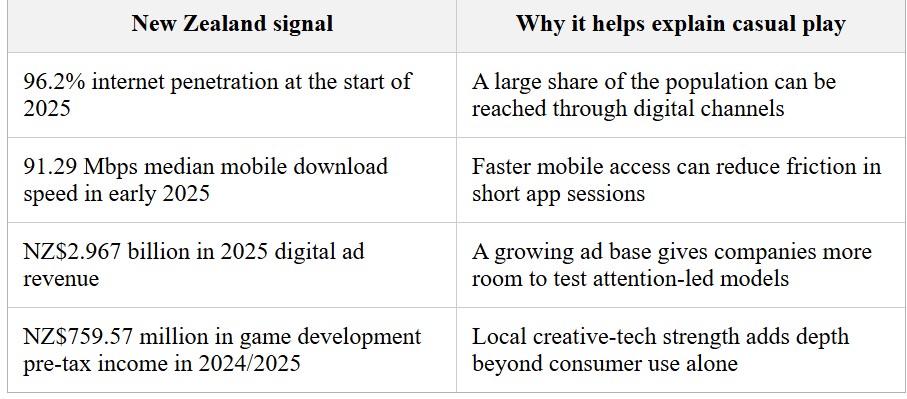
New Zealand had 5.03 million internet users at the start of 2025, equal to 96.2% internet penetration, according to DataReportal's Digital 2025: New Zealand. That one figure says a lot about why our small market can be so useful for reading digital entertainment behaviour: when nearly everyone is reachable online, casual play becomes easier to observe, measure and understand. If you follow brands in this space, even a SpinBet bonus offer is part of the same picture, because it shows how easy entry points draw people into casual digital leisure.
For New Zealand readers, the investment angle doesn't need to be wrapped in heavy market jargon. It starts with a simple question: if people here try a mobile entertainment product, return to it and interact with it often, what can that tell a company before it spends more heavily in Australia, North America or other English-speaking markets?
If you follow consumer entertainment brands such as SpinBet, the wider point is familiar. Casual play works best when it feels easy to enter, quick to enjoy and simple enough to return to without a lot of thought.
Kiwi Screens With Clear Signals
New Zealand's strength as a test market starts with its digital base. DataReportal reported 6.03 million cellular mobile connections in New Zealand in early 2025, equal to 115% of the population, while clearly noting that connections are not the same as unique people. That distinction is important because it keeps the story honest: we're talking about strong connectivity, not pretending every connection equals a separate player.
The quality of those connections adds another layer. DataReportal, using GSMA Intelligence figures, reported that 99.9% of New Zealand mobile connections were classed as broadband connections at the start of 2025, meaning 3G, 4G or 5G networks. The same source warned that broadband connection figures should not be treated as a proxy for mobile internet use, which is a useful reminder when reading any digital market statistic.
The performance picture is strong too. Ookla figures cited by DataReportal showed New Zealand's median mobile internet download speed was 91.29 Mbps at the beginning of 2025, up 30.6% year on year. For casual entertainment, that kind of speed helps the small moments feel smoother: opening an app, loading a feature, watching a short video or moving between screens without friction.
That's where the investment story begins to feel more grounded. A smaller country can produce clearer product feedback because companies can watch how people behave in a connected, everyday setting. If a casual play model struggles here, it may need refinement; if it earns repeat attention, that signal is worth taking seriously.
Big Readings From Tiny Sessions
Casual play often happens in short bursts. You might tap into an app between errands, while waiting for a bus or during a few spare minutes at home. Those moments can seem light from your side, but from a business side they can create a rich trail of signals about onboarding, return visits, design and timing.
The global category gives this local behaviour a wider frame. Mordor Intelligence valued the social casino market at US$8.36 billion in 2025 and estimated it would grow from US$9.06 billion in 2026 to US$13.49 billion by 2031, at an 8.32% CAGR. It also forecast Asia-Pacific as the fastest-growing region for social casino between 2026 and 2031, with a 10.19% CAGR.
New Zealand should not be presented as the engine of that global total. Its role is more useful than that. It can act like a behavioural testing room where companies see whether a product has enough clarity, pace and appeal before larger budgets come into play.
Brands such as SpinBet become easier to recognise from this perspective, because they sit in the wider world of fast, familiar digital leisure rather than in a remote technology niche.
The useful questions are simple:
- Can people understand the experience within the first few taps?
- Do they return after the first session?
- Do rewards, themes and features feel easy to follow?
- Can ads and app features sit together without making the experience feel cluttered?
- That's the part investors can miss. A five-minute session can still produce a long line of useful product data.
Ad Dollars Follow Attention
Once we understand the behaviour, the next question is commercial. New Zealand's digital advertising market reached NZ$2.967 billion in 2025, up 12% year on year, according to IAB New Zealand's Q4, CY 2025 Digital Advertising Revenue Report. The same report said it was developed with an independent third party, which gives the figures a stronger research footing.
Video was the standout format in that report, growing 27% year on year to NZ$653.8 million and accounting for 22% of total digital advertising revenue in 2025. Search remained strong at NZ$1.44 billion, up 12% year on year, while classifieds and directories grew 7% to NZ$389.5 million. For casual entertainment models, this tells us that attention has an active commercial market around it.
IAB Australia CEO Gai Le Roy put the broader pattern neatly, describing 2025 as 'a market that is growing, but selectively - driven primarily by video and search, while other display environments saw more modest movement'. That quote is useful because it points us away from lazy thinking. Digital growth is not spread evenly everywhere; investors need to look for formats that can show clear use, repeat interest and a sensible route to revenue.
Small Market With An Export Mindset
New Zealand's role becomes more interesting when we see it as both an audience market and a creator market. The New Zealand Game Developers Association reported that industry pre-tax income reached NZ$759.57 million for the 2024/2025 financial year, up 38.6% from NZ$548 million. The same NZGDA update said full-time equivalent jobs grew 29.2%, rising from 1,097 in 2024 to 1,418 in 2025.
That gives us more substance. We're not just a connected audience sitting at the end of someone else's product funnel. We also have a growing base of local game development talent that understands design, retention, export revenue and digital production.
When looking at SpinBet, the broader lesson is that entertainment habits can travel when the experience is simple, mobile-friendly and familiar to users across nearby English-speaking markets.
The Trans-Tasman link adds another useful layer. Industry reporting in July 2024 noted that ten New Zealand companies had listed on ASX in the previous 18 months, taking the total to 63. Separate commentary from 2023 said New Zealand information technology companies had become an expanding source of ASX listings, and that tech had become the top sector by number of IPOs.
That capital-market bridge gives investors a way to think beyond local audience size. A company can learn from New Zealand behaviour, refine its model and then look across the Tasman for a larger commercial arena. Deloitte Australia's 2025 media and entertainment consumer insights, reported in Australian media coverage, found average monthly digital entertainment spending rose from AUD$63 to AUD$78, a 24% increase.
The Clear Signal Ahead
The strongest investment story around social casino growth in New Zealand is not built on size. It is built on clarity. A compact, highly connected country can help companies see whether casual entertainment feels easy enough, repeatable enough and commercially readable enough before they place bigger bets in larger markets.
That is why New Zealand deserves more attention. We have high internet penetration, strong mobile performance, a growing digital advertising base, a rising game development sector and a clear Trans-Tasman route into deeper capital and consumer markets. None of that guarantees success for any single company, but it does give investors a better set of signals to watch.
The next interesting market clue may not come from a huge overseas launch or a complicated investor deck. It may come from what people here choose to open again tomorrow.
If a small market can reveal what people genuinely come back to, isn't that exactly the kind of signal investors should want?
Advisory Notice: A good rule of thumb is simple: gamble for fun, never for profit. Decide what you're willing to spend before you start, treat that money as already gone, and take a break if you notice yourself chasing losses or feeling pressured to carry on. If the enjoyment slips away or stress takes its place, you can talk to someone confidentially at any time through Gambling Help Online.