
Kingfisher Mining Ltd (ASX:KFM) earlier this week outlined its sharpened focus on the Broken Hill Project in New South Wales, with managing director Chris Bittar telling Proactive the company was building toward a maiden mineral resource at Copper Blow by the end of the year.
Bittar said the past six to nine months had been “a pretty transformative period for the company”, following its move from rare earth exploration in Western Australia to a portfolio of 11 New South Wales licences. Nine of those licences sit in the Broken Hill region, while the remaining two are in Cobar and Wellington.
He said Kingfisher Mining had recently divested its Western Australian rare earth projects to Dreadnought Resources, with the intention of focusing capital and management attention on the Broken Hill Project. Bittar said the timing was supported by the current pricing environment for gold, copper, silver and base metals.
A key catalyst for the company is expected to be upcoming assay results from the April drilling program at Copper Blow. Bittar said Kingfisher Mining had completed infill and extensional drilling to validate historical results and better understand the scale of the system. He said historical drilling had identified 16 metres at 2.6% copper with 0.6 grams per tonne gold, while more recent work returned 13 metres at 1.2% copper and 0.2 grams per tonne gold.
“At the moment we’re just laying the foundation,” Bittar said, adding that the work was building toward a maiden resource later in the year.
The company is also looking to maintain an exploration pipeline across the broader Broken Hill area. Bittar said desktop studies had identified lead-zinc-silver targets at Allendale and Stephens Trig, both north of Broken Hill. At Allendale, previous drilling intersected 10 metres at 16% lead-zinc with 29 grams per tonne silver credits.
Another potential catalyst is the agreement with Broken Hill Mines, which provides access to Broken Hill Mines’ Rasp processing plant in New South Wales. Bittar described the agreement as “a big step change for the company” and said it offered “a quick, cheap pathway to production” by reducing the need for Kingfisher Mining to build standalone infrastructure.
With Copper Blow around 20 kilometres south of Broken Hill and Allendale and Stephens Trig to the north, Bittar said access to existing processing infrastructure could lower the economic hurdle for the projects. He said planning was underway to return the rig to Copper Blow for further step-out drilling as Kingfisher Mining works toward the maiden mineral resource.
Interview highlights
- Kingfisher Mining has shifted focus from rare earth exploration in Western Australia to a New South Wales exploration strategy centred on the Broken Hill Project.
- The company acquired 11 licences in New South Wales, including nine in the Broken Hill region, plus one in Cobar and one in Wellington.
- Kingfisher Mining has divested its Western Australian rare earth projects to Dreadnought Resources to focus on Broken Hill.
- Copper Blow is being advanced through infill and extensional drilling to validate historical drilling and assess the scale of the system.
- Historical drilling at Copper Blow identified 16 metres at 2.6% copper and 0.6 grams per tonne gold.
- Recent drilling at Copper Blow returned 13 metres at 1.2% copper and 0.2 grams per tonne gold.
- Assay results from the April drilling program are expected in the coming weeks.
- Allendale and Stephens Trig provide additional lead-zinc-silver exploration targets north of Broken Hill.
- Previous drilling at Allendale intersected 10 metres at 16% lead-zinc with 29 grams per tonne silver credits.
- The agreement with Broken Hill Mines gives Kingfisher Mining access to Broken Hill Mines’ Rasp processing plant in New South Wales.
- Bittar said the agreement could provide a quicker and cheaper pathway to production by reducing the need for new infrastructure.
- The company is working toward a maiden mineral resource at Copper Blow by the end of the year.
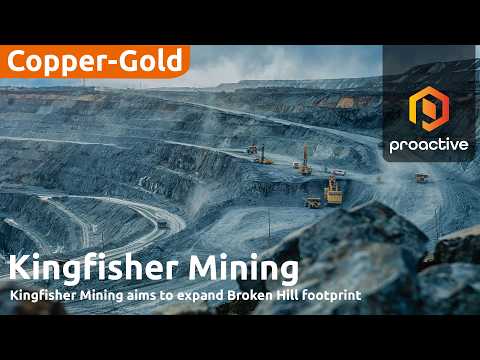
Proactive: With an eye on expanding its mineralised footprint and delivering a maiden resource estimate, Kingfisher Mining is full steam ahead at its Broken Hill Project. Here to discuss the project and what to expect from the company in the coming months is Managing Director Chris Bittar. Chris, welcome.
Chris Bittar: Thanks for having me, Jonathan.
Proactive: It’s a pleasure to have you. Before we get into the project, can you give us a high-level overview of the company?
Chris Bittar: Thank you. The last six to nine months has been a pretty transformative period for the company. This time last year, it was a rare earth explorer in Western Australia. Late in 2025, it completed an acquisition of 11 licences in New South Wales, nine of which were in the Broken Hill region. The other two were one in Cobar and one in Wellington.
Kingfisher Mining has recently divested its rare earth projects in Western Australia to Dreadnought Resources. The idea behind this was to allow the company to focus its resources and attention on the Broken Hill Project, particularly given the climate for gold, copper, silver and base metal prices at the moment.
The company has hit the ground running, with a couple of drill programs completed on its copper project over the past few months. That has been backed up by a recent mining and processing agreement signed with Broken Hill Mines in March.
Proactive: Let’s go back to Copper Blow. You’ve had some good results recently. Take us through those results and what you’ve been seeing there.
Chris Bittar: There has been a fair bit of work done at the Copper Blow project over the last 10 or 20 years. It has gone through a few hands, but now, with the price of copper and the change in sentiment towards the commodity, there is a bit more activity going on.
Kingfisher Mining has done infill and extensional drilling at Copper Blow to validate the historical drilling, and mainly to step out and get a grasp on the size of the system. It is an IOCG deposit and is considered the largest in the Broken Hill region.
Historical drilling identified zones including 16 metres at 2.6% copper, with 0.6 grams per tonne gold as credits as well. There are some good high-grade zones. Kingfisher Mining was able to step out that drilling and validate it with more drilling, where it got 13 metres at 1.2% copper and 0.2 grams per tonne gold.
At the moment, Kingfisher Mining is laying the foundation. It completed a program in April and is still waiting on the assay results, which are expected in the coming weeks. This is all building towards a maiden resource later in the year.
Proactive: You’ve got that going on, but you’ve also got work happening at Allendale and other places. Can you talk us through the other projects?
Chris Bittar: Kingfisher Mining is very mindful of keeping the exploration pipeline open. It has done a lot of desktop studies and identified two areas to the north of Broken Hill that are lead-zinc-silver projects underpinned by historic drilling.
One of the areas where the company recently mobilised the rig is Allendale, where previous drilling intersected zones of 10 metres at 16% lead-zinc, accompanied by 29 grams per tonne silver credits.
Kingfisher Mining has also completed a program at Stephens Trig. These sit about 10 to 15 kilometres north of Broken Hill, where historic drilling identified lead-zinc-silver mineralisation as well. The company has gone in and done infill and extensional drilling to validate and start getting a grasp on the size of these mineralised systems.
Proactive: All the work you are doing feeds into the strategic agreement you have with Broken Hill Mines. Can you talk us through that agreement?
Chris Bittar: The agreement signed with Broken Hill Mines is a big step change for the company. It allows Kingfisher Mining a quick, cheap pathway to production, where it can skip the long, arduous task of building infrastructure and diluting capital by having to spend hundreds of millions on building infrastructure.
The Broken Hill Mines agreement gives Kingfisher Mining access to Broken Hill Mines’ Rasp processing plant in New South Wales. Copper Blow is only 20 kilometres to the south of Broken Hill, and projects like Allendale and Stephens Trig are 20, 30 or 40 kilometres north of Broken Hill.
All of a sudden, these projects become economic as the hurdle to make money out of these projects is a lot lower, given Kingfisher Mining can skip the capex and avoid going through the building process.
Proactive: Assays are to come and there is a whole lot of work that you are doing as well. What’s next over the next few months?
Chris Bittar: Kingfisher Mining has started the planning process to get the rig back out to drill at Copper Blow and do some further step-out drilling. It will look to start doing some mining work, which is all leading into getting that maiden mineral resource done by the end of the year.
Proactive: Plenty to look forward to, Chris. We’ll catch up as it all unfolds. Thanks for your time this morning.
Chris Bittar: Thanks very much, Jonathan. Thanks for having me.