
New report says Australia’s AI advantage lies in critical minerals, strategic data, computer vision and international influence - but warns key gaps remain in compute, data management, skills and oversight
Australia does not need to control every layer of artificial intelligence to build national power, but it must better use its strengths in critical minerals, strategic data, infrastructure and trusted adoption to gain leverage in the global AI race, according to a new Tech Policy Design Institute report.
The June 2026 report, Expanding AI Sovereignty to AI Agency, argues that the national AI debate needs to move beyond the increasingly crowded idea of “AI sovereignty” and focus instead on “AI agency” — the practical ability to steer outcomes, protect national interests and capture value in a globally connected technology system.
The report says AI is reshaping global power, prosperity and security, but current debates about AI sovereignty are often binary, confused and disconnected from the trade-offs faced by governments and business leaders.
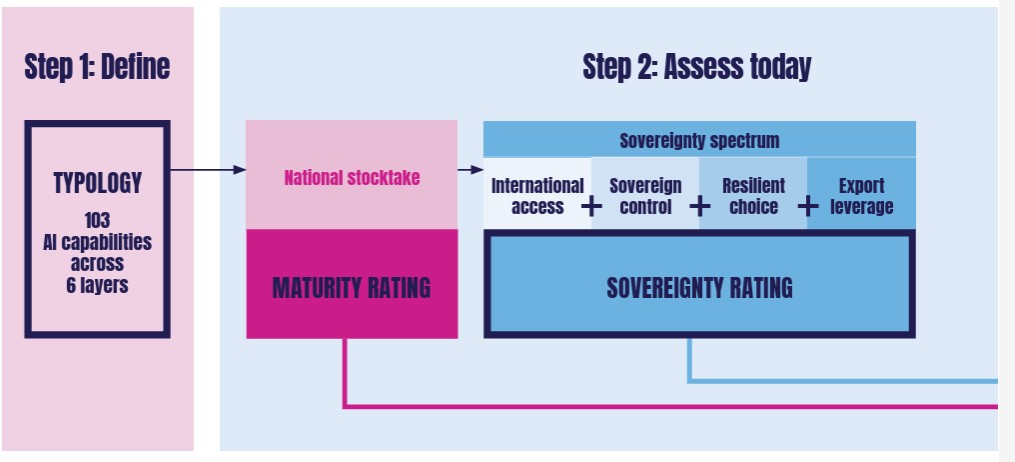
To address this, TPDi has developed an AI Agency Tool that assesses a nation’s AI maturity, sovereignty and agency across 103 capabilities.
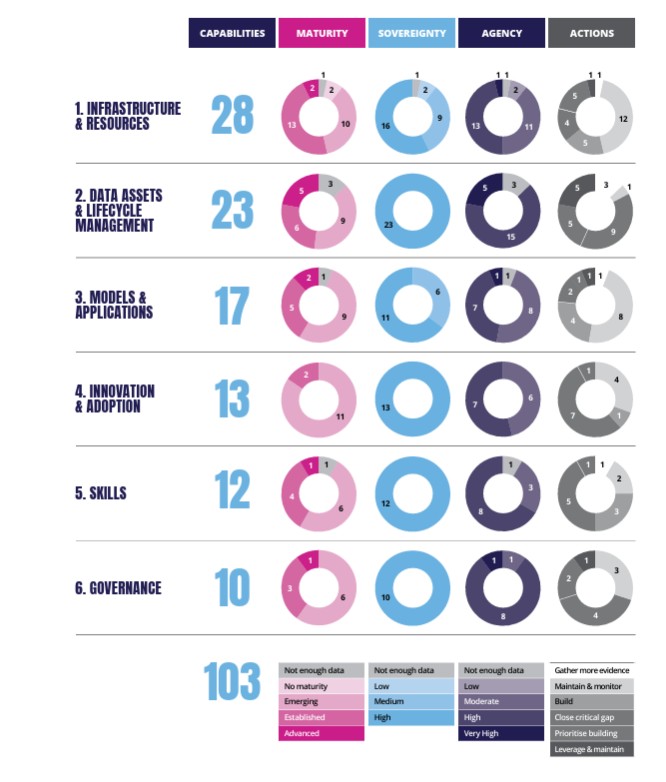
Australia’s 2025 AI Agency Assessment findings across 6 ecosystem layers.
From control to leverage
The central argument is that most countries cannot, and should not, aim to control the entire AI stack.
Instead, TPDi says countries need to understand where they have genuine strengths, where they are dependent on others and where they can build leverage through partnerships, resilience and strategic specialisation.
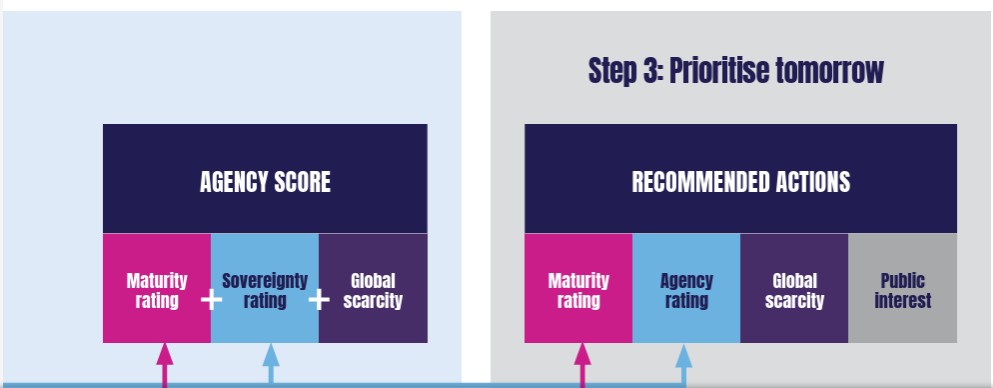
The AI Agency Tool assesses maturity, sovereignty and global scarcity, then combines those factors into an agency score designed to show where a country has competitive advantage.
This reframes sovereignty from a narrow question of domestic control into a broader spectrum covering international access, sovereign control, resilient choice and export leverage.
In other words, the report argues that agency is not about retreating from the global AI system. It is about knowing where to partner, where to build, where to protect and where to lead.
Australia has high AI agency
TPDi’s first application of the tool is Australia’s 2025 AI Agency Assessment, which found the country has emerging AI maturity but high AI sovereignty and high AI agency.
Across the 103 AI capabilities assessed, Australia had 51 emerging capabilities, 33 established capabilities and 11 advanced capabilities, while two had no maturity and six had insufficient data. Australia also recorded high sovereignty in 85 capabilities and medium sovereignty in 15, with only two assessed as low.
When global scarcity was included, Australia’s agency was assessed as high across 58 capabilities, moderate across 29 and very high across eight, with only two capabilities scoring low.
The report says this means Australia already has the baseline maturity and sovereignty needed to increase its AI agency, provided it makes strategic choices about where to focus.
Critical minerals and data stand out
Australia’s strongest areas of AI agency are not necessarily the areas most often associated with the global AI race.
While the US and China dominate the conversation around frontier models, chips and hyperscale AI infrastructure, TPDi says Australia’s very high agency lies in areas where it already has national advantages.
These include its rich endowment in strategic and critical minerals, five domain-specific datasets covering medical, geospatial, environment and resources, demographic and infrastructure data, expertise in computer vision model development and proven international influence in norm shaping.
The report says these strengths could be used more deliberately to strengthen national capability, address weaknesses elsewhere in the AI ecosystem and increase Australia’s international leverage.
AI chips remain a weak point
Australia’s weakest areas are in the production of accelerators, or AI chips, particularly manufacturing and packaging.
TPDi found Australia has low agency in only two capabilities, both tied to accelerator production.
The report does not suggest Australia should necessarily try to become a full-scale chip manufacturing power. Instead, it frames this as a critical dependency that should be managed through access, partnerships, supply agreements and by using Australia’s stronger areas — particularly critical minerals — as leverage.
TPDi argues that Australia’s critical minerals advantage could be better coordinated with AI policy to help secure access to capabilities where the country has low agency, including AI chips.
National AI Plan broadly aligned
The report also compares Australia’s 2025 National AI Plan with TPDi’s AI Agency Assessment.
It found 44 government commitments align with recommended actions, while 20 misalign where agency could be built and leveraged, 28 misalign where there is a critical gap to close, five require better coordination and six require more evidence.
TPDi says every significant commitment in the National AI Plan aligns with the assessment’s recommendations. The plan focuses on areas where Australia already has meaningful maturity and agency, including data centres, supporting infrastructure, public cloud, general AI applications, government and SME adoption, and international engagement.
The report describes this as a targeted approach, with government investment focused on foundational capabilities while allowing the private sector to lead in areas where that is more appropriate.
Untapped potential remains
Despite that broad alignment, TPDi says Australia is not yet fully capitalising on its highest-agency capabilities.
The report highlights critical minerals, strategic data assets and computer vision as areas where Australia already has very high agency but could do more to turn that advantage into broader national capability.
Data is a particular focus. Five of Australia’s eight very high agency capabilities are in the data layer, yet TPDi says there is a disconnect between Australia’s strength in domain-specific datasets and its maturity in data lifecycle management, including access, use, stewardship and assurance.
This matters because AI systems depend not only on the availability of data but also on whether that data can be sourced, validated, governed, shared and used responsibly.
Next wave of priorities
TPDi identifies several critical gaps that should be priorities for the next wave of government action.
These include public sector and public interest compute infrastructure, data lifecycle management capabilities such as copyright, sourcing, validation and annotation, culturally and nationally inclusive models, trusted AI adoption, general AI literacy, specialised AI skills, and regulatory and oversight capability.
The report says addressing these gaps would strengthen Australia’s ability to support innovation, research, public services and national resilience, while helping ensure AI systems reflect Australian values, cultures and identities and that the benefits of AI are widely distributed.
Business relevance
The AI Agency Tool is not aimed only at government.
TPDi says it can also be used by business leaders navigating geopolitical risk, supply chains and long-term investment decisions, as well as researchers conducting national assessments and tracking progress over time.
For businesses, the report’s message is that AI strategy should not simply ask whether a company or country has sovereign control. It should ask where capability exists, where dependence is unavoidable, where partnerships are needed and where existing strengths can be turned into leverage.