
Cauldron Energy Ltd (ASX:CXU) has strengthened the scale case for its 100%-owned Yanrey Uranium Project in Western Australia, releasing a revised JORC-compliant Exploration Target of 89.7 million to 269.0 million pounds of eU₃O₈ across part of its broader tenement package.
The updated target covers a subset of Yanrey exploration tenements extending from the North West Coastal Highway to the Ashburton River, representing the western portion of the company’s holdings. It comprises 30 discrete prospective areas and incorporates results from 2024 and 2025 drilling, as well as passive seismic surveys completed in 2024, 2025 and 2026.
The Exploration Target is in addition to Cauldron’s existing Yanrey resource inventory of about 55 million pounds of uranium oxide, which has been excluded from the new target estimate because mineralisation already classified in a JORC resource is not included in the Exploration Target.
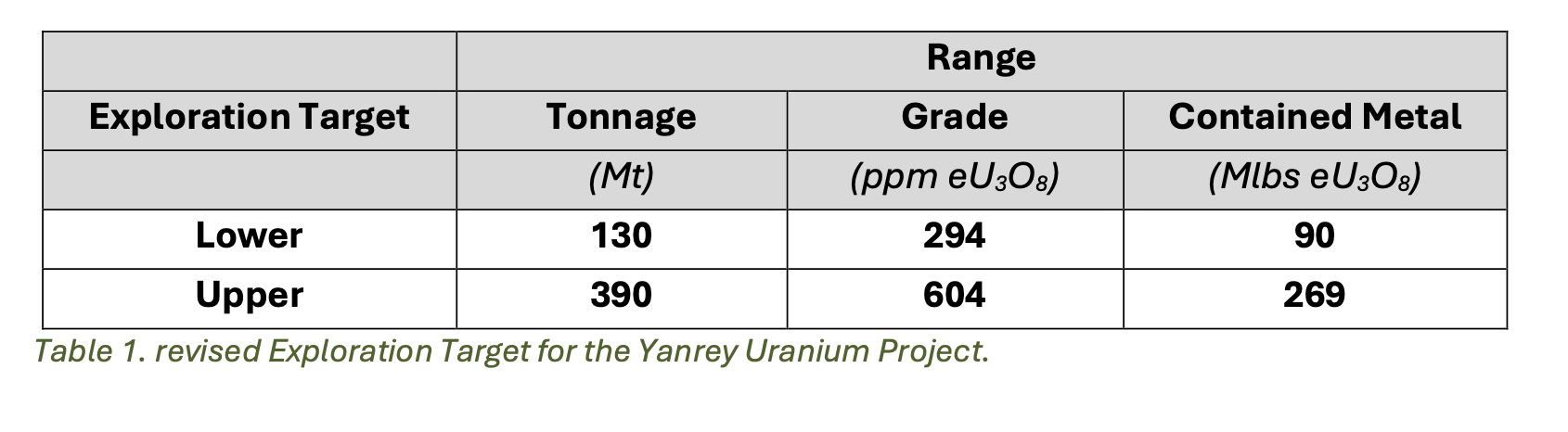
Yanrey scale potential comes into focus
The revised target ranges from 130 million tonnes at 294ppm eU₃O₈ for 90 million pounds at the lower end, to 390 million tonnes at 604ppm eU₃O₈ for 269 million pounds at the upper end. Cauldron noted the estimate remains conceptual in nature, with further exploration required before any Mineral Resource can be estimated in the target areas.
Cauldron chief executive officer Jonathan Fisher said the updated Exploration Target reflected “a significant amount of work” undertaken over the past two years to improve the company’s understanding of Yanrey, including drilling, passive seismic work, historical data review and refinement of the exploration model.
“We have been messaging for a while around how prolific the Yanrey region is for ISR amenable uranium mineralisation, and this updated Exploration Target goes some way to quantify that in our opinion. When considered alongside the existing JORC resource base at Yanrey, this suggests Yanrey has the potential to be amongst one of the largest uranium projects globally,” Fisher said.
Drilling to test targets this season
Cauldron said several targets within the revised estimate are scheduled to be drill tested as part of this year’s program, which is due to start in the coming week, subject to weather. Fisher said the company would continue refining its exploration model and geological understanding of the Yanrey province as work progresses.
The Yanrey Project sits about 100 kilometres south of Onslow and comprises 21 granted exploration tenements and five exploration licence applications covering about 1,493 square kilometres over more than 80 kilometres of Early Cretaceous coastline.
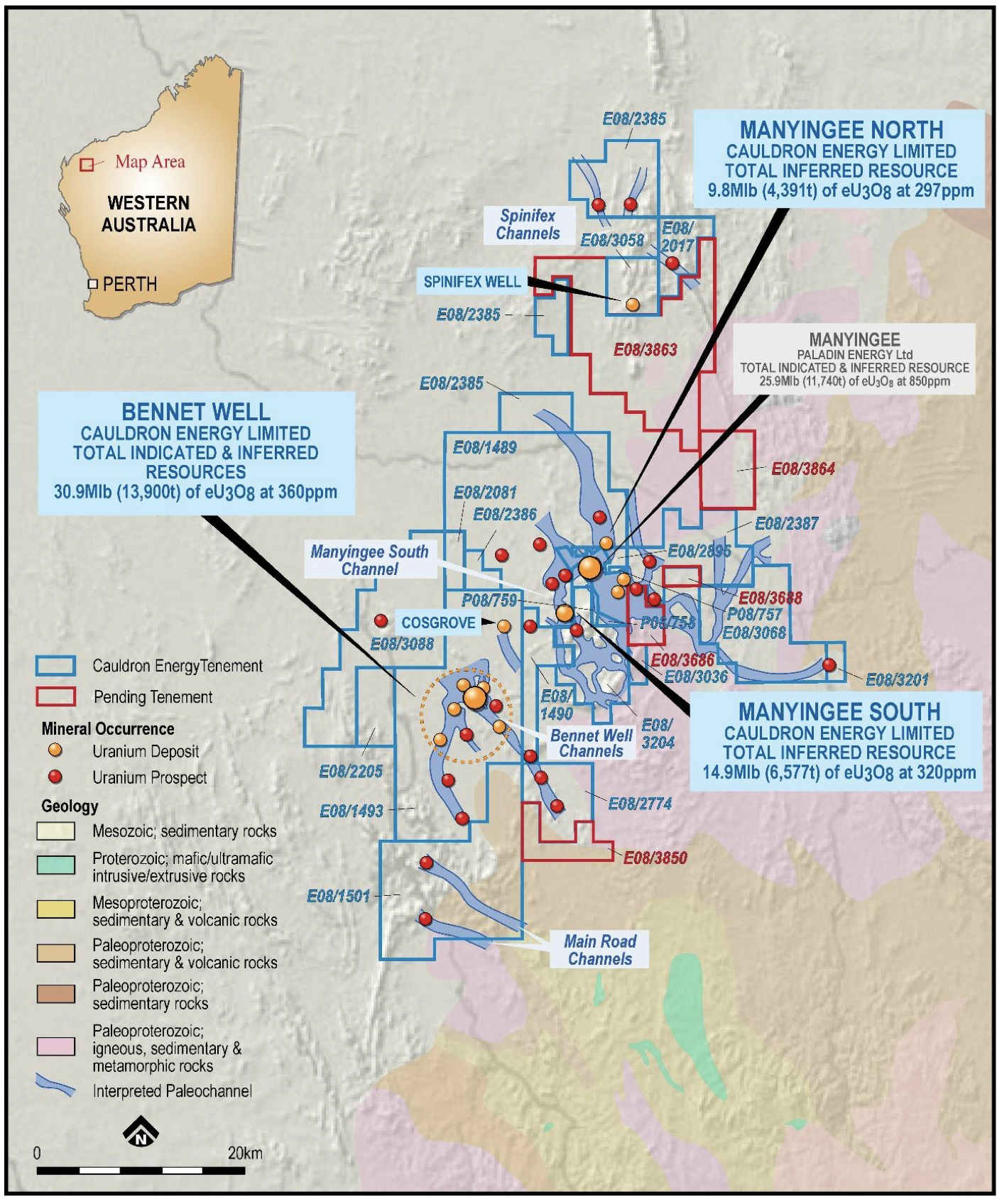
Yanrey Project tenements showing regional geology.
The company has already defined more than 55 million pounds of uranium oxide across three deposits at Yanrey: Bennet Well, Manyingee South and Manyingee North.
NASDAQ-listed ETF adds visibility
Cauldron recently confirmed it had been included in the Sprott Junior Uranium Miners ETF (NASDAQ:URNJ), further broadening the company’s exposure to institutional and uranium-focused investors.
As of June 18, 2026, URNJ held 18,454,935 fully paid ordinary Cauldron shares with a market value of US$1.55 million. The ETF held investments in 41 stocks with a combined investment value of US$385 million.
URNJ provides exposure to small and mid-cap uranium companies involved in mining, exploration and development, particularly those in the exploration and development phase. The fund aims to track the Nasdaq Sprott Junior Uranium Miners Index.
Third uranium ETF inclusion this quarter
The NASDAQ ETF inclusion follows Cauldron’s addition earlier this quarter to the BetaShares Global Uranium ETF (ASX:URNM) and the Sprott Uranium Miners UCITS ETF (Sprott Uranium Miners UCITS ETF – URNM (LSE:URNM)). Public disclosures showed BetaShares held 46,365,877 Cauldron shares as at 18 June 2026, while HANetf held 71,131,382 shares as at June 17, 2026.
Fisher said inclusion in URNJ opened Cauldron to “a much larger audience” through the ETF’s NASDAQ listing and represented “a strong endorsement of Cauldron’s progress and positioning within the uranium sector”.