
Lightning Minerals Ltd (ASX:L1M) has confirmed the presence of rhyolite intrusion-hosted gold mineralisation from an independent study at the Mt Turner Gold Project in northern Queensland.
The company received the independent validation of its exploration model from a University of New South Wales petrology study ahead of July drilling.
The study, based on selected drill core from the company’s 2025 diamond drilling program, found gold mineralisation is associated with rhyolite and dacite intrusions along the 14-kilometre Drummer Fault corridor, supporting the potential scale of the system.
Moving forward, Lightning will use the petrology findings to refine targets ahead of its Phase 2 drilling program, which is scheduled to start in mid-July 2026.

Independent study supports exploration model
UNSW carried out detailed petrological analysis on 14 drill core intervals to better define lithologies, alteration, vein generations, sulphide mineralisation and the overall mineralisation sequence.
The work confirmed that gold mineralisation at Mt Turner is spatially associated with rhyolite and associated breccias, as well as dacite intrusions emplaced within structural dilation zones along the Drummer Fault corridor and Cobar Line.
The findings provide a stronger geological framework for future drill targeting and support the view that the Mt Turner porphyry intrusive centre, together with brittle fracturing and brecciation, created important pathways for mineralising fluids.
Depth potential highlighted at Pit 5
One of the key outcomes from the study was the interpretation that drilling to date may have tested only the upper part of the mineralised system.
At Pit 5, petrography confirmed rhyolitic mill-matrix breccias and multiple tabular rhyolite dykes associated with gold mineralisation. Lightning said this supported its view that mineralisation may continue at depth.
Managing director Troy Brice said the study provided “strong independent validation” of the company’s geological model and significantly improved its understanding of the controls on gold mineralisation.
“The work confirms a close relationship between gold mineralisation, rhyolite and dacite intrusions and major structural corridors including the Drummer Fault and Cobar Line,” Brice added.
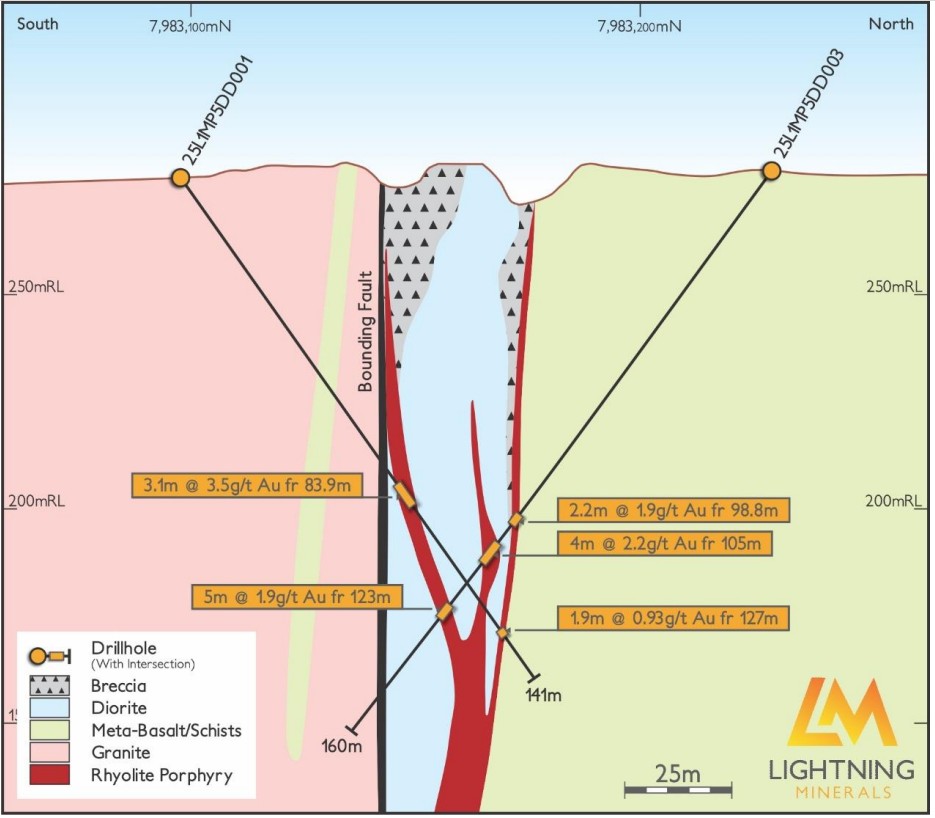
Schematic Cross Section of Pit 5.
Structural corridor comes into focus
The study also confirmed dacitic intrusive rocks at Pit 6, showing intrusive activity along the Drummer Fault a significant distance from the Mt Turner porphyry intrusive centre.
Lightning said this supported its interpretation that the Drummer Fault is a major structural corridor controlling intrusion emplacement and associated mineralisation.
The identification of hornblendite, a mafic intrusive rock, was also interpreted as evidence that the Drummer Fault is a deep-seated crustal structure capable of focusing mineralising fluids from depth.
Petrographic observations further indicated multiple phases of veining, sulphide mineralisation and hydrothermal alteration, including an interval in drill hole L1MP5DD003 from 99.8 metres to 101 metres that assayed 2.1 ppm gold, 2.7 ppm silver, 254 ppm arsenic, 237 ppm lead and 1,540 ppm zinc.
Visible gold and sulphides identified
The study identified microscopic visible gold within late-stage quartz veins and associated with arsenopyrite-bearing sulphide assemblages. Gold was observed in late-stage open-space quartz veins and adjacent to arsenopyrite-rich sulphide aggregates.
The petrographic assessment also documented widespread sulphide mineralisation, including arsenopyrite, pyrite, sphalerite, chalcopyrite, galena, covellite, pyrrhotite pseudomorphs and bismuth sulphides.
The mineral associations are encouraging indicators of a fertile hydrothermal system and provide important vectors for future exploration.
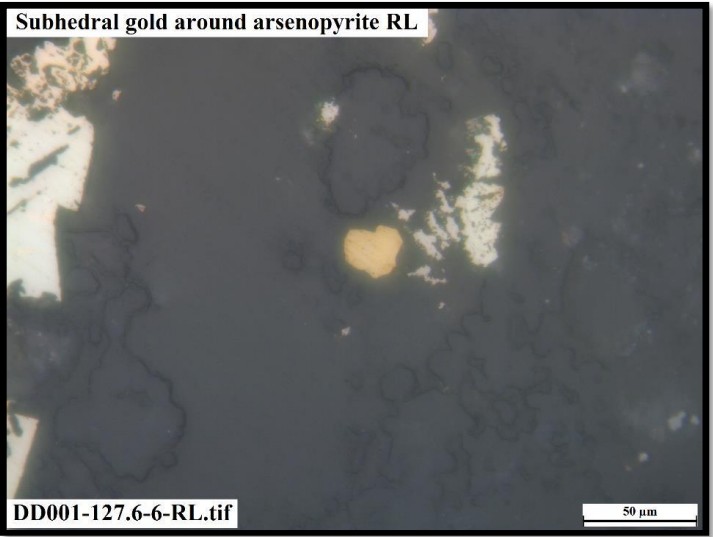
Photomicrograph showing sub-hedral gold grain around arsenopyrite within vein quartz, Pit 5 Hole 1.
Mt Turner remains flagship focus
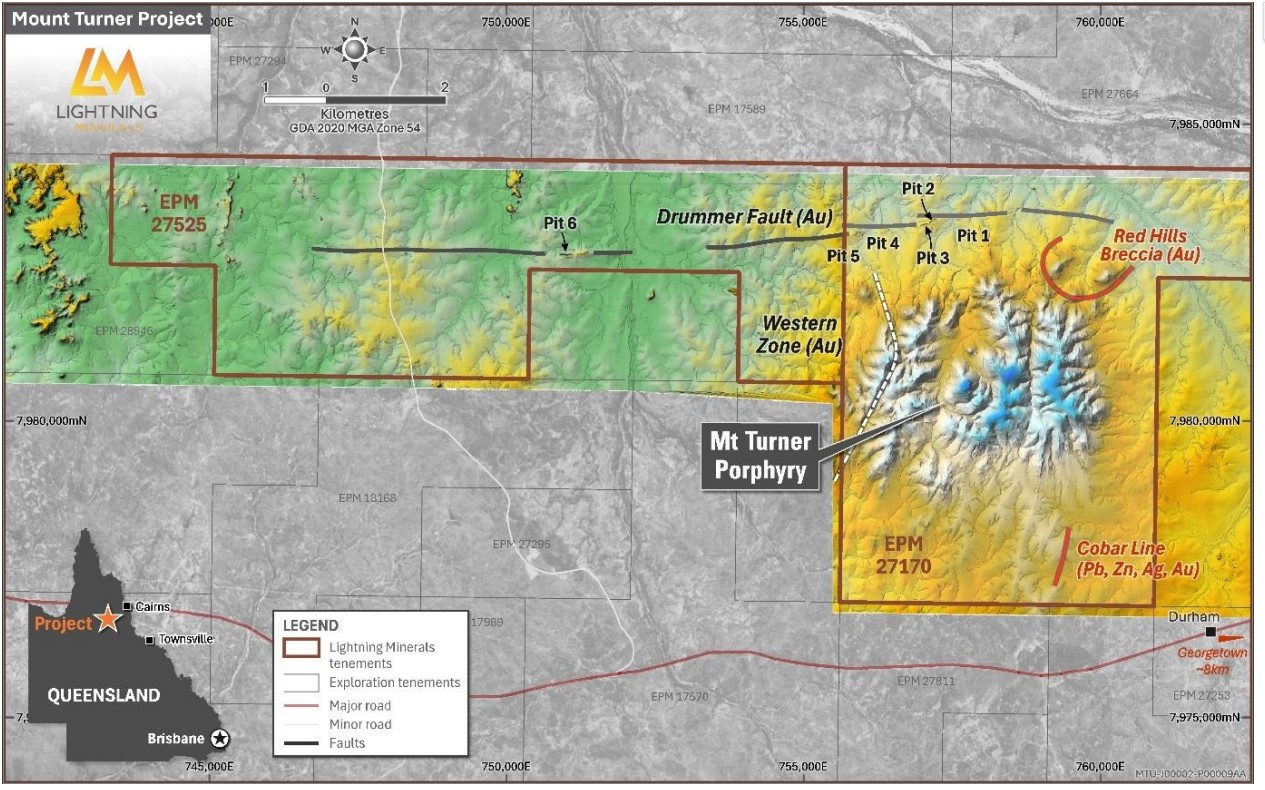
The wholly owned Mt Turner Gold Project sits within the Georgetown Inlier in northern Queensland and hosts a large mineralised system extending along about 14 kilometres of the Drummer Fault corridor.
The company’s maiden 2025 drilling program comprised 1,113 metres of diamond drilling across five target areas and intersected gold mineralisation in all holes drilled.
Previously reported results included:
- 20.4 metres at 2.4 g/t gold and 14.3 g/t silver from 62 metres, including 1.8 metres at 10.6 g/t gold and 27.1 g/t silver from 77 metres.
What’s ahead
Lightning will use the petrology findings to refine targets ahead of its Phase 2 drilling program, which is scheduled to start in mid-July 2026.
The program will focus on deeper testing beneath known mineralised intersections at Pits 2 and 3, intrusion-related targets along the Drummer Fault corridor, structural intersections along the Cobar Line, concealed targets east of Aurora Creek and additional rhyolite and dacite-related targets identified through geological and geophysical work.